Monitoring and response
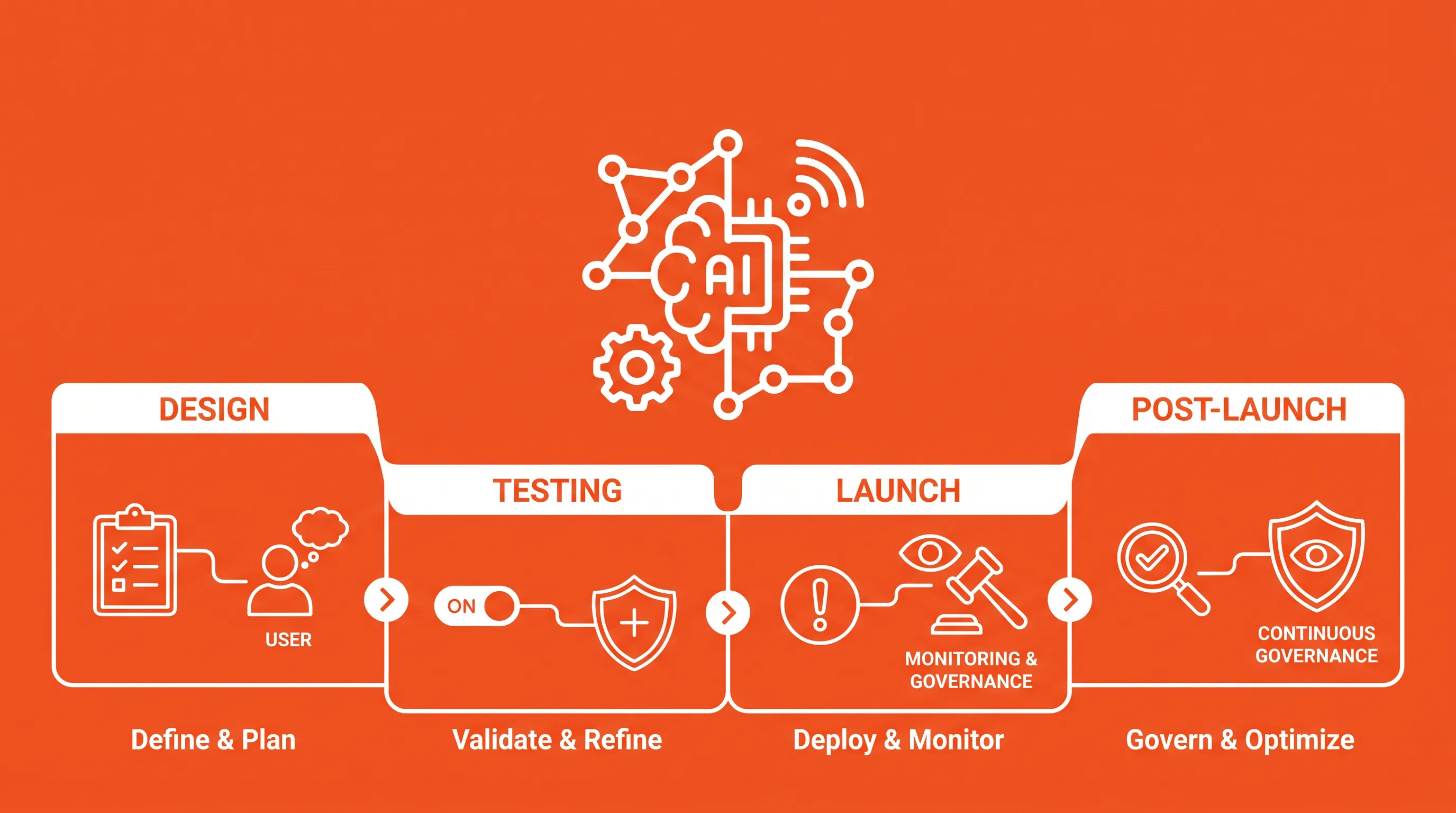
Once AI is operational, you need to know whether it's still working. Define two indicators per use case: output accuracy sampled weekly and override rate. A rising override rate is the earliest signal that something has shifted.
Drift checks matter because models change even when you don't touch them. Vendors update, and a system that performed well in March behaves differently in September. Schedule a review rather than waiting for complaints, since IBM found that only 37% of organisations had approval processes or oversight mechanisms in place.
Give users a route to flag bad output that takes ten seconds. Set an escalation path with a named person and a response time. Someone must hold explicit authority to shut a system down without waiting for a committee, and that authority should be written into the inventory alongside the owner's name. Corrective actions get logged, and where personal data or a regulated decision is involved, you need to know in advance who notifies whom and within what window.
Assign clear ownership
Ownership is where most governance quietly collapses in an AI governance framework. A tool has three people vaguely associated with it and no one accountable, so when it misfires, the conversation starts with who was supposed to be watching. Write it down instead.
The executive sponsor holds budget and accepts residual risk. The business owner defines intended use and owns the outcomes the system produces. A technical owner handles configuration and the shutdown switch. Your security or privacy lead reviews data handling and vendor terms, and a legal adviser covers regulatory classification and contract exposure. Users have a narrow but real duty: use the system inside its stated boundaries and report when it goes wrong.
Three decisions need unambiguous owners. Who approves deployment, which sits with the business owner for low tier and the executive sponsor for high tier. Who accepts residual risk after controls are applied, which is always an executive decision. And who runs an incident, which needs a single named person rather than a group.
In an SME, these roles collapse into three or four people wearing multiple hats, and that's fine. It is not fine when the same person approves a system and reviews its performance. Separate at least the approval from the review.
Preserve decisions and evidence
Evidence is what turns an AI governance framework from an assertion into something you can demonstrate. It also saves you when a customer or a regulator asks how a decision was made eighteen months ago, and everyone who built the system has left.
Keep the inventory current, with each entry recording purpose and owner. Keep risk assessments and the reasoning behind each tier decision to support AI risk management. Keep approval records showing who signed off and on what basis, and keep test results with the acceptance criteria they were measured against. Vendor reviews and incident records with corrective actions round out the minimum set.
ISO/IEC 42001 requires documented information covering the AI policy and risk assessment results as part of an AI management system for responsible AI governance. You don't need certification to borrow the discipline.
Retention periods follow risk and regulation rather than habit. Low-tier records can go after a year. High-tier records tied to decisions about individuals should survive as long as the limitation period on a challenge to those decisions, and your vendor contracts will set their own floors. Where the EU AI Act applies, authorised representatives must retain records for 10 years.
Scale governance in phases
You don't build all of this at once. The controls arrive as adoption earns them, which keeps the overhead proportionate and gives your team time to absorb each layer.
Phase one is inventory and ownership. List every AI system in operational use, even the ones nobody formally approved, and assign a named owner to each. This is the phase most organisations skip, and skipping it makes everything afterwards guesswork. WalkMe's State of Digital Adoption Survey of over 3,500 knowledge workers found that 78% admit to using AI tools their employer hasn't approved, so expect your first inventory to surprise you.
Phase two adds tiered approvals and monitoring. Classify what's in the inventory and start measuring performance in operation. This is the point where responsible AI governance becomes a working process rather than a policy document.
Phase three formalises change control and assurance. Model updates go through review, and someone periodically audits whether the controls are being followed. You need phase three once AI is making decisions without a human in the loop or once a regulator has a legitimate interest in your outputs.
Autonomy is the trigger to watch. A tool that suggests can live with light controls indefinitely. The moment it acts, permissions and rollback become non-negotiable, and the governance load of the AI governance framework steps up accordingly.
Put the framework to work
Three decisions get the AI governance framework moving. Build the inventory and find out what's already running. Assign an owner to each entry. Tier them, and treat anything affecting individuals as high until proven otherwise.
Test this against your live use cases rather than your planned ones, because the gap between the two is where risk collects. Evolved Ideas works with UK and European teams on AI adoption and governance to augment in-house capability. If you want an outside read on your controls, speak to our team about an AI readiness and governance workshop built around your existing AI governance framework.