Hire React Developers Without Losing Architecture or Product Control

Content authorBy Lincoln WoolseyPublished onReading time11 min read
Hands discussing over a computer in a modern workspace, with multiple monitors displaying code and a cluttered desk of sticky notes.

Adding React capacity is easy. Adding it without losing control of architecture and roadmap decisions is harder. Define the gap precisely before you hire React developers, so you bring in the skills you lack rather than the headcount you assume you need. Then onboard external developers in a way that keeps architecture and roadmap ownership inside your organisation.

The control problem behind the capacity problem

When teams hire React developers under delivery pressure, the thing that slips first is rarely velocity. It's ownership. A contractor who lands mid-sprint makes twenty small architectural decisions in a fortnight, and six months later your front end carries patterns no one on the internal team chose.

That outcome is caused by an unclear brief and absent decision rights. React remains the most widely used front-end framework, with 39.5% of developers reporting they work with it, so the hard part is keeping your architecture coherent while new hands join it.

Before you hire React developers

Start by writing down the delivery gap in terms of outcomes. "We need two React developers" is a resourcing statement that comes up when you hire React developers. "We need the billing redesign shipped by March, and our two senior front-end engineers are committed to the platform migration until February" is a brief someone can be measured against.

Then decide what kind of help you're actually buying, because the four options below demand different people and different contracts:

  • Extra coding capacity, where your team owns design and the external developer implements against agreed patterns

  • Specialist expertise for a bounded problem, such as rendering performance or a migration to React 19 and its new compiler and Actions

  • Architecture leadership, where you want someone to shape front-end direction because the role is vacant internally

  • A self-sufficient extended React development team that takes a product area end to end, with its own review and testing discipline

Most disappointments trace back to buying the first and expecting the third. Write the ownership boundary into the engagement: who approves architectural change and who owns the roadmap. Melvin Conway's 1968 observation that organisations ship copies of their communication structures applies here with force. An unclear boundary produces an unclear codebase.

Assess React capabilities

Years of experience tell you almost nothing. A developer with eight years of React could have spent them rebuilding the same dashboard, or could have carried a complex application through three major version upgrades without a rewrite. Ask for evidence from applications comparable to yours in traffic and domain complexity.

The question that separates candidates is why. Why did you choose that state library? What did it cost you later? When a React developer for hire can describe a decision they'd now make differently, you're talking to someone who has lived with their own code, a test that applies to React developers for hire. Among the pool of React developers for hire, the ones worth interviewing twice are those who can explain a tradeoff they lost an argument about.

Architecture and TypeScript

Look at how the candidate draws component boundaries. Containers that fetch and render in one file are a sign of someone who has never had to refactor under load. Ask what they do when a component crosses 300 lines.

TypeScript discipline is checkable in minutes. Does the codebase they show run with strict mode enabled, or is it sprayed with any and casting? On state management, there is no correct answer, only a defensible one, and server state and form state rarely belong in the same store. The React team's own guidance on avoiding unnecessary effects is a useful probe, because developers who still synchronise everything through useEffect will fight your data layer.

For evolving large applications, the instinct you want is incremental. Martin Fowler described the strangler fig pattern as a way to grow a new system around the edges of the old one rather than replacing it in one swing. Candidates who open with "we'd rewrite it in Next.js" have told you something useful about their appetite for your constraints.

Ready to bring your ideas to life?

Book a free 30-minute discovery call with our team — we'll understand your objectives and advise how bespoke software, MVP development, or an extended team can help your business.

Quality and accessibility

Testing strategy reveals more than test coverage percentages ever will. Kent C. Dodds built Testing Library around a single principle: "The more your tests resemble the way your software is used, the more confidence they can give you." Developers who test implementation details produce suites that break on every refactor and catch nothing.

Accessibility is where a lot of otherwise strong React developers for hire fall down. WebAIM's 2024 analysis of one million home pages found detectable WCAG failures on 95.9% of them, which tells you how rare genuine competence is. If you sell into the public sector, the UK accessibility regulations already bind you, and the European Accessibility Act has applied to in-scope consumer products and services since 28 June 2025. Ask candidates how they handle focus management in modals and whether they've worked to WCAG 2.2 rather than guessing at it.

Design-system experience matters for the same reason. Someone who has maintained components in Storybook with visual regression checks understands that a one-line change to a shared button is a change to forty screens.

Performance and DevOps

Ask for a specific performance story with numbers attached. Which page was slow and what did the profiler show? Interaction to Next Paint became a Core Web Vital in March 2024, and a good experience means INP at 200 milliseconds or below with Largest Contentful Paint under 2.5 seconds. Engineers who have actually chased these targets talk about hydration cost and route-level code splitting without being prompted.

DevOps contribution is the second half of the question. An extended React development team that cannot touch the pipeline will queue behind your platform engineers for every environment variable. Find out whether the candidate has edited build configuration and taken part in an incident. The four DORA metrics give you a shared language for what "contributing safely" means, and front-end security belongs in that conversation too, since cross-site scripting and broken access control still sit in the OWASP Top 10.

Use a hiring scorecard

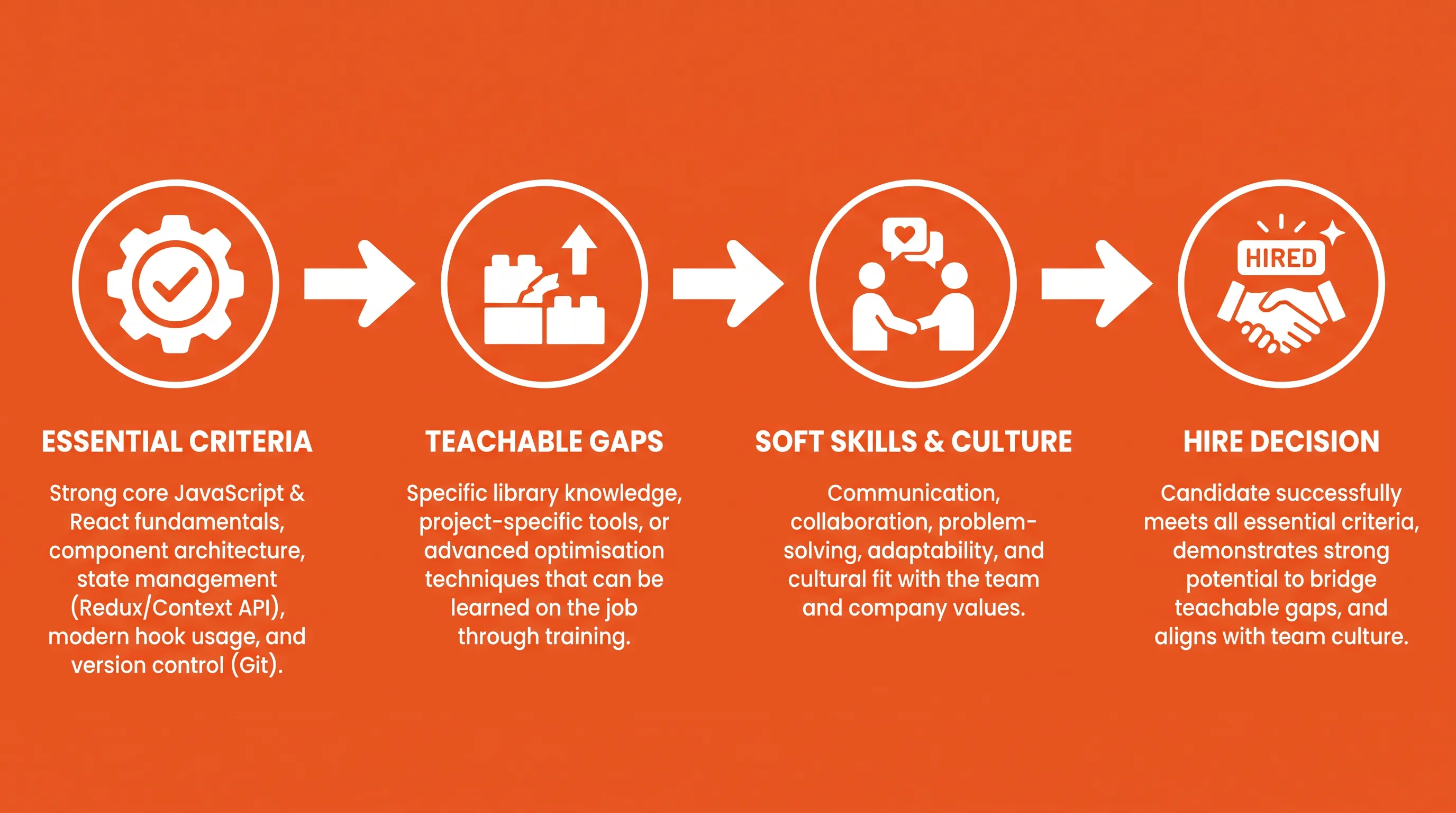
Infographic outlining interview criteria for hiring React developers, featuring white icons and text on a solid #f15a24 background.

Unstructured interviews reward charisma. A weighted scorecard forces you to compare the same things across candidates and to say out loud which gaps you'd accept. Before you hire React developers for a specific role, split your criteria into essentials, where a low score ends the conversation, and teachable gaps, where a strong engineer will catch up inside a month.

Every rating needs a sentence of written evidence beside it. "Strong on testing" is an impression. "Showed a test suite where business rules are covered at integration level and described how they cut flaky tests by removing timing assertions" is evidence you can revisit in six months when you review whether the hire worked.

Technical delivery score

Weight each line against what this person will actually own. A developer joining a mature design system needs less component-API judgement than one building your first shared library, so the weights shift with the role when you hire React developers.

  1. Architecture and component boundaries

  2. React and TypeScript fluency under strict settings

  3. State management and API integration patterns

  4. Testing strategy and regression prevention

  5. Accessibility against WCAG 2.2 criteria

  6. Performance diagnosis with measured outcomes

  7. Design-system and code-review habits

  8. DevOps contribution, from pipelines through to production support

Score each from one to five and multiply by your weight. The arithmetic matters less than the argument it forces when two assessors disagree by three points on the same answer.

Ready to bring your ideas to life?

Book a free 30-minute discovery call with our team — we'll understand your objectives and advise how bespoke software, MVP development, or an extended team can help your business.

Extended React development team fit

Technical scoring covers half the risk. The rest sits in how someone behaves when the brief is thin, or the estimate was wrong. Score communication clarity and estimation honesty.

Product judgement deserves its own weight. A developer who asks what the feature is for will save you from building the wrong thing. For distributed work, ask how they handle a blocker discovered at the start of their day when your lead comes online four hours later, because good answers describe escalation habits rather than patience. And ask directly whether they're comfortable working inside someone else's technical decision rights, since the honest no is far cheaper than finding out in sprint three.

Verify claims practically

Structured technical discussion beats whiteboard puzzles. Inverting a binary tree tells you nothing about whether someone can find the re-render that's costing you 400 milliseconds on a checkout page. When you hire React developers, walk through their code instead, line by line, and ask what they'd change now.

A short paid exercise is the strongest signal available, provided it looks like your work: a real component against your design tokens. Keep it to four hours and review it the way you'd review a colleague's pull request. Good React developers for hire respect that process, because it respects them.

Protect product control

Control is maintained through mechanics. Decide and document who approves architectural change and who sets the roadmap. Ambiguity on any of these is where an extended React development team quietly becomes the owner of decisions you meant to keep.

The practical safeguards are familiar, which is why they're easy to skip:

  • External developers work in your repositories, never a parallel one, with branch protection and required reviews from an internal engineer when you hire React developers

  • Architecture changes arrive as written proposals before code

  • Access is scoped by role and revoked automatically at the end of the engagement

  • Documentation lands in your systems, so knowledge accumulates where your team can find it

  • Reporting shows the same delivery metrics for internal and external contributors

Plan the first 30 days

Onboarding is where the money you spent on assessment is either banked or wasted when you hire React developers. The goal is to move someone from context gathering to safe, measurable contribution without letting them route around your quality gates to look fast.

Days 1 through 10

Access and a working local environment on day one. If it takes four days to run your application, that's your problem to fix before the next person arrives. Then walk the architecture and explain the product goals behind the current quarter.

Introduce the people who approve things and the people who get paged. Pair for the first week on small changes, with the internal engineer driving on day two and the new developer driving by day five. First pull request should be live before day ten, even if it's a tiny one, because the point is to exercise the whole path to production.

Days 11 through 30

Hand over bounded production work with a clear definition of done. Reviews and tests stay mandatory, and nobody gets a fast lane. Watch whether the questions change shape, since good hires move from "where is this file" to "should this live in the shared package" within a fortnight.

Check the communication rhythm honestly at the halfway point. Are updates arriving before you ask? Are blockers raised the same day? By day 30 you should know whether autonomy is increasing and whether review comments are repeating themselves, which is the clearest early warning that an extended React development team arrangement is drifting.

Ensure team continuity

When you hire React developers, one developer holding critical product knowledge is a risk whether they're on your payroll or not. Agree replacement terms before you need them, with a named overlap period of at least two weeks so handover happens through pairing rather than a document dump. Ask your partner what their retention looks like on long engagements, and ask what happens if the person you assessed becomes unavailable in month four.

Documentation ownership belongs in the contract. Architecture decision records and runbooks should sit in your repositories from the first week, which also makes offboarding a short administrative task instead of an archaeology project. The best React developers for hire write for the engineer who inherits the code, and an extended React development team that can't be unwound cleanly was never an extension of your team at all.

Discuss your React needs

Getting this right is mostly about sequencing: define the gap, then protect the decisions that belong to you. The mechanics above work whether you add one specialist or a full extended React development team.

Evolved Ideas builds and extends React teams for UK and European organisations inside your repositories and review process. Tell us where delivery is constrained and we'll talk through the capability profile that fits. Start a conversation about how to hire React developers without giving up control of your product.

Ready to bring your ideas to life?

Book a free 30-minute discovery call with our team — we'll understand your objectives and advise how bespoke software, MVP development, or an extended team can help your business.

Include the ownership boundary, architectural approval process, roadmap authority, repository rules, confidentiality terms, and intellectual-property assignment. Add access removal requirements and a handover period for departures. These clauses turn informal expectations into obligations that can be reviewed when delivery pressure changes the working arrangement.

Use a common evidence pack rather than comparing job titles or years of experience. Ask each candidate for one relevant project, a reference who reviewed their work, and a short explanation of a decision they changed later. This gives you comparable information about judgement, communication, and follow-through.

Use a contractor when the need has a clear end point, such as a migration, performance investigation, or release surge. Choose a permanent hire when the role includes long-term product knowledge, team leadership, or ownership of a core front-end platform. Define the expected duration before discussing rates.

They can access production systems only when the role requires it and the access is limited, logged, and time-bound. Prefer read-only access for diagnosis, separate deployment permissions from code permissions, and require approval for sensitive changes. Review access regularly and remove it when the engagement ends.

You can discuss your needs with Evolved Ideas, including the capability gap, decision rights, and team structure you want to keep internally. Contact the client at https://evolved-ideas.com/contact-us/ to discuss how to hire React developers without transferring product or architecture ownership.

Schedule a Discovery Call

Book a free 30-minute call that works for you

You Might Also Like

Discover more insights and articles

A project manager reviews specifications on a laptop at a modern conference table, surrounded by digital displays and tablets in a tech-focused office.

How to Choose an Ecommerce App Development Company for Complex Commerce

Most agency pitches look equally polished, and polish says little about whether a supplier can handle your custom pricing rules, your ERP, or your fulfillment edge cases. Evaluating an ecommerce app development company starts with mapping your requirements, especially the custom rules and deep integrations where projects tend to fail. Then score each shortlisted supplier against business risk instead of presentation quality.

A group of software engineers collaborates around a table with tablets, discussing code displayed on a monitor in a warm, tech-focused office.

SAST vs DAST: Building a Practical Application Security Testing Plan

Frequent releases leave little room for security checks that stall the pipeline, but skipping them is not an option. Static application security testing (SAST) examines code before it runs, while dynamic testing (DAST) probes the running application, so each catches flaws the other misses. Run together at the right pipeline stages, they cover both. Well-designed release gates then block risky builds without halting delivery.

A diverse team of professionals collaborates in a modern office, analyzing charts on a screen with laptops and tablets on the table.

Technical Feasibility Assessment: The Evidence Needed Before You Fund a Build

Before committing serious funding to a complex product or system, teams need proof that it can work within real-world constraints, not confidence that it will. This piece sets out a test grounded in evidence about constraints and risk rather than optimistic assumptions. It identifies which evidence to gather and shows how to structure the approval decision that follows, so funding is released on demonstrated viability.

Two hands swiping on a tablet in a tech startup office, with soft-focused brick walls and desks in the background, creating a collaborative atmosphere.

Private Cloud vs Public Cloud: Choosing for Business Applications

When choosing a hosting model for your applications, a cheap and secure solution sounds like a natural pick. But is this actually a good criterion? Learn about workload requirements and operating reality, multi-year economics, and a scoring approach you can apply per application.