Software intellectual property: 7 ownership questions before you sign

Content authorBy Lincoln WoolseyPublished onReading time12 min read
A focused programmer types on a laptop at a sleek black desk in a modern office, surrounded by multiple monitors displaying code.

Paying for bespoke software does not automatically mean you own it, and the gaps usually surface when the relationship ends. Before you sign, settle seven questions about software intellectual property with your development partner and with qualified legal counsel. They establish what transfers to you, and what you need in practice to keep the system running if the partnership ends, such as source code, documentation, and access to the environments it runs in.

Why the annex matters more than the quote

Software intellectual property is the part of a development contract most people skim. The price is on page one, and the rights annex for software intellectual property sits at the back where nobody argues about it. Then, two or three years later, the system needs rebuilding after the original supplier has moved on, and someone asks a question nobody can answer: are we allowed to do this?

That question has a cost. Not a dramatic one. It's weeks of delay while lawyers read old contracts and a new team tries to work out what it's permitted to touch. The seven questions below are the ones worth asking while you still have leverage, which is before you sign anything. None of this is legal advice, and your own counsel should read the actual words in your actual agreement.

Define the legal context

Start with who is actually contracting. The supplier's trading name and the legal entity on the signature page may differ, and you'll struggle to enforce software intellectual property rights assigned to a dormant holding company. Write down both entities, the governing law clause, and where the people writing your code are physically based.

Jurisdiction decides the default. Under section 11 of the Copyright, Designs and Patents Act 1988, an employer is the first owner of copyright in work made by an employee in the course of their employment. Spain reaches a similar result for software through Article 97.4 of the Ley de Propiedad Intelectual, which gives the employer the exploitation rights in both source and object code unless the contract says otherwise. Neither rule helps you when the code is written by a contractor rather than an employee.

Guidance from the UK Intellectual Property Office and Business.gov.uk describes UK law. It isn't evidence of what happens in Madrid or Austin, and a contract naming English law doesn't automatically decide how an assignment signed by a developer abroad will be treated there. If contributors sit in more than one country, your counsel needs to know that before drafting. Keep the assignment or licence wording visible from the start, because that single clause does most of the work in any discussion of software ownership.

Separate rights from access

Three different things get muddled in these conversations. There's who has source code ownership, and there's what permissions attach to the components inside the build. There's also whether you can actually get at the repository on a Tuesday morning without emailing someone. You need all three. Having one doesn't give you the others.

Payment doesn't settle it. The IPO's own guidance on commissioned works states that the first legal owner is the person or organisation that created the work, not the commissioner, unless you agree otherwise in writing. And section 90 of the same Act requires an assignment to be in writing and signed. A handover of files proves you have the files without proving you have the software intellectual property.

One small mercy for software specifically: section 79 disapplies the attribution moral right to computer programs, so you won't be arguing about credit lines in your codebase. Everything else needs reading by someone qualified in the relevant jurisdiction. Source code ownership is a legal conclusion drawn from documents.

Software intellectual property questions

Our position at Evolved Ideas is straightforward. If you commissioned bespoke work and paid for it, you should own it, and our contracts are written on that basis. Treat that as a starting point, because the honest answer in any specific build is shaped by the agreed terms and by the rights attached to components nobody wrote for you.

Here's how we'd put the same point less comfortably. A promise to assign everything is only as good as the chain of paperwork behind it, and no supplier can assign rights in a library it merely licenses. The seven questions that follow are designed to find where the promise and the paperwork diverge. Run them past your counsel, then run them past whoever is quoting for the build, because software intellectual property clauses are negotiable and most suppliers expect you to ask.

Ready to bring your ideas to life?

Book a free 30-minute discovery call with our team — we'll understand your objectives and advise how bespoke software, MVP development, or an extended team can help your business.

Who has source code ownership?

Define the deliverables by name. Application code is obvious, but designs and technical documentation carry rights of their own, and a clause covering "the Software" leaves those rights ambiguous. List what transfers and list what doesn't.

Then fix the timing. Assignment on full payment is common and reasonable, and assignment on delivery of each sprint is better for you. Ask what happens if the project stops in month four with three sprints paid for and accepted. Source code ownership of partially completed work is where cancelled projects turn ugly, and the fix is a sentence in the contract.

Which background components remain?

Any supplier that has built similar systems before brings tooling with it. Internal frameworks and component libraries. That reuse is why the quote is affordable and the timeline is realistic, and demanding assignment of it is the wrong ask.

The right ask is a licence broad enough to be useless to nobody. You need the right to run the software and transfer the whole lot if you sell the business. Name the background components in a schedule. A supplier who won't name them is asking you to accept a gap in your software ownership position that you can't size.

Which third-party licences apply?

Open source is no longer an edge case. Black Duck's audits found open source in 98% of codebases reviewed for its 2026 report, with a mean of 1,180 components per application. Those components come with conditions, and the conditions bind you once you own the result.

The conditions worth checking before signing:

  • Copyleft terms. GNU GPLv3 conditions its permissions on making the complete corresponding source available under the same licence when you convey the work, which reaches larger works built around it.

  • Network-use triggers. The AGPLv3 treats network use as distribution, so a hosted product can trigger disclosure where the GPL wouldn't.

  • Attribution and notice requirements that have to survive into your deployed product.

  • Commercial licences with named-user caps, renewal dates or restrictions on sublicensing to your own customers.

  • Whether a licence permits modification by a supplier other than the one who installed it.

Ask for a software bill of materials at handover and at every major release. The same audits found that 86% of commercial codebases contained known open source vulnerabilities, which means the inventory earns its keep twice over.

Have subcontractors assigned rights?

Follow the chain. Permanent employees of the supplier are covered by the statutory default in most European jurisdictions. Freelancers aren't, and neither are subcontracted agencies.

Ask the supplier to confirm, in the contract, that it holds signed assignments from every contributor and that it will produce them on request. The warranty is worth something. Evidence is worth more, which is why due diligence in an acquisition goes looking for the actual documents. If a supplier can't trace its own contributor chain, the software intellectual property it's promising you is a statement of intent.

Can you reproduce builds?

The practical test is simple. Could a competent team you've never met take what you hold and rebuild the running system without phoning your current supplier? That's the standard the Bank of England applies to regulated firms in chapter 10 of SS2/21, which expects documented and tested exit plans covering provider insolvency. The logic holds whether or not you're regulated.

What that requires in practice:

  • The repository itself, with full commit history and branches, under an account your organisation owns.

  • Build scripts, pinned dependency manifests and anything needed to resolve private packages.

  • Automated tests, plus whatever documentation explains the non-obvious decisions.

  • Infrastructure-as-code or deployment pipeline definitions, including environment variables and secrets management.

  • Credentials and administrative access for every service the build touches.

Escrow covers the gap where a supplier won't hand over everything up front, and verification services exist because untested deposits can't be compiled. Escode, part of NCC Group, says its arrangements protect 16,000 organisations worldwide. Whatever route you take, treat reproducibility as a separate question from source code ownership, because owning code you can't build is an expensive souvenir.

Ready to bring your ideas to life?

Book a free 30-minute discovery call with our team — we'll understand your objectives and advise how bespoke software, MVP development, or an extended team can help your business.

Who controls data and accounts?

Customer data isn't a software intellectual property question at all, and conflating the two causes trouble in both directions. Where a supplier processes personal data on your instructions, Article 28 of the UK GDPR requires a written contract, and the ICO sets out the terms it must contain, which include what happens to the data at the end of the engagement. Your software intellectual property clauses don't cover any of that.

Account ownership is the quieter risk. Cloud subscriptions and domain registrations are frequently opened in the supplier's name during a build and never moved. Put them in your organisation's name from day one, or set a deadline for transfer that falls before final payment. Specify how data gets exported, in what format, and how quickly credentials move across when you ask.

What happens at exit?

Exit terms written by someone who expects the relationship to end are better than exit terms written by someone hoping it won't. Decide who can maintain the system after termination, and confirm in writing that a different supplier is permitted to operate and modify it. A licence that permits use but not third-party modification locks you in as effectively as owning nothing.

Then price the transition. Agree how many days of assistance the supplier will provide, at what rate, and within what window after notice. Agree how long you keep read access to ticketing systems and documentation. Software intellectual property and support obligations are separate promises, and a clean assignment with no transition help still leaves you stranded for a quarter.

Test the arrangements

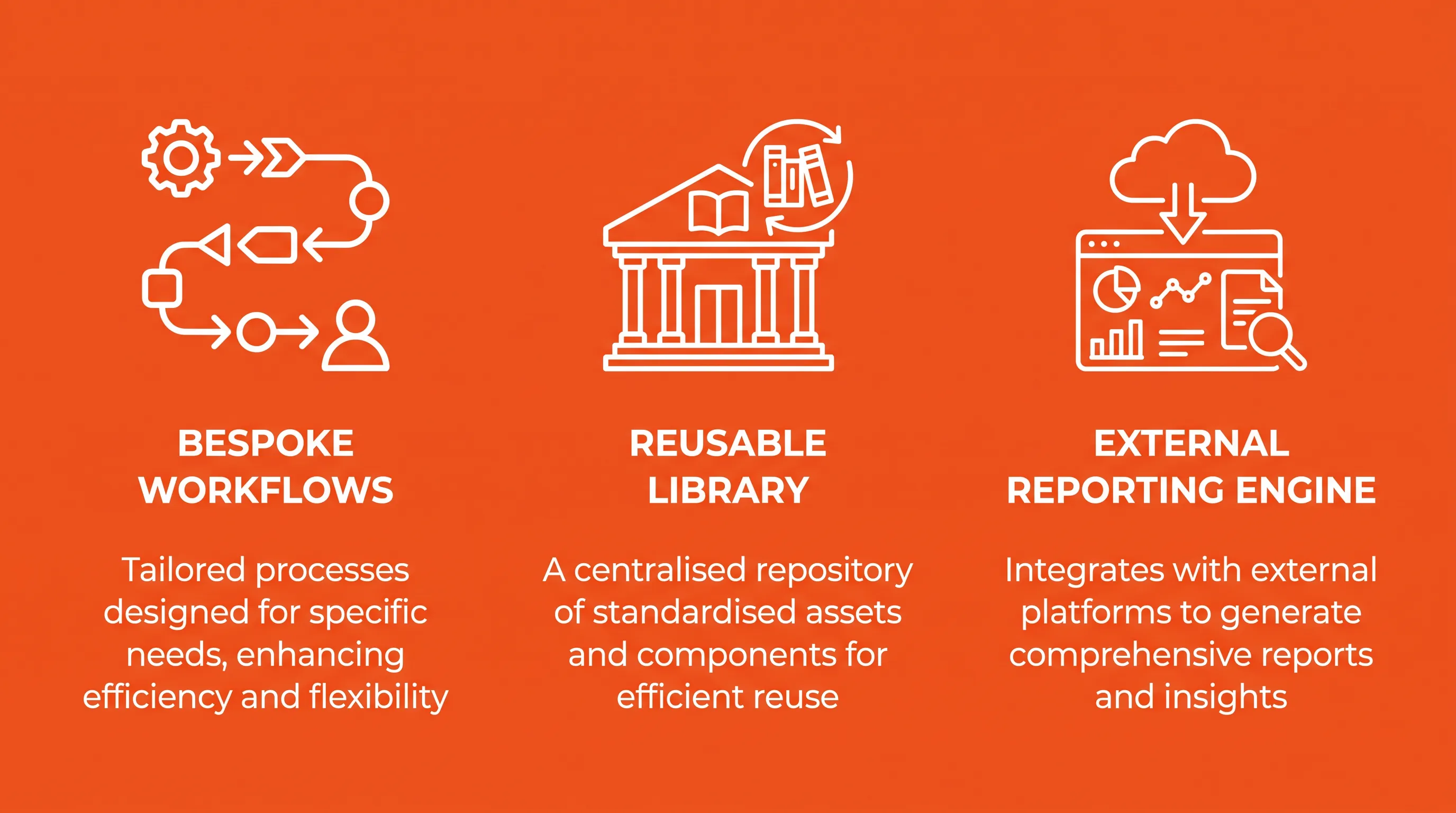
Horizontal infographic with bright orange background, featuring three sections: bespoke workflows, reusable library, and external reporting engine icons in w…

Take a customer portal as the shape of the problem, because almost every bespoke build breaks into the same three layers. The bespoke workflows written specifically for your business. The supplier's reusable library handling authentication and audit logging. An external reporting engine licensed from a vendor, with a per-seat charge and an annual renewal.

Each layer should land differently:

  • The bespoke workflows assign to you outright. You funded them, and nobody else uses them.

  • The reusable library stays with the supplier, licensed to you perpetually and irrevocably, with explicit permission to modify it and to let another firm modify it on your behalf.

  • The reporting engine is governed by its vendor's terms. Nobody can assign it to you. What you need is confirmation that the licence transfers with the system and that renewal sits in your name.

Insisting on assignment of all three would have one of two outcomes. The supplier refuses, or the supplier agrees and signs a promise it can't keep. A sensible software ownership position accepts that different layers carry different rights, as long as your permission to change and transfer the whole thing survives every one of them.

Build an asset inventory

Keep one document and update it at each milestone. Separating legal rights from operational control stops the common failure where a board is told the company owns everything while the passwords sit in someone else's inbox. The format matters less than the discipline of filling in every cell.

AssetClaimed ownerAssignment or licence evidencePermitted usesRestrictionsTechnical accessOpen questions
Bespoke portal codeYour companySigned assignment, clause 14, datedRun, modify, sublicense, transferNoneGitHub org owned by youDoes it cover design files?
Supplier auth librarySupplierPerpetual licence, schedule 3Run, modify, third-party modifyNo resale as a standalone productIncluded in main repositoryTransfer on sale of business?
Reporting engineExternal vendorVendor terms, renewal MarchInternal reporting only25 named users, no sublicensingVendor portal, admin unknownWho holds the admin login?
AWS production accountYour companyAccount in company nameFullNoneRoot access with finance directorMFA recovery documented?
Customer databaseYour company (controller)Data processing agreement, annex BProcessing on instruction onlyDeletion required at exitManaged by supplierExport format agreed?

Record unresolved items as unresolved rather than guessing. An honest inventory with eight open questions is more useful to your counsel than a tidy one built on assumptions, and it's the document that makes any later software intellectual property review quick instead of archaeological.

Clarify before signing

Software ownership questions get cheaper the earlier you ask them. Bring your inventory and let qualified counsel review the jurisdiction-specific clauses. Settle technical access and handover expectations while everyone still wants the project to go well. Evolved Ideas builds bespoke software from our Leicester head office, and our free 30-minute discovery call starts with understanding what you need to own and transfer later. Talk to our team about your project, and we'll be clear from the first conversation about software ownership and handover.

Ready to bring your ideas to life?

Book a free 30-minute discovery call with our team — we'll understand your objectives and advise how bespoke software, MVP development, or an extended team can help your business.

Ask for a schedule naming each deliverable, background component, third-party licence, and access item. Request evidence of contributor assignments, a software bill of materials, and a handover plan. Put unresolved points in the contract rather than relying on a proposal, invoice, or informal email.

Yes, ownership and modification rights can differ. A licence or assignment should expressly permit your organisation, a replacement supplier, and an acquiring business to run, modify, maintain, and transfer the relevant code. Check those permissions for supplier libraries and third-party components before accepting the handover.

Tell your lawyer where each contributor works and which entity employs or engages them. Local rules can affect how rights are assigned, even when the contract uses English law. Require the supplier to obtain signed assignments from overseas contractors and retain documents proving the complete chain.

Review it at contract signature, each delivery milestone, and the end of every major release. Evolved Ideas can help clarify what a project needs to own and transfer, but your counsel should confirm the legal effect of each assignment and licence. Record unknowns until evidence resolves them.

No. Payment and possession of files don't automatically transfer copyright in commissioned work. The contract should identify the rights being assigned, state when ownership transfers, and address unfinished work if the project ends early. A signed written assignment is required for a copyright transfer under UK law.

Schedule a Discovery Call

Book a free 30-minute call that works for you

You Might Also Like

Discover more insights and articles

A close-up of hands writing on documents at a wooden desk, surrounded by colorful post-it notes and a softly glowing laptop.

Membership website development: connecting members, events and CRM

An association’s public site and member portal often fail in the same way: they work on their own, but they no longer talk to the membership, payment, and event systems around them. Replacing either one is easier to commission when you start from seven requirements. Use them to set the scope first, then organise procurement around them, so every supplier responds to the same brief and the integration problems that prompted the replacement stay at the centre of the decision.

A person examines software development documents at a metallic desk, surrounded by a softly blurred office in warm natural light.

Fixed price vs time and materials for a software development project

Fixed price feels safe and time and materials feels flexible, but neither tells you what you’re committed to when the brief changes. Compare three ways to buy bespoke software: fixed price, time and materials, and a sequence of capped phases. For each, see what it commits you to and how an unplanned requirement plays out in practice. Then settle a short list of questions before you sign anything, while you can still change the terms.

A business professional focused on coding at a sleek black desk in a modern office with natural lighting and an exposed brick wall.

5 .NET development companies for established applications

Choosing a firm to look after an established, business-critical .NET application is a risk decision, and the case studies on a supplier’s website rarely settle it. Five companies that work on this kind of system are reviewed here against their published case evidence, so you can see what each one has demonstrably done. A set of due-diligence questions and a controlled trial brief then let you test any of them, including firms not on the list, before you hand over the application.

A lively outdoor scene with more people interacting, enjoying the atmosphere, and engaging in various activities.

Software maintenance costs: what to include beyond the monthly retainer

A support proposal for live software can look reasonable on the first page and still hide the real commitment in the clauses around it. Read it line by line so the annual cost is visible before you sign. Separate what you’re buying access to, such as response times, coverage, and named expertise, from what you’ll pay to leave, including notice periods, handover work, and renewal terms.