5 .NET development companies for established applications

Content authorBy Lincoln WoolseyPublished onReading time12 min read
A business professional focused on coding at a sleek black desk in a modern office with natural lighting and an exposed brick wall.

Choosing a firm to look after an established, business-critical .NET application is a risk decision, and the case studies on a supplier’s website rarely settle it. Five companies that work on this kind of system are reviewed here against their published case evidence, so you can see what each one has demonstrably done. A set of due-diligence questions and a controlled trial brief then let you test any of them, including firms not on the list, before you hand over the application.

Why inherited applications need a different supplier test

Choosing a .net development company for an application that already runs your business is a different exercise from hiring for a new build. The code exists, and somebody else made the architectural decisions years ago. What you need is evidence that a supplier can take ownership of work they didn't write.

Most supplier comparisons answer a different question. They rank firms on team size or review scores, neither of which tells you whether a team can read an unfamiliar solution file and ship a safe change in week three. So this review stays narrow. Five companies, each with a published client case, assessed on what that case actually proves and what it leaves open.

How the sample works

This sample was reviewed in November 2026. Inclusion required one condition: a published, named client case involving .NET work on an application the client already depended on. Companies are listed alphabetically, and the order carries no ranking.

Evolved Ideas publishes this article and appears in the sample, which is a conflict you should factor into how you read the section on us. The same evidence standard applies throughout. Where a claim comes from a published case study or a public register, it's attributed. Where it doesn't, it's marked as something to confirm directly with the supplier. You can review the company's wider case evidence separately.

One more boundary. None of these profiles include prices or comparative scores, because none of those are verifiable from public sources. Anything a supplier tells you in a sales conversation belongs in the "confirm" column until you've seen it demonstrated.

Check your .NET estate

Before you talk to anyone, find out what you're actually running. ".NET" covers two separate things, and suppliers answer differently according to which one you have. .NET Framework is a Windows component whose support follows the lifecycle of the parent operating system, so a 4.8 application on Windows Server loses support when that server does.

Modern .NET runs on its own clock. Microsoft shipped .NET 10 on 11 November 2025 as a long-term support release with cover until November 2028, while .NET 8 and .NET 9 both reach end of support on 10 November 2026. If you are on 4.6.2, your date is 12 January 2027. Those dates set your real timetable.

Here's where buyers go wrong. A case study describing .NET 2.0 WinForms work in 2011 is evidence of inherited-system capability, and it says nothing about whether the same team can target .NET 10 today. Ask any .net development company for the exact runtime versions their current engineers are shipping to production and the third-party libraries they have had to replace.

.NET development company shortlist

net-development-company-shortlist.png

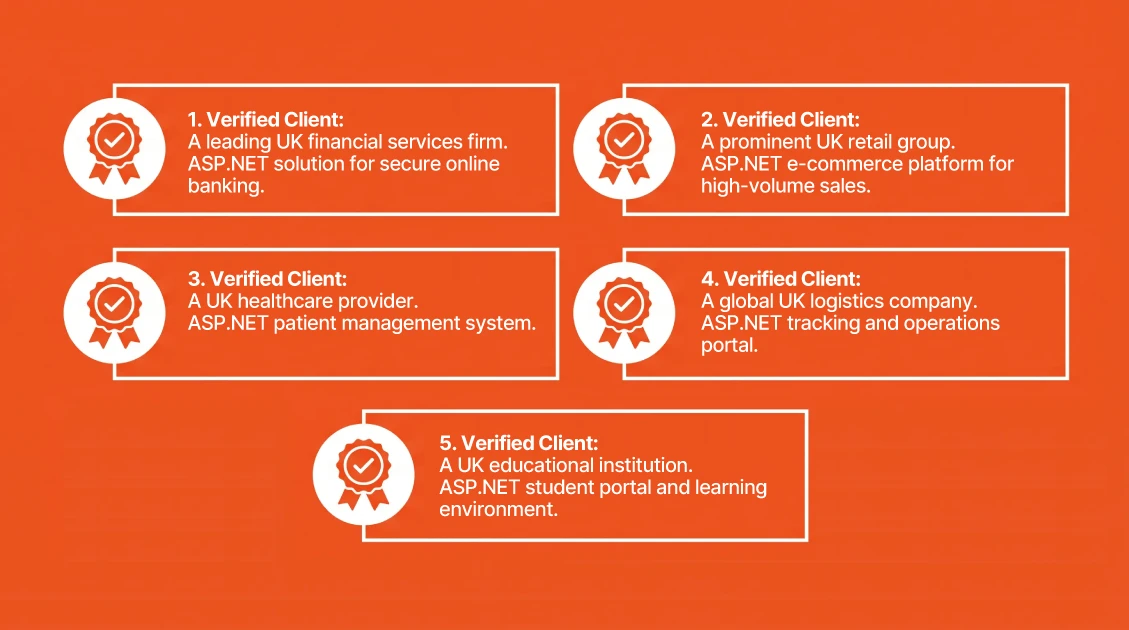
The five profiles below separate what the published evidence demonstrates from what remains unverified. Read the second part as closely as the first, because for inherited applications the unanswered questions carry more weight than the case study headline. Each firm is a UK-registered asp.net development company with a named client in the public record.

Assemblysoft

Assemblysoft's published work with Liverpool Victoria covers two engagements. One describes maintaining the LV= Adviser Centre for financial advisers, with the stated challenge of keeping the platform secure and compliant with financial services regulation. The other covers the LV.com content management system, where the firm describes developing a custom DevOps process and working to Financial Conduct Authority requirements over a five-year period.

What that supports is a long-running relationship on a regulated .NET application owned by someone else, with release process work included. The company was founded in 2009 by Carl Randall and reports more than 200 Azure, Blazor and .NET solutions delivered since. Assemblysoft Ltd is registered in England, number 07098083, with its office in Bournemouth.

Confirm the rest directly. Ask which runtime versions the team has shipped in the past twelve months and how long onboarding to an unfamiliar codebase takes before the first production change. Headcount matters too, because an asp.net development company with a small core team plus associates has a different continuity profile from a salaried bench.

Ready to bring your ideas to life?

Book a free 30-minute discovery call with our team — we'll understand your objectives and advise how bespoke software, MVP development, or an extended team can help your business.

Blueberry

Blueberry Consultants' HML case concerns a property services group whose Microsoft Access database had become business-critical and started producing errors. The firm migrated the backend to SQL Server and rebuilt the system as three tiers, with a WinForms .NET client and a .NET web services middle tier. The case study records that the client and middle tiers used .NET 2.0.

That's a clean example of stabilising a failing system and then continuing to develop it, since the case notes an ongoing relationship as HML's systems grew. The proven scope is a Windows desktop and database application for a defined internal user group.

Blueberry was formed in 1997 by Martin Green, who remains managing director, and works from Birmingham. The documented delivery is historical, so ask who is on the team now and what the firm hosts and deploys today. For an asp.net development company whose strongest inherited-code evidence predates modern .NET, that currency question is the one that matters.

Evolved Ideas dotnet development company

Our own inherited-application evidence is the Apply4 engagement. The brief was to maintain filmapp.org while rebuilding the whole system, so one .NET developer was assigned to the existing platform to keep it running for its 10,000-plus users and add functionality as required, while a separate rebuild began. A permanent team of three developers and a project manager continues the work, and the platform is now used across more than 20 cities in the UK and USA.

What that demonstrates is maintenance of an inherited .NET application running in parallel with new product development, under one accountable team. What it doesn't demonstrate is a stated availability target, because the case study publishes no uptime figure or cutover window. Continuing stewardship is a separate commitment from delivery, which is why our tiered support service is contracted on its own terms for monitoring and security patching.

Separately, EasyGo is our own .NET base platform, built to shorten the start of custom projects. Out of the box it includes authentication with two-factor and roles. It applies to new builds, and we publish no savings figure for it. Evolved Ideas trades as Evolve IT Consulting Limited, registered in England and Wales, number 06149634, with its office near Leicester. As a dotnet development company we also run teams in Spain and Eastern Europe, which is about specialist capacity and working-hour overlap.

Imobisoft

Imobisoft's GSK Pharmacy Portal case records a B2B platform for UK retail pharmacists that lets customers monitor rebate payments and track monthly sales. The published project details list the technology as .NET Core with MS SQL Server on AWS and GCP, and the timeline as 2020 and ongoing.

That combination is useful evidence. An ongoing timeline on a named enterprise client suggests the firm has kept a production system in service. The case supports integration-heavy portal work in a regulated sector.

The company was founded in 2009 by two Coventry University computer science graduates and is registered as Imobisoft Ltd, number 06811978, with ISO 27001 for three consecutive years and Cyber Essentials. Validate current platform expertise against your own runtime and establish who owns operational decisions once something breaks at 2am. Those answers decide whether any .net development company can carry your service, whatever its accreditations say.

One Beyond

One Beyond's TechMarketView case describes a research firm replacing a restrictive legacy database. The system was built using Microsoft ASP.NET technologies with existing company data migrated across, and separate online environments provided for testing and live use. Built-in reporting reduced company comparison tasks from several hours to minutes, and authorised analysts gained the ability to adapt the system themselves.

Those are published facts with a measurable outcome and a migration component, which is more than most capability statements offer. Note the boundaries. This is an internal analyst database with a defined user group, delivered as a replacement.

One Beyond Ltd was founded in 1994 and employs around 233 people across engineering centres in several European countries. Before appointing this or any asp.net development company, confirm how it takes over an existing repository and what happens to support when the project team disbands.

Ready to bring your ideas to life?

Book a free 30-minute discovery call with our team — we'll understand your objectives and advise how bespoke software, MVP development, or an extended team can help your business.

Compare each .NET development company

Comparing suppliers only works if you ask everyone the same questions and write the answers in the same places. Build a single matrix and fill it from written responses. Anything you can't record as a specific answer should be recorded as a gap.

Use these fields for every candidate:

  • Application types handled, with runtime versions shipped to production in the last twelve months

  • Onboarding to inherited code: the process, the elapsed time before a first production change, and who does it

  • Dependency handling, including out-of-support libraries and how replacements are assessed

  • Hosting and infrastructure they will operate, versus what stays with you

  • Integration experience with your specific external systems

  • Testing approach, automated coverage and what evidence accompanies a release

  • Deployment pipeline, release approval and rollback

  • Documentation produced as standard, not on request

  • Support model, named accountability and response commitments

  • Contracting entity, team locations, overlap with your working hours, data access arrangements, service languages and genuine availability dates

Two fields get skipped most often and cause the most trouble later. Data access is one, since a supplier touching personal or regulated data needs an agreed basis for it before work starts. Availability is the other, because a firm can be the right dotnet development company on paper and still have no senior engineer free until the next quarter.

Use one trial brief

Give every candidate the same small, redacted piece of real work and judge the output. A permissions change suits this well, because it touches authorisation logic and data exposure at once. No tests of this kind have been run for this article, so treat what follows as a proposed evaluation you run yourself.

The brief: a role in your application currently sees records it shouldn't, and you need the role's access narrowed to its own organisational unit without breaking existing users. Supply a redacted schema extract and the relevant code area. Then require the same five deliverables from everyone:

  1. A written diagnosis of where authorisation is enforced today and why the current behaviour occurs

  2. The proposed code and configuration changes, with the alternatives considered and rejected

  3. Test evidence covering the changed path and the regression risk to unaffected roles

  4. A release plan with approval steps, rollback and the monitoring they'd watch afterwards

  5. Handover deliverables, meaning updated documentation and anything your own engineers need to maintain the change

You learn who asks clarifying questions before touching anything and who hands back work your team can own. Any .net development company that returns a patch with no test evidence has told you something important about how it will behave in production.

Prepare the application inventory

Suppliers can only respond to what you give them, and incomplete information produces estimates that collapse in month two. Assemble the inventory before the first conversation, and be honest about the gaps.

Cover the following:

  • Codebase location, size, branch structure and who holds administrative access

  • Exact runtime and framework versions, plus every third-party library with its version

  • Infrastructure: servers, hosting provider, database versions and operating system versions with their support dates

  • Integrations, both inbound and outbound, with the authentication method each uses

  • Data classifications, particularly personal and regulated data, and where it sits

  • Deployment process as it actually happens today, including any manual steps

  • Documentation that exists, and the parts that live only in one person's head

  • Incident history for the past twelve months with causes and resolution times

  • Access constraints, approval chains and anything that blocks a new supplier from starting

  • Ownership gaps: systems with no named internal owner, and licences nobody can locate

That last point is the one organisations find hardest to write down. It's also the one a competent asp.net development company will probe immediately, because unowned components are where takeover projects stall.

Plan continuing ownership

Stewardship is a contract question. Establish who is accountable when the application fails and what response and resolution commitments apply. Ask how knowledge is retained when an engineer leaves, because a team of three with no documentation standard is a single point of failure wearing a logo.

Then press on security and release authority. Who patches dependencies, on what schedule, and who decides a vulnerability is urgent? Who approves a production release, and can the supplier deploy without your sign-off? Finally, agree the exit before you need it, with repository handover and a defined transition period. A .net development company that negotiates exit terms openly at the start is telling you how it expects the relationship to run.

If you are weighing up a supplier change on a live .NET application, we'd rather understand your estate before proposing anything. A scoped first engagement with Evolved Ideas can start as a diagnostic on your current runtime and release process, and our application support service covers continuing maintenance once ownership is settled.

Where to start

Published case evidence narrows a shortlist. What separates these five is less about past logos and more about how each one answers the questions their case studies leave open, which is why the same trial brief and the same matrix matter more than any profile above.

Run your inventory first, then test two candidates on identical work. If you want a second view on your .NET estate before that, talk to Evolved Ideas about a scoped diagnostic and how we work as a .net development company on inherited applications.

Ready to bring your ideas to life?

Book a free 30-minute discovery call with our team — we'll understand your objectives and advise how bespoke software, MVP development, or an extended team can help your business.

Record the exact runtime, operating system, database, third-party libraries, integrations and deployment process. Ask each supplier how it handles unsupported dependencies, learns an unfamiliar codebase and documents changes. Written answers expose gaps that a general capability statement won't show.

Give each candidate the same redacted permissions problem from your application. Require a diagnosis, proposed changes, test evidence, release and rollback plan, and updated documentation. Compare how well each response explains risk, asks questions and gives your team maintainable work.

They follow different support schedules. .NET Framework support depends on the parent Windows operating system, while modern .NET has Microsoft release dates. Check your exact version first, then ask the .net development company which supported runtime and replacement libraries it currently ships.

It should name the person accountable for incidents, response and resolution commitments, patching duties, release approval, access rules and exit steps. Include repository handover, documentation standards and a transition period so the application remains manageable if an engineer leaves.

No. A case study proves only the work and period it describes. For example, a historical .NET 2.0 project demonstrates inherited-system experience, not current .NET 10 delivery. Before appointing a supplier, ask for recent production runtimes, team ownership and deployment evidence. Contact Evolved Ideas if you need a separate review of your estate.

Schedule a Discovery Call

Book a free 30-minute call that works for you

You Might Also Like

Discover more insights and articles

A close-up of hands writing on documents at a wooden desk, surrounded by colorful post-it notes and a softly glowing laptop.

Membership website development: connecting members, events and CRM

An association’s public site and member portal often fail in the same way: they work on their own, but they no longer talk to the membership, payment, and event systems around them. Replacing either one is easier to commission when you start from seven requirements. Use them to set the scope first, then organise procurement around them, so every supplier responds to the same brief and the integration problems that prompted the replacement stay at the centre of the decision.

A focused programmer types on a laptop at a sleek black desk in a modern office, surrounded by multiple monitors displaying code.

Software intellectual property: 7 ownership questions before you sign

Paying for bespoke software does not automatically mean you own it, and the gaps usually surface when the relationship ends. Before you sign, settle seven questions about software intellectual property with your development partner and with qualified legal counsel. They establish what transfers to you, and what you need in practice to keep the system running if the partnership ends, such as source code, documentation, and access to the environments it runs in.

A person examines software development documents at a metallic desk, surrounded by a softly blurred office in warm natural light.

Fixed price vs time and materials for a software development project

Fixed price feels safe and time and materials feels flexible, but neither tells you what you’re committed to when the brief changes. Compare three ways to buy bespoke software: fixed price, time and materials, and a sequence of capped phases. For each, see what it commits you to and how an unplanned requirement plays out in practice. Then settle a short list of questions before you sign anything, while you can still change the terms.

A lively outdoor scene with more people interacting, enjoying the atmosphere, and engaging in various activities.

Software maintenance costs: what to include beyond the monthly retainer

A support proposal for live software can look reasonable on the first page and still hide the real commitment in the clauses around it. Read it line by line so the annual cost is visible before you sign. Separate what you’re buying access to, such as response times, coverage, and named expertise, from what you’ll pay to leave, including notice periods, handover work, and renewal terms.