Membership website development: connecting members, events and CRM

Content authorBy Lincoln WoolseyPublished onReading time14 min read
A close-up of hands writing on documents at a wooden desk, surrounded by colorful post-it notes and a softly glowing laptop.

An association’s public site and member portal often fail in the same way: they work on their own, but they no longer talk to the membership, payment, and event systems around them. Replacing either one is easier to commission when you start from seven requirements. Use them to set the scope first, then organise procurement around them, so every supplier responds to the same brief and the integration problems that prompted the replacement stay at the centre of the decision.

Why integration decides the outcome

Replacing a tired website is rarely the hard part. Membership website development gets difficult at the joins, where renewal dates and payment records have to agree with each other and with your CRM. Get those joins wrong and staff spend their week reconciling spreadsheets.

The sector knows this. The MemberWise Digital Excellence Report 2023/24 drew on over 600 membership professionals, and Katie Molloy, Head of Delivery at Wattle, summarised the finding this way: "The fact that nearly 60% of membership organisations continue struggling to integrate core systems shows these challenges are more endemic than many of us appreciate."

So this guide treats integration as the main event and the website as the surface it shows through. Every section below builds towards one question: who owns each piece of data, and how do you prove it works?

Set the project boundaries

Before anyone names a platform, write down two or three representative member journeys end to end. A student member upgrading to full membership after graduation behaves differently from a fellow renewing by invoice, and both differ from a corporate scheme administrator adding three colleagues mid-year. These journeys are the specification. Membership website development that starts from a feature list instead of a journey produces a site that demos well and fails in month two.

Agree the operating envelope next. Which countries members join from and where personal data is allowed to sit. The Information Commissioner's Office is explicit that you must be able to justify how long you keep personal data, which makes retention a scoping decision.

Then inventory what you already run. List the CRM or association management system and the payment gateway, and note for each one whether it is doing its job. Membership website development starts from that inventory, because the site has to present data it does not own.

Finally, separate the member problem from the staff problem. Members complain about logging in twice and about discount codes that fail at checkout. Staff complain about manual reconciliation and about not knowing which record is right.

Choose the delivery model

There are two defensible routes. Configure membership portal software and accept its model of status and renewals, or commission-focused custom functionality that wraps the systems you keep. The wrong instinct is to replace everything because one part hurts.

Configuration wins when your rules are conventional and your volumes are moderate. Umbraco has now been the most-cited content management system among medium and large UK membership bodies for five successive years, which tells you the mainstream products handle mainstream requirements well. If your renewal logic fits the product, fighting it is expensive.

Custom functionality earns its place where the rules are genuinely yours: pro-rata upgrades tied to accreditation dates and grace periods that vary by grade. In those cases the sensible pattern is to keep the capable CRM and payment gateway, and build only the connective layer and the member-facing journeys. Membership website development then becomes an exercise in exposing existing data cleanly.

Keep a tool if it holds authoritative data and has an application programming interface (API) you can read and write. Replace it when it blocks a journey you've committed to. Membership portal software that can't express your renewal rules is not a bargain, however complete the feature matrix looks.

Membership website development requirements

Organise the procurement around seven requirements. For each one, decide what you are buying and state the evidence you'll accept before you sign the work off. Membership website development goes wrong when acceptance means "it looked fine in the demo".

The structure below is deliberately repetitive, because consistency is what lets you compare two proposals side by side. Whether you end up configuring membership portal software or commissioning custom work, the same seven questions apply.

Membership website design and access

Decide how people register and log in. Decide what happens when someone joins at an event with a personal email and already exists in the CRM under a work address. Identity is the first place duplicates breed, and duplicates corrupt everything downstream.

Ask a prospective partner how they match incoming registrations against existing records and who resolves a conflict when the automated rule declines to. Ask whether login lives in the website or the CRM. Membership website development decisions about account pages are cosmetic by comparison.

For acceptance, require accessible prototypes tested against the member types you defined at the boundary stage. WCAG 2.2 was published as a W3C Recommendation on 5 October 2023 and adds nine success criteria, several of which land directly on authentication and form design. Ask for the test results.

Ready to bring your ideas to life?

Book a free 30-minute discovery call with our team — we'll understand your objectives and advise how bespoke software, MVP development, or an extended team can help your business.

Status and renewal rules

Name the authoritative source for membership status and never allow a second system to disagree with it. Then write down the renewal date logic and the grace period. These rules exist today in someone's head or in a procedure document, and getting them onto paper is the single most useful week of the project.

Ask where the calculations run. Status computed in the CMS and status computed in the CRM will drift, and the drift surfaces as a member who can't book an event they've paid for. Ask what the system does when a payment succeeds after the renewal date has passed.

The compliance angle is moving too. Under section 258 of the Digital Markets, Competition and Consumers Act 2024, traders must send reminder notices tied to renewal payments, and Osborne Clarke notes the government confirmed these must arrive on a durable medium, so a transient in-app notification won't qualify. Test every status transition and every staff override before launch.

Events and entitlements

Set the rules for who can book what, at which price, with what capacity and cancellation terms. Member pricing is the obvious case. The harder ones are the member who books at the member rate and then lapses before the event, and the non-member who joins during the booking flow to get the discount.

Ask when entitlement gets checked: at basket or at payment. Each answer produces different failure modes. Ask what happens to a confirmed booking when status changes afterwards, and who is notified.

Verify against examples you write yourself. Take a real cancellation from last year's programme and a real refund, and require the partner to walk each one through the built system. Payment flows carry their own obligations, since the Financial Conduct Authority set 14 March 2022 as the final deadline for full Strong Customer Authentication compliance on e-commerce transactions.

CRM ownership and synchronisation

Choose a system of record for every field and every transaction, and write it down field by field. Membership website development projects stall here more than anywhere else because two teams each assumed they owned the email address. The decision is organisational, not technical, and nobody outside your organisation can make it for you.

Ask about timing and failure, in that order. Does data move on a schedule or on an event? What happens when the CRM is unavailable at the moment a payment clears? Stripe's guidance on idempotent requests explains the pattern a competent partner should already be using, where a client-generated key lets a retry return the original result instead of creating a duplicate charge.

Accept the work only after reconciliation testing. Run a defined period of transactions and compare totals on both sides. An audit trail that records what synced and what failed is not a nice-to-have when a member disputes a charge.

Content permissions and workflow

Define what members-only means in practice. Some associations gate a journal archive, others gate a handful of policy documents and leave everything else open. Decide whether permissions attach to grades or to purchased products, and whether they inherit down a content tree.

Ask how a partner handles the embargo case, where a report is published to the site before its public release date and must be visible to fellows only. Ask who can approve what, and whether an editor can accidentally publish a draft to the open web. Good membership website development makes the permission state visible to the editor at the moment they press publish.

Test with real content and real user accounts. Include an account that should see nothing. Accidental access is discovered by members, not by test suites, unless you write the test.

Migration and reconciliation

Decide what moves. Current members and lapsed records. Decide retention for each category, because the storage limitation principle applies to the new system from day one.

Ask how fields map when the old structure and the new one disagree, and what the rollback looks like if the cutover weekend goes wrong. Ask for the exceptions report format before the first trial run. Membership website development schedules collapse when migration is treated as a single task at the end.

Require at least two trial migrations with record totals and a signed reconciliation from the person who owns the data. That signature is what lets you switch off the old system with confidence.

Ready to bring your ideas to life?

Book a free 30-minute discovery call with our team — we'll understand your objectives and advise how bespoke software, MVP development, or an extended team can help your business.

Operations, access and support

Assign owners for monitoring and platform updates. Platform updates have hard deadlines: Drupal 8 reached end of life on 17 November 2021 and Drupal 7 on 5 January 2025, and every major platform runs a similar clock. A site nobody owns becomes a site nobody can safely change.

Ask for service levels in writing, with response and resolution times separated. Ask what handover includes, and whether your own team gets runbooks and training or a password and good luck. Membership portal software vendors and custom partners alike should be able to answer this in a paragraph.

Accessibility needs evidence. The Public Sector Bodies (Websites and Mobile Applications) (No. 2) Accessibility Regulations 2018 require a published accessibility statement kept under regular review, and the government guidance confirms the current benchmark is WCAG 2.2 AA. Many associations fall outside those regulations and adopt the standard anyway, because the Equality Act duty does not go away. Finish by running a support escalation drill with a real ticket.

Trace a member journey

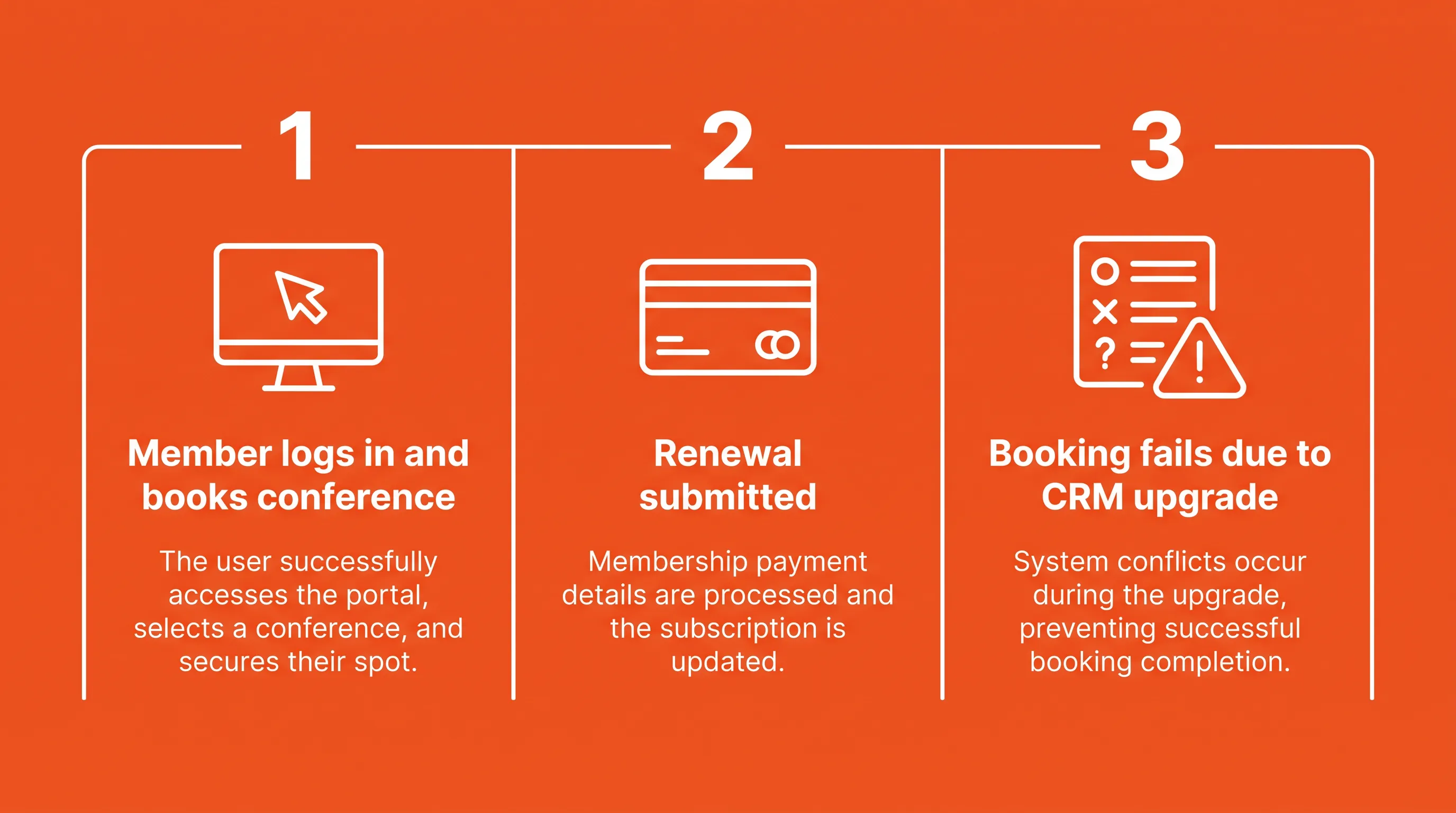
Infographic on member journey steps with bright orange background, featuring white icons for login, renewal, and booking issues.

What follows is a hypothetical worked example. A member whose grade expires on 31 March logs in on 28 March and books a member-rate place at an April conference in a single session.

  1. The site reads status from the CRM, which is the authoritative source, and shows the member as current with three days remaining.

  2. Renewal is submitted. The payment request carries an idempotency key, so a timeout on the gateway response doesn't produce two charges.

  3. The payment clears. The new expiry date is written to the CRM first, then cached for the session, so entitlement checks later in the flow read the updated value.

  4. The event booking checks entitlement at basket and again at payment. Member pricing applies because expiry now falls after the event date.

  5. The CRM write for the booking fails because the CRM is mid-upgrade. The job queues and raises an alert after the third failure.

  6. Membership staff see the booking in an exceptions queue with the payment reference and the failed payload, and can either retry it or correct the record manually with the change logged.

Membership website development is largely about step five and step six. The happy path takes a fortnight to build. The queue and the staff correction screen are what keep the finance team from rebuilding the picture in Excel every month.

Build the requirements matrix

Fill this in before you write the invitation to tender. The examples are typical of a professional body with roughly 5,000 individual members and a regional events programme, and the point is to force a named owner into every row. Membership website development proposals improve immediately when a partner can see who they'll be arguing with about the email address field.

RequirementBusiness ownerAuthoritative data sourceLikely exceptionLaunch priority
Design and accessHead of MembershipCRM contact recordDuplicate from event sign-up using a personal emailMust have
Status and renewalMembership Operations ManagerCRM membership recordCheque payment received after grace period endsMust have
Events and entitlementsEvents ManagerEvent booking systemMember lapses between booking and attendingMust have
CRM synchronisationDirector of OperationsCRM, field by fieldCRM unavailable during a payment confirmationMust have
Content permissionsHead of CommunicationsCMS roles, grade from CRMEmbargoed report visible to fellows before releaseShould have
MigrationData ManagerLegacy database exportHistoric records with no valid email addressMust have
Operations and supportIT LeadRunbook and monitoring platformOut-of-hours incident during conference bookingMust have

Two columns deserve attention. The exception column is where your real requirements hide, because exceptions are what staff spend their time on. The priority column protects the launch date, since some membership portal software configuration can wait until month three without anyone noticing.

Historical RMetS evidence

In early 2018, Evolved Ideas launched a new website for the Royal Meteorological Society, a body founded in 1850 with a worldwide membership. The brief named two problems directly: a high bounce rate and editors who found publishing new content difficult. The site had to carry an active events calendar and a large private members area.

The team built a custom Drupal 8 theme and migrated data from the older Drupal 6 system. After launch, bounce rates fell from almost 60% in April to under 10% two months later, with page views and session durations moving in the same direction.

Those software versions are history and should not be specified for a new build today. What transfers is the shape of the work: a migration from a legacy content system and custom modules written against a CRM the organisation chose to keep.

Why consider Evolved Ideas

The seven requirements above are mostly tests of whether a partner has done migration and integration work before and can show you the scars. Evolved Ideas has run a legacy CMS migration with event and membership modules connected to an existing CRM, which is the same problem shape as deciding a system of record and proving reconciliation. The company was founded in Leicester in 2007 and now runs a team of over 100 developers, with extended teams in Spain and Eastern Europe that provide timezone-aligned specialist capacity when a project needs it.

What that experience is worth to you depends on your own discovery. Exception handling and operational handover are where the detail lives, and nobody can price them honestly without seeing your renewal rules and your data. Membership website development is the part you'll look at, and the integration underneath is the part you'll live with.

So treat published evidence as a starting point. Ask for the reconciliation approach and the support escalation path, whether you end up with custom work or membership portal software.

Discuss your member journeys

Bring the two or three member journeys you mapped at the boundary stage and a renewal or event example that currently causes staff grief. That's enough material for a useful conversation about scope and which delivery model actually suits your rules. Get in touch with Evolved Ideas to talk through your requirements and where membership website development is hardest for your organisation.

Ready to bring your ideas to life?

Book a free 30-minute discovery call with our team — we'll understand your objectives and advise how bespoke software, MVP development, or an extended team can help your business.

It should define member journeys, data ownership, exception handling and acceptance evidence before procurement begins. For each requirement, name the business owner, authoritative system, launch priority and test result required. Include renewal, payment, event and migration cases that staff currently resolve by hand, since those cases expose whether the proposed design will work after launch.

Use a matching rule based on agreed identifiers, then route uncertain matches to a named staff owner. Decide whether the CRM or website creates the primary record, and record every merge or rejection. Test sign-ups that use personal and work email addresses, especially when an existing member joins at an event.

Choose custom functionality when your renewal, entitlement or identity rules cannot be represented safely by the portal product. Keep the CRM and payment gateway if they hold reliable data and expose suitable APIs. Commission the smallest connective layer that supports the journeys you have accepted, rather than replacing systems without a defined problem.

Test a full cutover rehearsal before switching off the old site. Compare record totals, payment results, membership status and permissions, then review every exception with the data owner. Keep a rollback plan, preserve the old export, and confirm that queued failures, staff corrections and audit records remain available after launch.

Yes. Evolved Ideas can discuss your member journeys, integration boundaries and support requirements before you set procurement scope. Bring a renewal example, an event case and your current system inventory. You can [contact Evolved Ideas](https://evolved-ideas.com/contact-us) to discuss which questions need evidence before a build begins.

Schedule a Discovery Call

Book a free 30-minute call that works for you

You Might Also Like

Discover more insights and articles

A focused programmer types on a laptop at a sleek black desk in a modern office, surrounded by multiple monitors displaying code.

Software intellectual property: 7 ownership questions before you sign

Paying for bespoke software does not automatically mean you own it, and the gaps usually surface when the relationship ends. Before you sign, settle seven questions about software intellectual property with your development partner and with qualified legal counsel. They establish what transfers to you, and what you need in practice to keep the system running if the partnership ends, such as source code, documentation, and access to the environments it runs in.

A person examines software development documents at a metallic desk, surrounded by a softly blurred office in warm natural light.

Fixed price vs time and materials for a software development project

Fixed price feels safe and time and materials feels flexible, but neither tells you what you’re committed to when the brief changes. Compare three ways to buy bespoke software: fixed price, time and materials, and a sequence of capped phases. For each, see what it commits you to and how an unplanned requirement plays out in practice. Then settle a short list of questions before you sign anything, while you can still change the terms.

A business professional focused on coding at a sleek black desk in a modern office with natural lighting and an exposed brick wall.

5 .NET development companies for established applications

Choosing a firm to look after an established, business-critical .NET application is a risk decision, and the case studies on a supplier’s website rarely settle it. Five companies that work on this kind of system are reviewed here against their published case evidence, so you can see what each one has demonstrably done. A set of due-diligence questions and a controlled trial brief then let you test any of them, including firms not on the list, before you hand over the application.

A lively outdoor scene with more people interacting, enjoying the atmosphere, and engaging in various activities.

Software maintenance costs: what to include beyond the monthly retainer

A support proposal for live software can look reasonable on the first page and still hide the real commitment in the clauses around it. Read it line by line so the annual cost is visible before you sign. Separate what you’re buying access to, such as response times, coverage, and named expertise, from what you’ll pay to leave, including notice periods, handover work, and renewal terms.