Software maintenance costs: what to include beyond the monthly retainer

Content authorBy Lincoln WoolseyPublished onReading time10 min read
A lively outdoor scene with more people interacting, enjoying the atmosphere, and engaging in various activities.

A support proposal for live software can look reasonable on the first page and still hide the real commitment in the clauses around it. Read it line by line so the annual cost is visible before you sign. Separate what you’re buying access to, such as response times, coverage, and named expertise, from what you’ll pay to leave, including notice periods, handover work, and renewal terms.

The monthly figure is not the price

A monthly retainer is the most quotable number in any proposal, and it's rarely the software maintenance cost you end up paying. It covers a defined slice of work. Everything around that slice, from onboarding to the enhancement someone approves in month four, lands on a separate line or a separate invoice.

That gap matters because software maintenance cost dominates the lifetime spend on custom software. Galorath, which builds cost estimation models for defence and enterprise programmes, puts maintenance at around 75% of total cost of ownership. So when you compare two providers on their headline rate, you're comparing the smallest variable in the equation.

Build the annual figure first. Then decide which provider you trust with the work behind it.

Compare software maintenance cost

A monthly-rate comparison gives you a number that's easy to put in a board pack and almost impossible to defend twelve months later. The honest comparison is the total annual software maintenance cost, broken into parts that behave differently.

Five groups cover most of it. Onboarding is paid at the start and sometimes again if discovery reopens. The recurring fee buys a defined service each month. Variable work is approved as it arises and billed at agreed rates. Infrastructure and licences follow usage rather than any agreement with your supplier. Exit costs sit in the contract and get ignored until the day you need them.

Two suppliers can quote the same retainer and differ by thousands once those groups are filled in. That's the point of separating them.

Reserved capacity

A retainer sometimes buys availability rather than output. You're paying to hold a named team, a priority position in a queue, or an agreed slice of someone's week, and the fee stands whether or not you raise a single ticket that month.

That's a reasonable thing to buy for a system your operations depend on. It stops being reasonable when nobody writes down what it includes. Ask what the fee reserves and what happens in a quiet month. If unused capacity disappears, you need to know that before the first invoice.

Included hours

Hour-based packages need scrutiny. The allowance is the easy part. The rules around the allowance determine what you actually receive.

  • The monthly allowance and whether unused hours roll forward, expire, or offset a later overrun

  • The overage rate, and whether it differs from the blended rate used to price the retainer

  • Whether a solution architect, a developer, and a tester draw on the same pool at the same rate

  • What counts as billable: triage, meetings, release management, waiting on your approvals

  • How hours are reported, how often, and at what level of detail

Reporting deserves particular attention. If you can't see where the hours went inside a month, you can't challenge an overage claim at the end of it.

Defined tasks

Task-based coverage reads cleanly and hides more. The proposal lists what the supplier will do (patching and minor fixes) and prices it as a package.

The question is what falls outside the list. ISO/IEC/IEEE 14764:2022 separates corrective, preventive, and adaptive maintenance from enhancements. Most task-based packages quietly draw the same line. A dependency upgrade forced by a vendor or a change triggered by new regulation sits near that boundary. Agree in writing which side each one lands on, and who signs off when something needs a separate estimate.

Ready to bring your ideas to life?

Book a free 30-minute discovery call with our team — we'll understand your objectives and advise how bespoke software, MVP development, or an extended team can help your business.

Map every cost line

Once the shape of the agreement is clear, write down every charge the year will generate. Group them by how they behave, because that's what makes the budget predictable.

  • Recurring: the retainer, support cover, routine upkeep, monitoring, scheduled releases, fixed hosting commitments and named licences

  • Usage-based: infrastructure consumption, overage hours, incident work outside cover, third-party transaction fees

  • One-off: onboarding, knowledge transfer, environment and access setup, approved improvements, offboarding

Infrastructure is where budgets leak hardest. Flexera's 2026 State of the Cloud Report, based on 753 respondents, found wasted cloud spend rose to 29% of IaaS and PaaS spend after five years of decline. If your supplier manages the environment but you hold the cloud account, decide now who's accountable for that number.

Licences carry their own timers. Microsoft charges $61 USD per device for the first year of Windows 10 Extended Security Updates, and the price doubles each year after. Cloud support tiers work similarly: AWS Business Support+ is priced at 9% of monthly AWS charges up to $10K, with a minimum per account. Those charges sit outside a development retainer and still appear on your annual total.

Check coverage terms

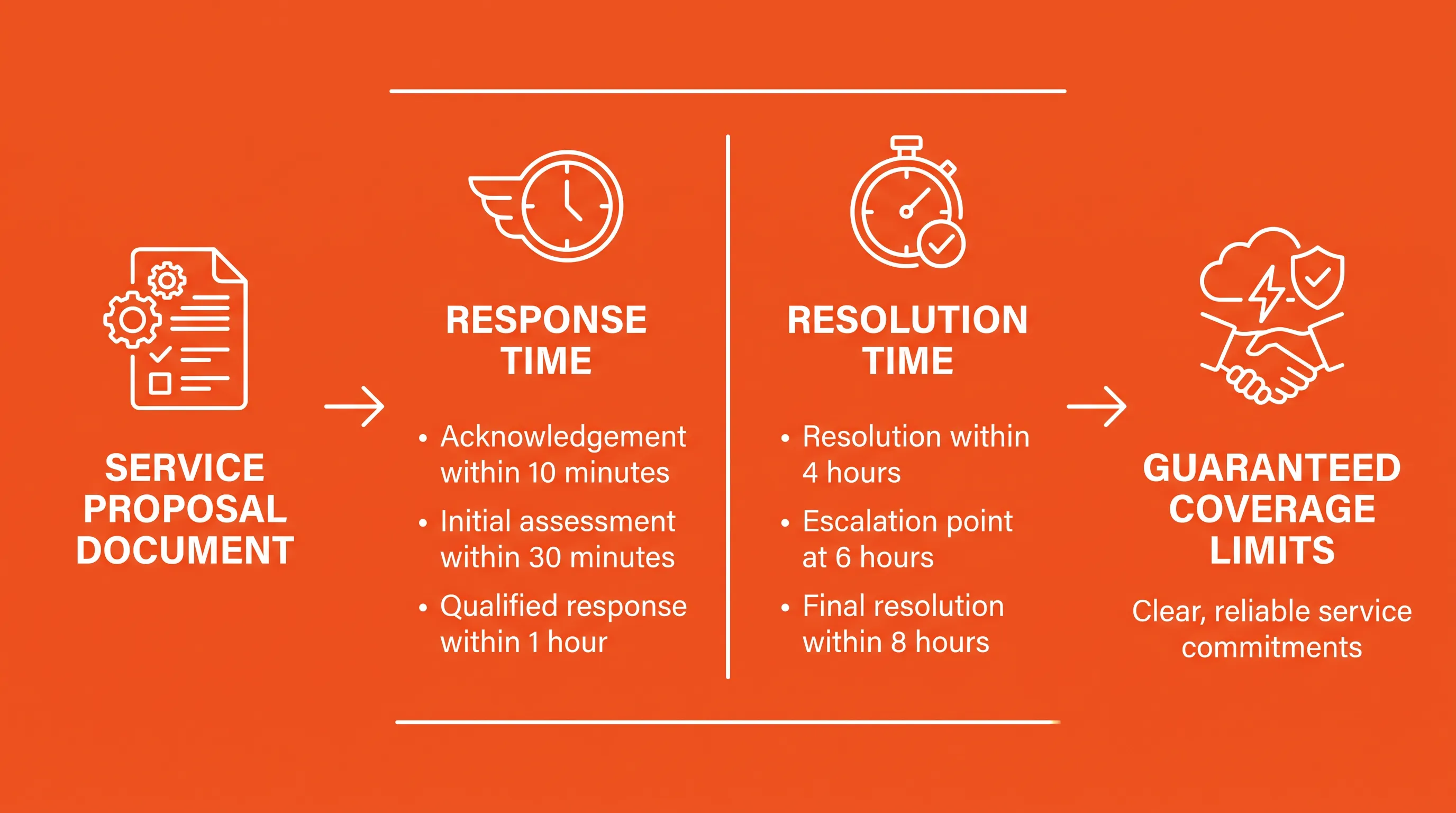
Infographic on a bright orange background detailing a service proposal with icons, response time, and resolution time comparisons in white text.

Coverage is the part of the proposal that gets read quickly and regretted slowly. Service hours and the priority matrix need to be compared side by side, in your own working hours rather than the supplier's.

Response targets are commitments to acknowledge. Response time measures how quickly a request is acknowledged and assigned, while resolution time covers diagnosis through to closure. A proposal that promises a fifteen-minute response says nothing about when your checkout will work again. Published ITIL reference figures pair a P1 target of acknowledgement within 10 minutes with a four-hour resolution target, and those two numbers belong in different columns of your comparison.

Purchased capacity isn't unlimited repair, and cover inside business hours isn't cover at 2am. If you need out-of-hours response, price it as its own line.

Assess takeover readiness

A provider has to understand what they're taking on before they can quote a defensible software maintenance cost for a system they didn't build. Code review and a documentation audit are how the unknowns surface. A study in Acta Informatica Medica identified incomplete documentation as a direct driver of software maintenance cost, because the people who built the system have moved on.

Technical debt makes the same point in financial terms. McKinsey's survey of CIOs found tech debt amounts to 20 to 40 percent of the value of an entire technology estate before depreciation. A supplier who quotes without looking is pricing a system they haven't seen.

At Evolved Ideas, discovery and structured knowledge transfer come before any support plan is proposed. That work is an input to a tailored plan, and what it finds in your codebase and environments shapes what the plan can responsibly include.

Use evidence carefully

Published evidence tells you whether a provider has done this kind of work without indicating what they'll charge or who will be on your team.

Evolved Ideas' offered case study records a stabilisation-first approach to a failing MVP, with the platform now live and application support continuing. Founder Jamie Beaumont's comment in that write-up is about outcome rather than price: "We have people using our product and getting value from it now, which is great." The Apply4 engagement appears in the same published case study archive as historical evidence of a dedicated team maintaining a live permitting platform alongside redevelopment work.

Treat both as evidence of capability. Current rates and contract terms come from your own proposal.

Ready to bring your ideas to life?

Book a free 30-minute discovery call with our team — we'll understand your objectives and advise how bespoke software, MVP development, or an extended team can help your business.

Build the annual worksheet

Put every line in one table and make someone own each row. The worksheet is what turns a proposal into a budget you can defend, and it's what you'll reuse when the software maintenance cost comes up for renewal.

Cost lineInternal ownerSupplier ownerAllowanceExclusionsApproval thresholdOverage rateBillingAnnual total
Onboarding and discoveryn/aOne-off
Knowledge transfern/aOne-off
Support retainerMonthly
Out-of-hours coverMonthly
Monitoring and alertingMonthly
Hosting and infrastructureMonthly, usage
Licences and subscriptionsn/aAnnual
Approved enhancementsOn approval
Excess hoursOn approval
Offboarding and handovern/aOn exit

Fixed annual costs

These are the figures you can commit to a budget line today. Onboarding and knowledge transfer are non-recurring. The retainer multiplies cleanly by twelve. Hosting commitments and named licences are predictable where they're reserved or contracted, and variable where they follow traffic, so split them rather than averaging them.

Variable approved costs

Enhancements and excess hours share one feature: somebody has to say yes. Name that person for each row and set the threshold above which approval goes to a second signature. Without it, you'll reconcile a year of small approvals nobody remembers making.

Exclusions and exit

Exclusions are a cost line, because that work still gets paid for. Record VAT, which stands at 20% for most services in the UK, along with third-party charges passed through at cost.

Exit terms belong in the same place. Capture the notice period and data export. Under Article 28 of the UK GDPR, a processor must delete or return personal data at the end of the service, so agree the format and who pays for it while you're still on good terms.

Software maintenance cost example

Here's a hypothetical calculation in pounds sterling with invented figures that show the arithmetic rather than a benchmark.

Onboarding is quoted at £2,000, paid once. The retainer is £800 a month, so twelve months come to £9,600. Hosting and licence charges run at £200 a month, adding £2,400. That gives you a committed annual software maintenance cost of £14,000 before any variable work.

Then add the approved extras. Twenty hours of enhancement work at £75 an hour adds £1,500, which takes the year to £15,500. Taxes sit outside this figure and get added according to your jurisdiction. Substitute your own quoted numbers and your own currency, because the only useful version of this calculation is the one built from your proposal.

Plan year two

Year two is where a well-compared agreement quietly drifts. Start by removing onboarding, unless architectural change or a new system means discovery has to run again.

Then recheck everything that moves. Retainers come up for review, and service price indices give you a reference point: Ireland's Central Statistics Office recorded a 0.7% annual change for computer programming and consultancy prices in Q4 2025, which is a weaker case for a large uplift than most suppliers will make. Read the inflation clause and establish whether it's capped or indexed.

Usage-based lines deserve a fresh look, too. A traffic increase or a migration changes hosting and licence tiers. Compliance deadlines belong in the same review, because the Cyber Essentials 14-day patching window is an automatic-fail criterion, and the NCSC recommends completing updates to internet-facing services within 5 days. That cadence has a capacity cost, and somebody is paying it.

Check before signing

Run the proposal against the gaps that cost most:

  • Onboarding, out-of-hours cover, infrastructure usage, licence renewals and exit assistance

  • Overage rates, approval owners, rollover rules and the documentation you get on the way out

Swap in your actual quotes, currency, taxes and coverage hours before you compare anything.

Evolved Ideas runs Support as a Service for live applications and supplier takeovers. Bring your application inventory and required cover to our team, and we'll work through the full software maintenance cost with you.

Ready to bring your ideas to life?

Book a free 30-minute discovery call with our team — we'll understand your objectives and advise how bespoke software, MVP development, or an extended team can help your business.

Build a contingency into the software maintenance cost before approving the contract. Base it on the supplier’s overage rate and the volume of unresolved risks found during discovery. Keep this reserve separate from the retainer, then release it only through the named approval process.

Test the SLA against realistic incidents before signing. Ask the supplier to classify a payment failure, security issue, and slow report, then show the response, escalation, communication, and resolution steps for each. Check whether the clock pauses while your team supplies information.

You can control cloud spending with budgets, alerts, resource limits, and an approval path for unusual usage. Avoid hard limits on services that support essential transactions, because a cost control could interrupt users. Assign one owner to review alerts and explain material changes each month.

Review the agreement before its renewal notice period, after a major usage change, or when repeated work falls outside the package. Compare actual hours, incidents, hosting charges, and approved enhancements with the original assumptions. Use that record to adjust allowances and exclusions before the next term.

Ownership and delivery rights depend on the contract, so the client should specify them before support begins. List source materials, runbooks, environment details, credentials, dependency records, and export formats, then set a handover deadline. Contact Evolved Ideas if you need help reviewing these terms.

Schedule a Discovery Call

Book a free 30-minute call that works for you

You Might Also Like

Discover more insights and articles

A close-up of hands writing on documents at a wooden desk, surrounded by colorful post-it notes and a softly glowing laptop.

Membership website development: connecting members, events and CRM

An association’s public site and member portal often fail in the same way: they work on their own, but they no longer talk to the membership, payment, and event systems around them. Replacing either one is easier to commission when you start from seven requirements. Use them to set the scope first, then organise procurement around them, so every supplier responds to the same brief and the integration problems that prompted the replacement stay at the centre of the decision.

A focused programmer types on a laptop at a sleek black desk in a modern office, surrounded by multiple monitors displaying code.

Software intellectual property: 7 ownership questions before you sign

Paying for bespoke software does not automatically mean you own it, and the gaps usually surface when the relationship ends. Before you sign, settle seven questions about software intellectual property with your development partner and with qualified legal counsel. They establish what transfers to you, and what you need in practice to keep the system running if the partnership ends, such as source code, documentation, and access to the environments it runs in.

A person examines software development documents at a metallic desk, surrounded by a softly blurred office in warm natural light.

Fixed price vs time and materials for a software development project

Fixed price feels safe and time and materials feels flexible, but neither tells you what you’re committed to when the brief changes. Compare three ways to buy bespoke software: fixed price, time and materials, and a sequence of capped phases. For each, see what it commits you to and how an unplanned requirement plays out in practice. Then settle a short list of questions before you sign anything, while you can still change the terms.

A business professional focused on coding at a sleek black desk in a modern office with natural lighting and an exposed brick wall.

5 .NET development companies for established applications

Choosing a firm to look after an established, business-critical .NET application is a risk decision, and the case studies on a supplier’s website rarely settle it. Five companies that work on this kind of system are reviewed here against their published case evidence, so you can see what each one has demonstrably done. A set of due-diligence questions and a controlled trial brief then let you test any of them, including firms not on the list, before you hand over the application.