How to Choose an Ecommerce App Development Company for Complex Commerce

Content authorBy Lincoln WoolseyPublished onReading time12 min read
A project manager reviews specifications on a laptop at a modern conference table, surrounded by digital displays and tablets in a tech-focused office.

Most agency pitches look equally polished, and polish says little about whether a supplier can handle your custom pricing rules, your ERP, or your fulfillment edge cases. Evaluating an ecommerce app development company starts with mapping your requirements, especially the custom rules and deep integrations where projects tend to fail. Then score each shortlisted supplier against business risk instead of presentation quality.

Why portfolio claims stop being useful

Choosing an ecommerce app development company gets harder the moment your project stops looking like a storefront. Once pricing logic and three back-office systems both touch the same checkout, a portfolio of clean retail apps tells you almost nothing about whether a supplier can deliver yours.

The problem is that most selection processes test the wrong things. Design quality is visible in a pitch. Integration failure under peak load is not. Neither is the way a team handles a pricing rule that contradicts an ERP record at the point of order capture.

What follows is a method that turns complexity into a requirements map and consistently scores suppliers against it. It takes longer than reviewing case studies. It also removes most of the guesswork from a decision that will shape your product for the next three years.

Define complexity first

Complexity in commerce rarely comes from one thing. It comes from interaction. A catalogue with 40,000 variants is manageable. A catalogue with 40,000 variants and contract pricing per account is a different proposition entirely when stock is reserved across stores and a warehouse, with a returns process owned by a third-party logistics provider.

Frame this in business terms before you speak to anyone. With a quarter of UK retail sales now happening online, the commercial consequence of a broken journey sits with operations and finance. Stakeholders align faster around revenue at risk than around architecture diagrams.

Complexity shows up in four places worth naming explicitly:

  • Journeys that branch by account type, channel, or service state

  • Commercial rules that no platform supports out of the box and require custom ecommerce software

  • Operational workflows owned by teams outside the digital function

  • Enterprise systems that hold the authoritative version of your data

An ecommerce app development company that understands which of these dominates your project will ask different questions from the outset. That difference is diagnostic on its own.

Build the requirements map

A requirements map is a structured picture of what the product has to do and who owns the decision. Organised this way, it becomes the shared reference for every conversation with every supplier.

Separate launch needs from later optimisation while you build it. Teams that skip this step end up negotiating scope during delivery, when the cost of change is highest. And resist specifying a technical solution at this stage, because an experienced ecommerce app development company will propose options you haven't considered, and a prescriptive brief closes that door before discovery starts.

Customer journeys and channels

Start with who buys and in what state. A logged-out browser on mobile differs from a contract customer with approval workflows, and a returning shopper collecting in store wears the same interface as both.

Map devices and every checkout path you support, even the awkward ones. Then map the handoffs from web to app and from self-service to support agent. Handoffs are where context gets lost, and lost context is where roughly 70% of online carts quietly disappear.

Personalisation deserves its own entry rather than a passing mention. Decide what varies by customer and who signs off on the rules.

Custom ecommerce software scope

This section documents everything your platform cannot configure. Catalogue structures with complex variant logic and customer-specific pricing are the recurring culprits.

Write each rule as a statement of business behaviour, with the edge cases attached. "Trade customers see net pricing based on contract tier, which overrides promotional pricing except during clearance periods" is a requirement, and it is the kind of statement that reveals whether a supplier is estimating seriously.

Be honest about which of these genuinely needs custom ecommerce software. Every custom rule you build is a rule you maintain, so the map should record the commercial reason each one exists.

Commerce operations

Operations is where digital projects meet reality. Inventory visibility and fulfilment routing both involve people and systems outside the product team.

Record the responsible team against each workflow. Payment and refund logic in particular carries compliance weight, since PCI DSS v4.0.1 sets requirements that affect architecture decisions made in week two, and Strong Customer Authentication under the FCA's payment services rules changes how checkout and re-authentication behave.

Fraud controls need the same treatment. The National Cyber Security Centre's supply chain guidance is a useful reference point for how far your assessment should extend into third-party services.

Ready to bring your ideas to life?

Book a free 30-minute discovery call with our team — we'll understand your objectives and advise how bespoke software, MVP development, or an extended team can help your business.

Systems and data

List every system the product touches, from the ERP to the Order Management System (OMS). For each one, record four things that suppliers consistently need and rarely receive upfront.

  1. Which system owns the data, and which merely holds a copy

  2. Direction of flow and frequency, whether that's real time, batched, or event-driven

  3. Availability guarantees and known maintenance windows

  4. What happens commercially when that integration fails for an hour

That fourth point matters more than the others combined. An integration whose failure stops order capture belongs in a different risk tier from one that delays a marketing sync, and the architecture should reflect that difference.

Quality and delivery

Non-functional requirements decide whether the product survives its first peak trading weekend. Define load targets against your actual traffic history rather than a round number, and set performance thresholds you can measure. Google's guidance on Largest Contentful Paint under 2.5 seconds is direct about this: "To provide a good user experience, sites should strive to have an LCP of 2.5 seconds or less."

Security and accessibility are legal requirements in UK and European markets. Your obligations under the Data Protection Act 2018 shape data handling, and WCAG 2.2 sets the accessibility benchmark that the Equality Act 2010 effectively makes enforceable. Directive (EU) 2019/882 extended accessibility duties to e-commerce services across the EU from June 2025.

App-store delivery and post-launch optimisation belong here too. Write them as measurable targets, because anything unmeasured gets dropped when timelines tighten.

Ecommerce app development company criteria

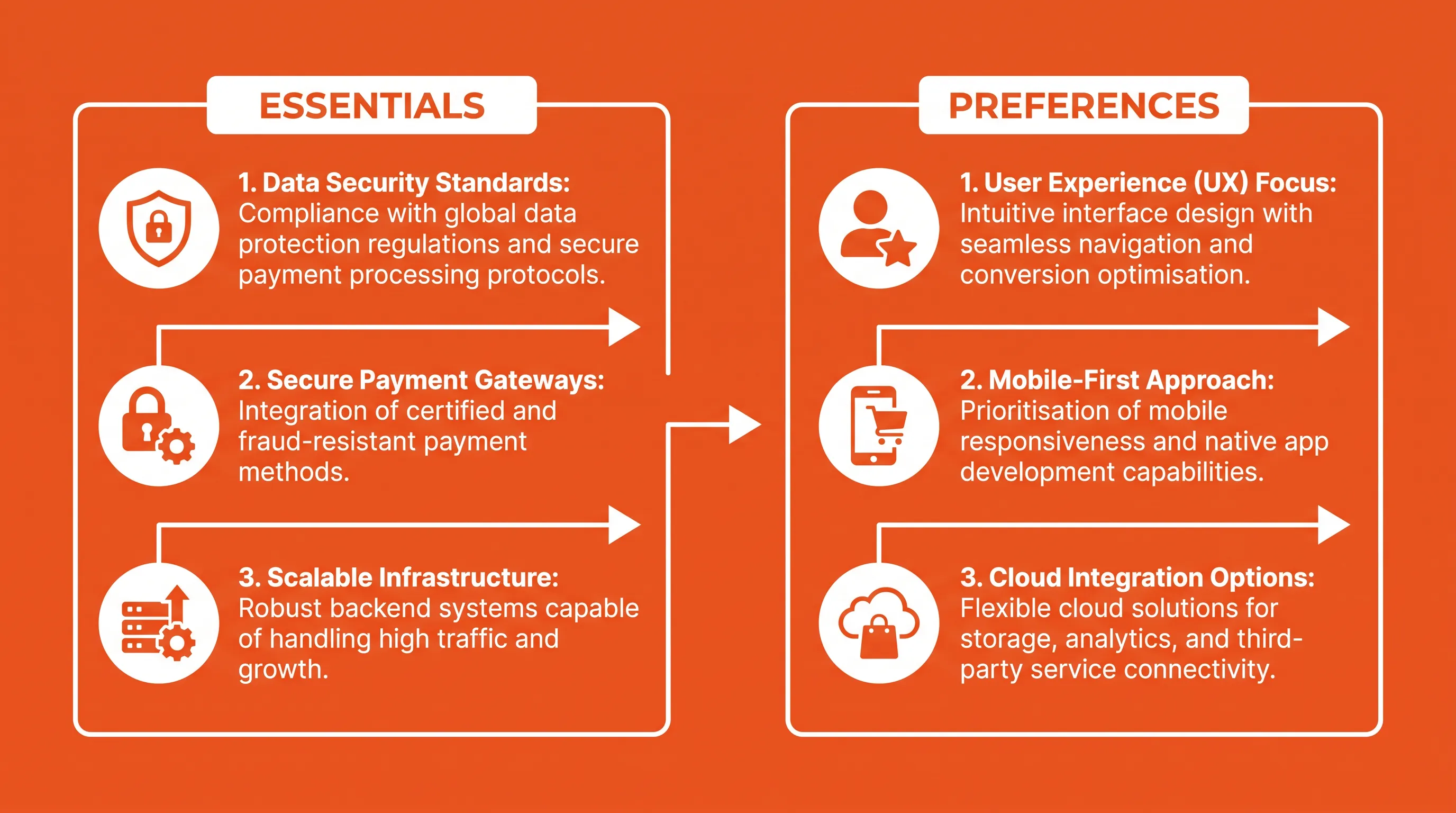
Structured infographic layout for ecommerce app evaluation, featuring 'Essentials' and 'Preferences' sections with white icons on orange background.

Now convert the map into criteria. Each significant requirement should produce a question that a supplier answers with evidence rather than assurance. "Have you built contract pricing that overrides promotions?" beats "do you have retail experience" every time.

Split your criteria into essentials and preferences before you see a single proposal. Essentials are capabilities whose absence creates unacceptable delivery risk. Preferences are things you'd like, and they should never outvote an essential during scoring.

Generic mobile or web credentials mislead here. A team that has shipped 30 consumer apps without touching order management or stock reservation will meet your commercial rules for the first time in your project. An ecommerce app development company that has already handled custom ecommerce software of comparable depth brings pattern recognition, which is the thing that shortens discovery and prevents expensive architectural reversals.

Ecommerce app developers

Ask who actually does the work. Pitch teams and delivery teams diverge, so request named ecommerce app developers with their commerce background and their expected tenure on your project.

Continuity matters because complex commerce knowledge lives in people's heads for the first six months. Then ask what sits around the core team. A capable supplier gives you access to architecture and DevOps specialists without hiring a new company each time.

Assess collaboration honestly. Experienced ecommerce app developers push back on requirements and tell you when something is a bad idea. A team that agrees with everything in the sales process will agree with everything in delivery, which is how contradictory pricing logic reaches production.

Ready to bring your ideas to life?

Book a free 30-minute discovery call with our team — we'll understand your objectives and advise how bespoke software, MVP development, or an extended team can help your business.

Architecture and integration evidence

Sector similarity is the weakest form of evidence. A supplier that built a fashion app has solved a different problem, while one that built a plant-hire platform with contract pricing and live asset availability has solved most of it.

Ask for specifics. How did they handle write operations against an ERP that goes down for nightly processing? What transaction volume did the system sustain at peak, and how did they verify that before launch? Where did they choose composable services over monolithic platform extensions, and what did that trade off? The MACH Alliance publishes reference material on these architectural patterns, which gives you a shared vocabulary for the conversation.

Pay attention to the trade-offs they volunteer. A team that describes only successes is either new to complexity or editing heavily, and both should concern an ecommerce app development company's prospective client equally.

Delivery and governance

Discovery method tells you how a supplier thinks. Look for a structured approach to assumptions and estimation ranges rather than a single confident number attached to a nine-month plan.

Then examine the mechanics. Testing strategy and rollback procedures determine whether your peak trading weekend is uneventful. The DORA research programme has spent over a decade measuring deployment frequency and change failure rate against delivery performance, and those metrics give you a neutral way to compare engineering discipline between suppliers.

App-store delivery carries its own governance burden. Rejections under the App Review Guidelines or Google's Developer Programme Policies delay releases by days at a time, so ask how many submissions a supplier manages monthly and how they handle a rejection mid-campaign. Any ecommerce app development company working at scale will answer that immediately.

Optimisation capability

Launch is the start of the commercial case. Ask how the supplier uses analytics and customer feedback to improve conversion after release.

The financial argument for this is well documented. Deloitte's work with Google found that a 0.1 second improvement in load speed lifted retail conversion rates by 8.4%, which is the kind of gain that only shows up when someone is measuring continuously. Experimentation capability should be part of the proposal, with a clear account of who owns hypotheses and how results reach the business.

Test claims during discovery

Run a scenario workshop with each shortlisted ecommerce app development company that tests your two hardest requirements. It is a working session where their technical people respond to your real constraints in front of you.

Give them the same brief and the same two hours. Ask them to walk through how they would handle a pricing conflict between your CRM and your checkout, or how they would keep order capture running when the OMS is unavailable. The useful signals come from what they ask and what they refuse to commit to without more information.

Warning signs are consistent across these sessions:

  • The supplier sends only commercial staff, with e-commerce app developers absent or silent

  • Assumptions go unstated, and estimates arrive without ranges

  • Every question gets an immediate yes

  • Integration failure handling is described as "we'll catch that in testing"

Ask for a short written artefact afterwards: a sequence diagram and a risk list. The quality of that document, produced under time pressure, predicts the quality of everything that follows.

Create a weighted scorecard

Scoring prevents the most persuasive presentation from winning by default. Build a scorecard covering capability fit and delivery approach.

Weight each criterion by business risk rather than by how much the topic interests you. If a failed payments integration stops trading, payments evidence carries more weight than design process. If your audience includes public sector buyers, accessibility compliance becomes a gating criterion rather than a scored one. An ecommerce app development company should be assessed against the risks that would actually hurt you.

Score consistently on the same scale with the same scorer for each criterion across all suppliers. Then record a confidence level next to every score. A 4 out of 5 backed by a working session is worth more than a 5 backed by a slide, and separating confidence from score stops strong claims about custom ecommerce software from inflating totals that nobody can defend later.

Compare value and risk

Estimates are only comparable when the assumptions behind them are. Normalise the proposals first: same scope and same exclusions. Differences of 40% between suppliers dissolve once you do this, and the ones that remain tell you something real.

Read the exclusions more carefully than the inclusions. Then check the delivery model and how change requests are priced and approved. A supplier whose change control process is vague will use that vagueness, and the experienced ecommerce app developers in your own organisation will recognise the pattern.

Price alone is the worst available criterion for complex commerce. Rework on a mis-architected order flow costs more than the entire discovery phase that would have prevented it, and the business absorbs that cost through delayed launches and manual workarounds in operations.

Choose the right partner

Before signing, do five final checks. Speak to references about problems rather than outcomes, and ask specifically what went wrong and how the supplier responded.

Validate the named team against the proposal and confirm the discovery plan has defined outputs and decision points. Then make sure the contract carries practical safeguards: IP assignment and a change process with named approvers. The ecommerce app developers you meet in discovery should be the ones who start in week one, and an ecommerce app development company confident in its own delivery will put that in writing.

Deciding with evidence

Complex commerce rewards preparation. A requirements map and a weighted scorecard will tell you more in four weeks than six months of proposals and portfolio reviews.

Evolved Ideas runs structured discovery for complex e-commerce products across UK and European markets, and the discovery covers integration architecture and commercial rules before anyone writes code. If you're shortlisting an e-commerce app development company and want a second view on your requirements, get in touch with our team.

Ready to bring your ideas to life?

Book a free 30-minute discovery call with our team — we'll understand your objectives and advise how bespoke software, MVP development, or an extended team can help your business.

Ask what failed, who owned the problem, and how quickly the supplier communicated a workable response. Request examples involving integrations, scope changes, or production incidents rather than general satisfaction scores. Also ask whether the final team matched the promised team and whether the client would use the supplier again for similar work.

Check whether the estimate names data mapping, error handling, monitoring, test environments, security reviews, and production cutover. Ask for assumptions behind each integration and the cost of changes when an external system behaves differently than expected. A credible estimate separates build effort from supplier coordination and post-launch support.

Make accessibility a pass-or-fail requirement when legal duties, public-sector procurement, or the target audience make exclusion unacceptable. Define the required WCAG level before proposals arrive, then require keyboard testing, screen-reader checks, and remediation evidence before launch. A high score elsewhere shouldn't compensate for failing that threshold.

Yes, provided it can show evidence for the risks your project carries. Review named engineers' integration work, incident response, security practices, and access to specialist support. An ecommerce app development company doesn't need the largest headcount, but it does need enough coverage to maintain critical systems during delivery and after launch.

Yes, require a transition plan before signing. It should identify documentation owners, knowledge-transfer sessions, source-code access, environment credentials, and support responsibilities after handover. Evolved Ideas can provide a second view of this preparation through its contact page if you're comparing suppliers for complex commerce.

Schedule a Discovery Call

Book a free 30-minute call that works for you

You Might Also Like

Discover more insights and articles

Hands discussing over a computer in a modern workspace, with multiple monitors displaying code and a cluttered desk of sticky notes.

Hire React Developers Without Losing Architecture or Product Control

Adding React capacity is easy. Adding it without losing control of architecture and roadmap decisions is harder. Define the gap precisely before you hire React developers, so you bring in the skills you lack rather than the headcount you assume you need. Then onboard external developers in a way that keeps architecture and roadmap ownership inside your organisation.

A group of software engineers collaborates around a table with tablets, discussing code displayed on a monitor in a warm, tech-focused office.

SAST vs DAST: Building a Practical Application Security Testing Plan

Frequent releases leave little room for security checks that stall the pipeline, but skipping them is not an option. Static application security testing (SAST) examines code before it runs, while dynamic testing (DAST) probes the running application, so each catches flaws the other misses. Run together at the right pipeline stages, they cover both. Well-designed release gates then block risky builds without halting delivery.

A diverse team of professionals collaborates in a modern office, analyzing charts on a screen with laptops and tablets on the table.

Technical Feasibility Assessment: The Evidence Needed Before You Fund a Build

Before committing serious funding to a complex product or system, teams need proof that it can work within real-world constraints, not confidence that it will. This piece sets out a test grounded in evidence about constraints and risk rather than optimistic assumptions. It identifies which evidence to gather and shows how to structure the approval decision that follows, so funding is released on demonstrated viability.

Two hands swiping on a tablet in a tech startup office, with soft-focused brick walls and desks in the background, creating a collaborative atmosphere.

Private Cloud vs Public Cloud: Choosing for Business Applications

When choosing a hosting model for your applications, a cheap and secure solution sounds like a natural pick. But is this actually a good criterion? Learn about workload requirements and operating reality, multi-year economics, and a scoring approach you can apply per application.