App Developers Near Me: How UK Buyers Should Evaluate Local Fit

Content authorBy Lincoln WoolseyPublished onReading time13 min read
A UK buyer evaluates app development teams in a modern workspace, featuring natural light, a premium desk, and minimalist decor.

Picking a software partner because they're a short drive away feels safe, but proximity solves fewer problems than you might think. This guide separates what proximity genuinely improves from what it doesn't guarantee, and matches collaboration models (co-located, nearshore, extended team) to what your project actually needs.

Why the search usually starts with a postcode

The search for app developers near me almost always begins the same way. A budget has been approved, and a brief exists in rough form. Someone in the leadership team wants a supplier they can visit if things go quiet. That instinct is sound. Face-to-face access does something for trust that a video call struggles to replicate.

But the instinct answers the wrong question. McKinsey and the University of Oxford studied more than 5,400 large IT projects and found they ran 45% over budget while delivering 56% less value than predicted. Those overruns were caused by unclear objectives and weak governance. Nobody had pinned down the requirements.

What proximity actually changes

Proximity earns its keep in a narrow set of moments. Discovery is the obvious one, because the first two days of a project are where you're deliberating what the product is for and what happens to the process the app is meant to replace. Those conversations move faster in a room with a whiteboard and the people who own the process.

Stakeholder workshops are the second. If your finance director and your operations lead need to agree with your customer service manager on how a booking flow works, getting them in one place for half a day beats six weeks of asynchronous comments. The third is escalation: when something has gone wrong, and you want to read the room.

Outside those moments, distance does very little. Day-to-day development is code review and testing, both of which happen through tools regardless of where anyone sits, as do ticket triage and demo cycles. Even among app developers near me, a supplier ten minutes away who assigns you a junior team and a part-time project manager will still miss dates. Colette Wyatt, CEO of Evolved Ideas, puts it plainly: "Distance is rarely the thing that causes delivery problems."

The trap in the app developers near me search is assuming a shared postcode creates a shared understanding. The Project Management Institute found that 39% of organisations name inadequate requirements gathering as the primary cause of project failure, with another 30% pointing to an unclear vision. Both are process failures.

Choose a collaboration model

Three models dominate the UK market, and each one trades something away. Before you compare app developers near me, decide which trade you're willing to make, because a local app development company and a distributed delivery team are not competing on the same axis. One sells accessibility. The other sells depth of bench.

A useful way to frame it is to ask how many genuinely in-person moments your project needs over its lifetime. If the honest answer is four or five, you need a partner willing to travel and a contract that says when.

Local app development company

The case for local app developers near me is real and worth stating properly. You can sit in the same room within an hour, you build relationships with named people, and there's a reputational pressure that comes from operating in the same business community. For a first-time product owner who has never run a build before, that access shortens the learning curve considerably.

The limits show up in specialist depth for UK app developers. A local app development company draws from one regional talent pool, and the UK's tech workforce is unevenly distributed. Reading and Bracknell alone host roughly 60,000 digital specialists across 8,000 companies, a concentration that simply doesn't exist in most of the country. If your app needs payment integrations, offline sync, and a compliance layer, the nearest firm has one person who has done that before, and that person is booked until the autumn.

Availability is the second constraint. Smaller regional firms run smaller benches, which means a single resignation or a competing project can slow you down. Ask directly what happens to your timeline if the lead developer leaves.

Remote UK app developers

Remote delivery removes the travel constraint without removing the working-hours overlap that makes collaboration practical. UK app developers operating remotely share your calendar and your holidays. They also share your regulatory context and your language for talking about VAT. That matters more than most buyers expect.

The evidence on distributed working is stronger than the debate suggests. A randomised controlled trial of 1,612 employees published in Nature by Nicholas Bloom of Stanford and colleagues found hybrid arrangements cut quit rates by a third with no measurable drop in performance or promotion rates. Lower turnover on your supplier's side means fewer handovers on your project, which is a direct delivery benefit.

What makes remote work is structure, and you should interrogate it before signing. Ask for the sprint cadence and the demo schedule, along with the named person who answers when something breaks and the response time you can expect on a Tuesday afternoon. If a supplier can't describe its communication rhythm in specifics, remote will fail and it won't be the distance that caused it.

Ready to bring your ideas to life?

Book a free 30-minute discovery call with our team — we'll understand your objectives and advise how bespoke software, MVP development, or an extended team can help your business.

Hybrid delivery

Hybrid is where most serious UK software projects land, because it buys in-person contact at the moments that need it and pays remote rates for everything else. The pattern is straightforward. Discovery and major planning happen face to face, while delivery happens through structured remote sprints with quarterly reviews that bring people back into a room.

The failure mode is vagueness. "We'll come to you when needed" is a sentence that sounds reassuring in a sales meeting and means nothing in month seven. Define the in-person sessions in the statement of work so that you record who attends and what each session is meant to produce.

Hybrid also lets you combine regional accountability with wider capability. Evolved Ideas runs this model from its Leicester head office with engineering hubs in Spain and Ukraine. That is how a team of over 100 engineers, designers and analysts can staff a specialist role without a three-month recruitment wait. If you're weighing that structure against a single-site supplier, our technology strategy and consulting team can walk you through the trade-offs on a discovery call.

Evaluate app developers near me

Once you've chosen a model, the evaluation shifts from distance to evidence. The question stops being how far away they are and becomes whether app developers near me can build the thing and run it after launch.

Start with discovery quality. A supplier who takes your brief at face value and quotes against it within 48 hours is telling you something about how they handle ambiguity. The Standish Group's research into project outcomes weights user involvement and executive sponsorship at 15 points each in its success factors, ahead of skilled resources and standard architecture. A discovery process that never speaks to your actual users isn't discovery.

Then look for relevant evidence. Twenty consumer apps tell you little if you're building an internal operations tool for a regulated business. Ask for two projects with a comparable technical shape, then ask to speak to those clients without the supplier in the room.

Communication style matters because you'll live with it for years. Some teams over-report and bury the signal. Others go silent between demos. Neither is fatal on its own, but you should know which one you're buying. The best shortlisting question in the app developers near me process is simple: tell me about a project that went wrong and what you did about it.

Willingness to challenge is the final filter. A partner who agrees with every assumption in your brief is optimising for the sale. UK app developers worth hiring will push back on scope and question whether a feature earns its cost.

Use a weighted scorecard

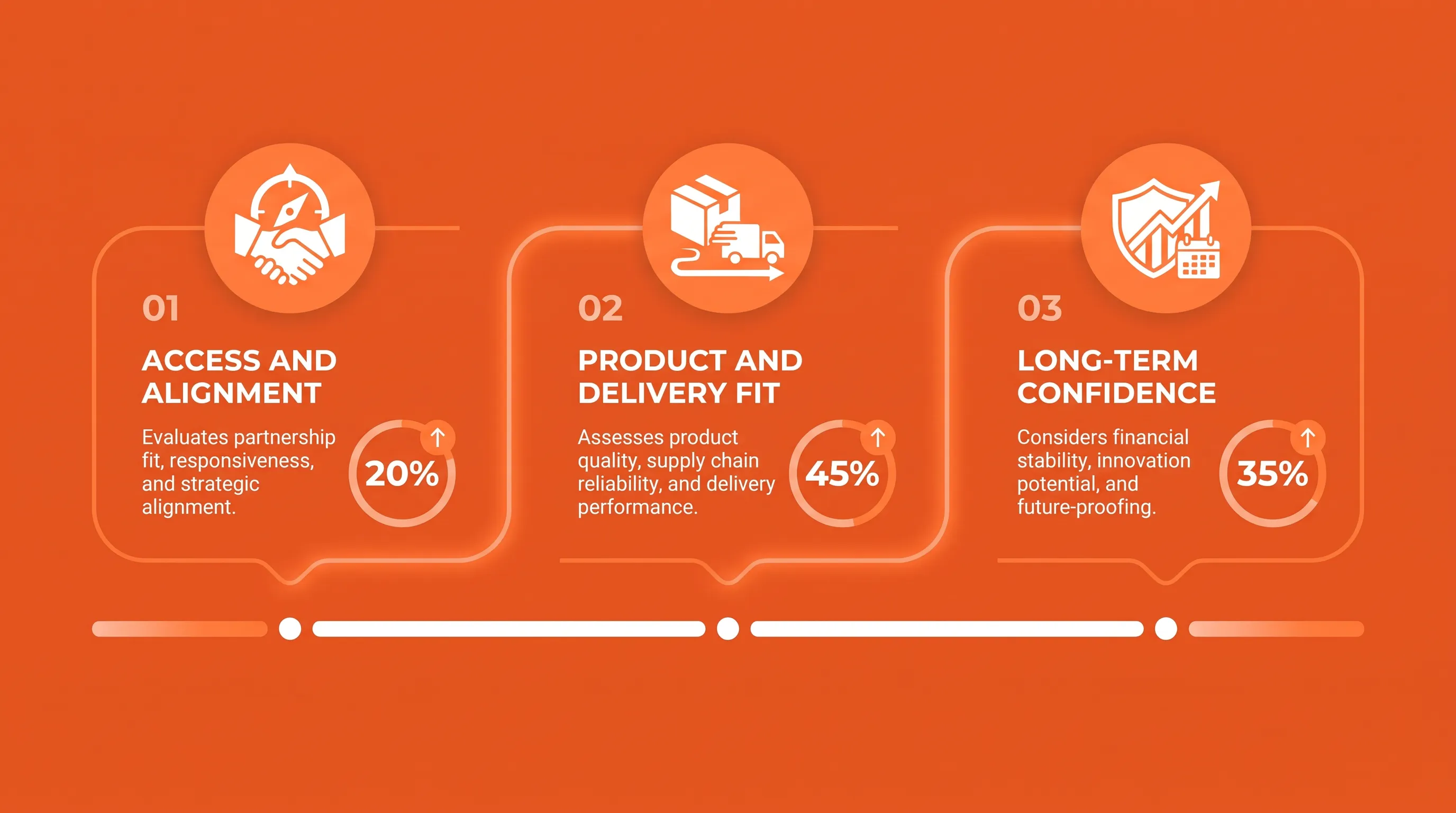
Infographic with a flat design style, featuring a warm orange background and white icons, detailing a sequential process.

Scoring beats instinct because it forces you to say out loud how much proximity is worth. Build a simple sheet and score each supplier out of ten on every factor. Weight the categories before you meet anyone. Setting weights afterwards just rationalises the choice you'd already made.

A defensible starting split for most projects looks like this:

  • Access and alignment: 20% of the total score

  • Product and delivery fit: 45%

  • Long-term confidence: 35%

Raise the access weighting only when regular physical presence is essential, which means on-site hardware or stakeholders who cannot or will not work through screens. Otherwise, the app developers near me shortlist should be decided by the other 80%.

Access and alignment

Score travel convenience honestly. A two-hour journey you'll make four times a year is not a meaningful cost. A two-hour journey you'll make weekly is a different proposition and belongs higher in the weighting.

Then score timezone overlap and workshop availability as separate lines. A local app development company wins easily on travel and can still lose on workshop availability if its senior people are committed elsewhere for the next quarter. Cultural fit is the softest line on the sheet and the one experienced buyers trust most, because it predicts whether difficult conversations will happen early or late.

Ready to bring your ideas to life?

Book a free 30-minute discovery call with our team — we'll understand your objectives and advise how bespoke software, MVP development, or an extended team can help your business.

Product and delivery fit

This is where the weighting sits, so score it in detail. Discovery approach and user focus each get their own line, as do comparable evidence and technical competence. Add project ownership, because "who is accountable when a sprint slips" has a name or it doesn't.

Governance and reporting deserve equal attention. Ask what a status report looks like and what triggers an escalation to a director. UK app developers with mature delivery processes will show you a real example.

Long-term confidence

An app is a commitment. Industry benchmarks put annual maintenance at 15-25% of the original build cost, and that spend continues for as long as the product lives. Score support capacity on whether the supplier has a dedicated support function or borrows developers from delivery teams when something breaks.

Financial stability is checkable in ten minutes. Companies House filings show status and accounts, along with directors and any charges against the company, and a pattern of late filings tells you something worth knowing. Score references and maintenance terms alongside it.

The last line on the sheet is the one buyers skip: how easily could you leave? If the answer involves undocumented code and accounts registered in the supplier's name, the score should reflect that.

Verify team transparency

Sales teams present their strongest people. Delivery teams are assembled later. The gap between those two facts causes more disappointment than any other part of supplier selection, and it's entirely preventable with three questions asked before contract signature.

Ask who will actually do the work, by name and role. Ask where each person sits and where any subcontractors sit, because a supplier presenting itself as one of the local UK app developers may be planning to route 70% of the build through a third party you've never assessed. Ask who owns technical decisions when the client and the developer disagree.

Then ask whether the people in the room today will still be on the project in month three. Write the answer into the contract as named key personnel with a notice requirement for changes. A local app development company that resists naming its team is telling you the team doesn't exist yet, which is useful information if you plan around it while comparing app developers near me.

Subcontracting isn't the problem. Undisclosed subcontracting is. Under the UK General Data Protection Regulation (UK GDPR), if your app handles personal data, the Information Commissioner's Office requires that a processor must not engage a sub-processor without your written authorisation, so you need the full chain visible anyway.

Check commercial safeguards

Security evidence should be proportionate to what your app handles. For most SME projects, Cyber Essentials is the sensible floor, and the National Cyber Security Centre now calls on industry to make it a standard requirement for suppliers. Liz Lloyd, the cyber security minister, noted that only 14% of firms are on top of the risks posed by their immediate suppliers, which is a low bar to clear by simply asking for a certificate.

Intellectual property is where UK buyers get caught. Under section 11 of the Copyright, Designs and Patents Act 1988, the author of a work is its first owner, and the government's guidance confirms that for commissioned work the creator owns it unless you agree otherwise in writing. Paying an invoice does not transfer copyright. Your contract has to say so explicitly, and it should cover designs and documentation.

Alongside assignment, secure the practical control that makes ownership real:

  • Source code in a repository your business owns, with administrator rights held by your team rather than the supplier's

  • App Store, Play Store, cloud hosting and domain accounts registered to your company from day one

  • A written list of third-party licences and subscriptions, with renewal dates and who pays for them

  • Acceptance criteria defined per deliverable, so "done" is a test result

Handover terms and support levels belong in the same conversation. So does total lifetime cost, which is the build price plus three years of maintenance and hosting, along with licences and the app store compliance work nobody quotes for. Apple reviewed 7.77 million submissions in 2024 and rejected 1.93 million of them, so budget for at least one resubmission cycle and agree in advance who absorbs that cost.

Shortlist app developers near me

By the first call you should already know what you're testing for. Work through these eleven points and take notes you can compare side by side afterwards:

  1. How do you run discovery, and what do you produce at the end of it?

  2. Which two projects of yours are closest to this one in shape and sector?

  3. Who exactly would work on this, and where are they based?

  4. What delivery model do you use, and how many in-person sessions are included?

  5. What are the three biggest risks you see in our brief right now?

  6. What's the reporting cadence and how do issues escalate?

  7. What budget assumptions sit behind your estimate, and what would change them?

  8. Who owns the code and the intellectual property?

  9. What security certifications do you hold, and how do you handle personal data?

  10. What happens in the four weeks after launch, and what does it cost?

  11. Which three clients can we speak to without you present?

Any supplier among the app developers near me who answers all eleven without defensiveness has earned a second meeting. A local app development company that bristles at question three or question eight has answered a different question entirely, and you should weigh that answer accordingly when you compare the app developers near me options in front of you.

Make the final choice

Pick the partner who will work best with you over two years. The scorecard exists to keep that decision honest when a persuasive sales meeting tempts you to shift the weightings after the fact.

If you're weighing proximity against capability on a live brief, arrange a discovery conversation with Evolved Ideas. It's a free 30-minute call, and you'll leave with a clearer view of the delivery model that suits your project, whichever app developers near me you eventually choose.

Ready to bring your ideas to life?

Book a free 30-minute discovery call with our team — we'll understand your objectives and advise how bespoke software, MVP development, or an extended team can help your business.

Yes. When comparing app developers near me, ask how they test screen-reader access and keyboard navigation. Request a sample accessibility report and confirm which standard they use, such as WCAG 2.2 AA. Include accessibility checks in discovery and acceptance testing.

Compare quotes only after normalising their assumptions. Put scope, milestones, team allocation, exclusions, VAT, hosting, support, and change-request rates in one table. Ask each supplier to price the same written scenario. The lowest total is useful only when the included work matches.

Ask references about the supplier’s behaviour after launch, not only the build. Check whether defects were resolved within agreed times, invoices matched expectations, and the client retained access to code and accounts. Speak with a reference whose project is at least six months old.

Bring representative users into discovery before the backlog is fixed. Give them realistic tasks and record where they hesitate, use workarounds, or need support. The findings should change priorities, terminology, or acceptance criteria. Ask the supplier how it will recruit users and protect participant data.

A short paid pilot is useful when requirements or integrations remain uncertain. Define one narrow outcome, a fixed time limit, the evidence required, and decision rules before it starts. Treat pilot code as disposable unless its quality, security, and ownership standards match the planned production build.

Schedule a Discovery Call

Book a free 30-minute call that works for you

You Might Also Like

Discover more insights and articles

Over-the-shoulder view of hands typing on a laptop in a modern tech studio, with multiple screens displaying code and a coffee cup nearby.

Flutter vs React Native for B2B Mobile Apps: A Buyer’s Decision Guide

Picking a mobile framework by gut feel is how commercial trade-offs get made by accident. This guide translates the technical differences between the two leading options into terms that matter before you brief suppliers: cost, timeline risk, and talent availability. It includes a weighted scoring method you can run against your own requirements to reach a defensible decision rather than a default one.

A modern office space with an IT consultant discussing disaster recovery plans, featuring a laptop and collaborative professionals in the background.

RTO vs RPO: Setting Recovery Targets for Business-Critical Software

Every resilience conversation eventually needs to answer two questions: how long can this system be down, and how much data can you afford to lose? Here's how to turn those questions into numbers the board will actually sign off on.

A modern tech startup workspace with exposed brick, featuring diverse professionals collaborating around sleek devices and a central digital tablet.

AI Governance Framework for SMEs: Controls That Scale With Adoption

Most AI governance frameworks are built for enterprises with dedicated compliance teams. But what about lean teams that prioritise a fast pace? Here's an alternative: risk tiers to triage exposure, and a phased rollout sized for smaller organisations.

A modern tech startup office with a premium desk split into two zones, featuring a biometric login laptop and an access management dashboard.

Authentication vs Authorisation: What Business Software Teams Need to Get Right

Authentication and authorisation solve different problems: verifying who a user is and deciding what they can access. Understanding the difference helps you assess the cost and risk of getting either one wrong.