Systems that don't talk
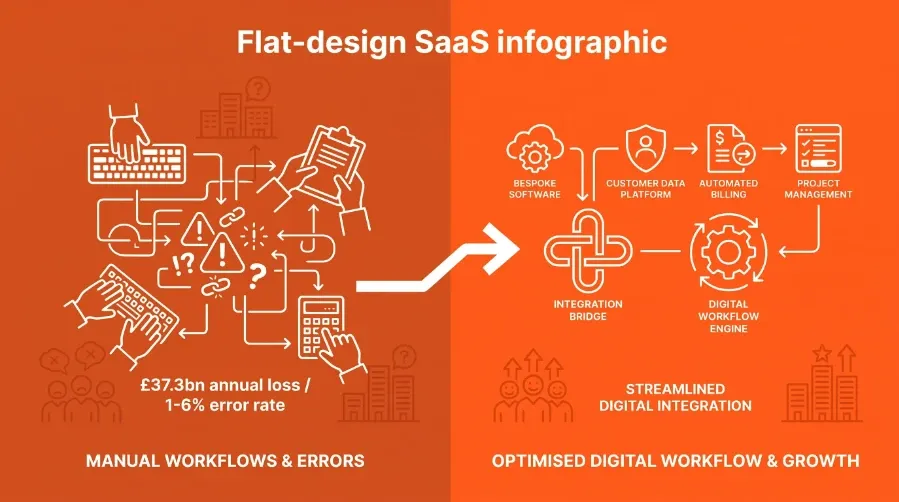
The second signal is integration. Your CRM does not talk to your finance system, which does not talk to your operations tool, so someone re-keys the same order into three places and reconciles the differences by hand. Reporting means exporting from each system and stitching the numbers together in a spreadsheet on a Friday afternoon.
That manual bridging is expensive and error-prone. Research cited by Red Eagle Tech found UK businesses lose £37.3 billion a year to human error in manual data entry alone. Manual entry itself carries error rates of 1 to 6 percent, which is enough to trigger wrong invoices and customer complaints.
Bespoke software development UK earns its place here as a connecting layer. It sits between the SaaS tools you already pay for and makes them behave as one operational flow. You keep Xero and your CRM. You stop paying people to copy data between them.
Data you don't fully own
The third signal is control. If your business depends on a vendor's platform for data you need to own and build on, you are more exposed than you think. Limited access to your own customer and transaction data constrains your reporting and future options.
That lock-in becomes a real problem the moment you want to do something the vendor did not anticipate. You cannot analyse what you cannot reach, and switching costs climb the longer you stay. For a growing business, operational data is a core commercial asset, and renting access to it indefinitely is a weak position.
A bespoke software development UK build puts that asset back under your control. You decide the structure and what gets built on top of it, which matters when the data is central to how you compete.
Growth your tools can't handle
The fourth signal is scale. The stack you chose at ten staff starts to break at fifty. Per-user SaaS pricing that looked cheap balloons as headcount grows, and manual steps that were fine for a small team become bottlenecks that need a dedicated person to manage.
This is the common story for a scaleup. The tooling was chosen for a smaller version of the company, and now it adds friction. Bespoke software development UK can automate the repetitive work and scale with the operation instead of charging you more for every seat you add.
The stakes are higher than they look. The MIT report on the state of AI in business found that tools built to fit real workflows delivered value, while 95% of pilots that were bolted onto existing processes produced no measurable financial return. Software that fits how you work is the difference between automation that helps and automation that stalls.
What bespoke software development UK actually costs
Most agencies dodge the cost question until you are deep in a sales conversation. Here are the directional numbers, so you can budget and set board expectations before you talk to anyone.
Bespoke software development UK pricing spans a wide range because scope varies so much. The costs can run from around £10,000 for simple internal tools to over £500,000 for enterprise systems, with a typical customer-facing web application sitting between £30,000 and £100,000. Developer day rates fall between £300 and £900. And location matters more than most buyers realise, because development rates in northern UK cities run lower than London, at £40 to £90 per hour against £100 to £150 in the capital.
Four factors move those numbers:
-
Feature depth, because every screen and edge case adds build and testing time.
-
The number of integrations to existing systems, since each connection has to be built and maintained.
-
Compliance requirements, which push regulated builds toward the upper end.
-
Design quality, particularly for anything customers will see and use themselves.
The number people forget is the running cost. The industry benchmark for annual maintenance is 15% to 25% of the original build cost per year, which covers security patches and dependency updates. A £50,000 platform carries roughly £7,500 to £12,500 a year in upkeep before you add new features. A cheaper build that carries 40% annual maintenance costs more over its life than a higher-quality build at 15%, so the right question is the software's total cost of ownership.
The practical move is to start small. Start with the distinctive piece that proves value, then expand once live use shows what it saves and confirms the return. That approach also happens to be how the successful projects behave. The Standish Group's CHAOS research, drawn from 50,000 projects, found small projects succeed more often than large ones, while 66% of technology projects end in partial or total failure because of incomplete requirements. Scope discipline is how you avoid becoming that statistic.