Choosing a Logistics Software Development Company for Connected Operations

Content authorBy Lincoln WoolseyPublished onReading time10 min read
A team of three collaborates over a laptop displaying programming code in a modern office with natural light and exposed brick walls.

Outgrown your spreadsheets and patchwork of point tools? Start by mapping the capabilities your operation depends on, so your specification reflects how work actually moves. Then put prospective development partners to the test and see whether they understand transport, not just software.

Why connected operations matter

Choosing a logistics software development company starts with a question that isn't technical at all: what happens when a delivery fails at four o'clock on a Friday? In a fragmented setup, the answer involves a phone call and a record re-keyed into a system nobody fully trusts.

Stale data is the expensive part. Depot staff quote availability from last night's stock file while the customer finds out about the delay after the window has closed, and by then the exception has already cost you a reschedule.

Generic process automation moves a task along a fixed path. Logistics doesn't behave that way, which is why transport management software has to keep stock positions and customer promises aligned while both keep changing by the hour.

Map logistics capabilities
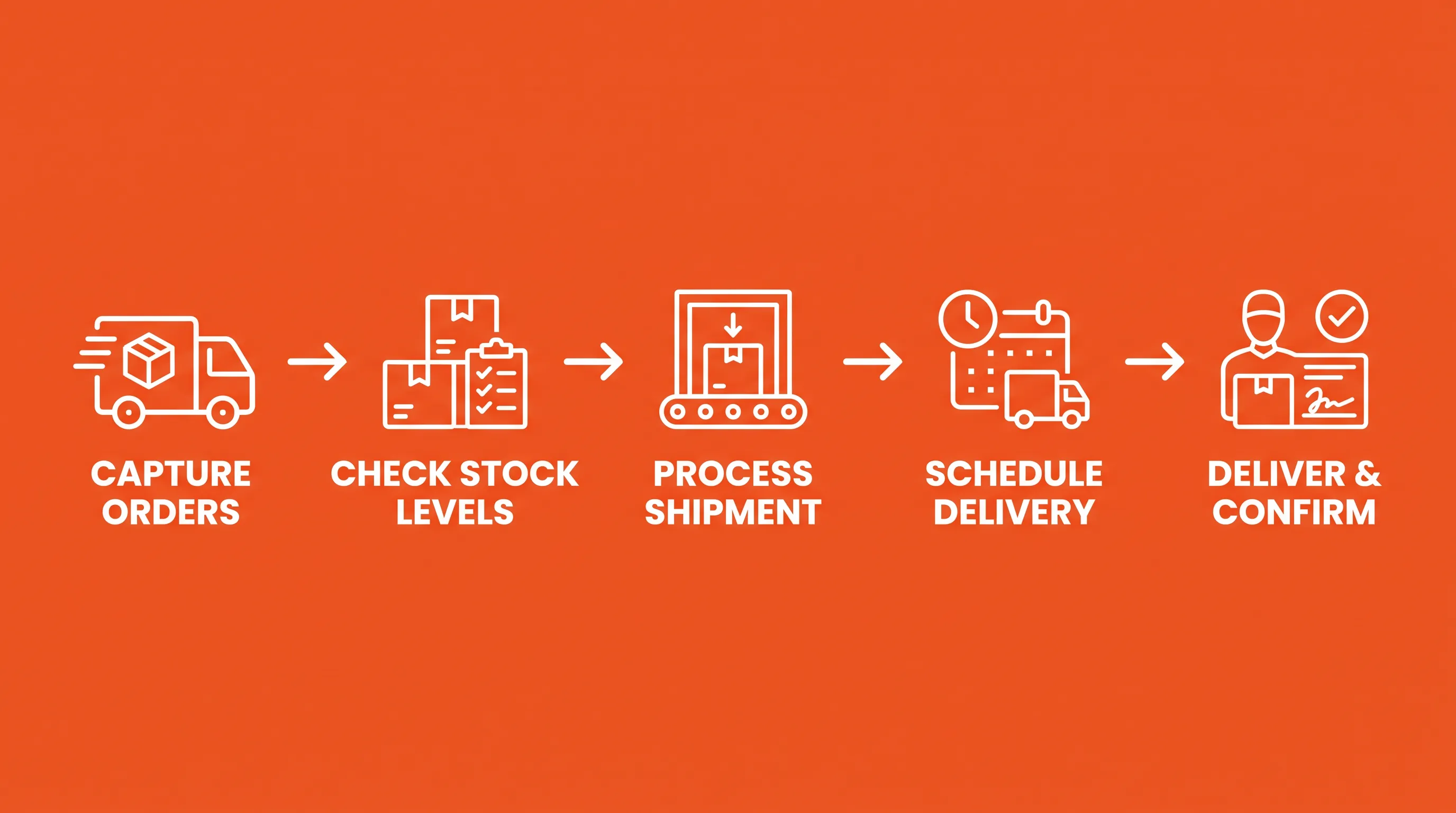
Infographic with bright orange background showing a step-by-step logistics process using white line icons and bold sans-serif text.

Before anyone draws an architecture diagram, write down what your operation actually does, in the order it does it. The sequence runs from order receipt to the update that reaches the customer. Every handoff between those steps is a place where information either survives or gets retyped.

The waste is measurable at sector level. GB-registered heavy goods vehicles ran 5.9 billion kilometres empty in 2025, roughly 31% of all kilometres travelled, and a good share of that comes from planning decisions made without current information. A logistics development company worth hiring will ask about those gaps before it asks about your preferred technology stack.

Split your map into two columns. Essential operational functions are the ones that stop the business when they fail:

  • Order capture and allocation against real stock positions

  • Dispatch and load planning, including same-day rescheduling

  • Delivery confirmation that holds up as evidence in a billing dispute

  • Status updates that reach the customer without someone sending an email

Optional enhancements come second. Carbon reporting and driver scoring earn their place later, once the core record is reliable.

Planning and inventory

Order intake sets everything downstream. If availability is calculated from a nightly file, your allocation logic is working with yesterday's truth, and your dispatchers will keep building loads that the warehouse can't fulfil. That's the single most common root cause behind a "routing problem" that turns out to be an inventory problem.

Load planning and routing depend on the same discipline. Transport management software needs vehicle capacity and the actual pick status of each order, and it needs them at the moment the plan is built rather than at midnight. Where rescheduling happens, the exchange has to run both ways, because a changed drop time affects warehouse pick sequencing.

Be specific about frequency when you write this down. Transport management software that polls a warehouse system every four hours is fine for next-day consolidation and useless for same-day amendments, and only your operation can say which one you're running.

Execution and visibility

Drivers are your most data-rich users and your least forgiving ones. A mobile app that assumes constant connectivity will fail in rural Britain, where 81% of the UK landmass had 4G coverage from all operators as of July 2025. Offline capture with deferred sync is the baseline, and experienced logistics software developers design for it from the first sprint.

Telematics and geofencing earn their keep when they trigger something. An arrival event that just sits in a log is decoration. An arrival event that closes a job and pushes a notification to the consignee is operational.

Decide which events genuinely need to be real time. Delivery completion and ETA changes affect a customer within minutes, so they belong in the live stream. Fuel readings and driver behaviour scores can batch overnight without anyone noticing.


Ready to bring your ideas to life?

Book a free 30-minute discovery call with our team — we'll understand your objectives and advise how bespoke software, MVP development, or an extended team can help your business.

Enterprise connections

Nothing you build will live alone. Enterprise resource planning and warehouse management have to meet somewhere, and that meeting point is where projects quietly fail. A peer-reviewed 2024 review of ERP implementations ranked integration challenges first among the factors that derail delivery.

Ask about mechanism. Bobby Harris, chief executive of BlueGrace Logistics, was blunt about the old standard in an interview on electronic data interchange versus application programming interfaces: "It's popular to say what's outdated is the technology of EDI, but it's because it's true. It's a dying technology that doesn't serve any more purpose as soon as we can replace it with an API."

For each connection, record who owns the data and what happens when it returns an error at two in the morning. A logistics software development company that can't answer the error-handling question in plain language hasn't built enough of these. Its integration capability should be clear before work begins.

Set technical requirements

Now translate. Each operational need becomes a requirement you can test. "Dispatchers need current stock" becomes a defined sync interval with a maximum acceptable staleness. "Drivers work in signal blackspots" becomes a queue-and-replay specification with conflict rules for when two devices update the same job.

Compliance is where UK and European operations get concrete. Since the 19 August 2025 deadline, vehicles over 3.5 tonnes on international work have needed a second-generation smart tachograph, and drivers on UK/EU journeys must produce 56 days of records instead of 28. If you're in DVSA-earned recognition, your system reports maintenance measures where the threshold is 100% of safety inspection records, every four weeks, with no manual tidying.

Location data about a named driver is personal data, so vehicle tracking sits under UK GDPR and the ICO's guidance on monitoring in work vehicles. Build the retention rules and the access controls into the specification rather than bolting them on at user acceptance testing. Good logistics software developers will raise this unprompted.

Write the non-functional requirements down too, because transport management software is judged at peak and not at average. Peak concurrent users on a Monday morning and acceptable page load on a five-year-old rugged handset. Your technical requirements should make those limits testable.

Logistics software development company fit

A portfolio of features tells you what a supplier has shipped without showing whether they've argued with a carrier's API about duplicate tracking events, or watched a driver try to capture a signature in the rain. Relevant workflow experience is the thing that shortens discovery and prevents the rework that turns a nine-month build into an eighteen-month one.

The money backs this up. Research by McKinsey with the University of Oxford across more than 5,400 large IT projects found they ran 45% over budget and delivered 56% less value than predicted, with poor grip on content and requirements accounting for about half of the overspend. Choosing a logistics development company on domain fit is a cost control.

Look at how the supplier runs discovery. Do they sit in the transport office for a day, or do they send a questionnaire? Ask which architecture decisions they'd defer and which they'd lock early. Ask how operators get involved in testing and how a release reaches depot staff who have run the old way for fifteen years. A development company that treats change management as your problem has told you something useful.

Ready to bring your ideas to life?

Book a free 30-minute discovery call with our team — we'll understand your objectives and advise how bespoke software, MVP development, or an extended team can help your business.

Assess logistics software developers

Interviews beat brochures. Put the questions in a form that can't be answered with terminology, and listen for reasoning rather than reassurance:

  1. Describe a comparable build. What was the order volume, and what was the hardest part?

  2. Tell me about an integration that failed in production. What was the root cause, and what did you change?

  3. How would you architect live ETA updates for 200 vehicles, and what would you do differently at 2,000?

  4. How did you test your last mobile app in the field, and who held the device?

  5. What trade-off did you recommend against the client's wishes, and what happened?

Confident promises are cheap. Logistics software developers who have done this work will volunteer the constraints, because they've been caught by them before.

Review support ownership

Day two matters more than day one. Agree incident response times by severity, who monitors what, and whether integration maintenance sits inside the retainer when a carrier changes its API without warning. Security patching and knowledge transfer to your own team need naming in the contract.

Ownership deserves its own conversation. Source code and cloud infrastructure accounts should belong to you, with a written exit path. Ask a logistics software development company how a client has left them, and listen to how comfortable the answer sounds. Logistics software developers who build for handover write differently from those who build for lock-in. Clear ongoing support terms are part of that assessment.

Build the supplier scorecard

Score candidates against weighted criteria so the decision survives contact with a persuasive sales meeting. Weight the categories by your own risk, and keep the evidence column filled with things you saw rather than things you were told:

  • Logistics domain expertise and workflow discovery quality (25%)

  • Integration capability and architecture reasoning (20%)

  • Delivery evidence, testing depth and field validation (15%)

  • User experience for drivers and depot staff (10%)

  • Security, access control and resilience (10%)

  • Support model and ownership terms (10%)

  • Commercial transparency and total cost of ownership over five years (10%)

Total cost of ownership is where the comparison flips. Hosting and the internal time your operation spends on the project belong in the figure. A logistics development company that volunteers these numbers before you ask is showing you how it will behave later.

Validate before committing

Test the supplier on your worst day. Run a scenario workshop using real disruptions: a driver loses connectivity mid-route, and two systems disagree about stock. Watch how they reason through each one.

Then add reference calls with operators rather than sponsors, and a paid prototype that touches one real integration. Gartner's December 2024 survey of 506 supply chain leaders found only 19% fully integrate scenario planning into strategy, and the same gap shows up in procurement. A separate Gartner study of 579 practitioners found 29% of supply chain organisations had built the capabilities tied to future performance.

Phase the delivery after that. Confidence in UK logistics sat at 40.4 on the Barclays index in 2025, its lowest in fourteen years, yet 86.5% plan to invest in at least one digital improvement within two years. Phasing lets you prove value on one depot before committing the network, and it gives transport management software a chance to earn trust from the people using it. Any logistics development company confident in its work will welcome that structure.

Map workflows with Evolved Ideas

Sector-wide, logistics generates £170 billion for the economy, and most of the friction inside it is data moving badly between systems that were never designed to talk.

Evolved Ideas has built bespoke operational software and integrations for UK and European businesses since 2007, from our Leicester base with extended engineering teams across Europe. Before you define scope or shortlist anyone, talk to us about mapping your current workflows and data gaps, so your brief to any logistics software development company starts from evidence rather than assumption.

Ready to bring your ideas to life?

Book a free 30-minute discovery call with our team — we'll understand your objectives and advise how bespoke software, MVP development, or an extended team can help your business.

Include your operating model, transaction volumes, user groups, integrations, compliance duties, service targets, and acceptance tests. State what must work at launch and what can wait. This gives each logistics software development company the same basis for estimating delivery effort, risk, support, and five-year cost.

Compare quotes only after aligning scope and assumptions. Ask suppliers to separate discovery, build work, and ongoing costs, then identify what each price includes for integrations, migration, testing, and support. Record internal staff time separately and compare the five-year total rather than the initial build price.

Replace a transport management system when its operational limits create recurring costs that exceed migration risk. Review failed integrations, manual re-entry, support status, security gaps, and data export options first. A replacement decision should include a tested migration plan, not only a feature comparison.

Yes, a pilot can test fit before a network-wide rollout. Use one representative depot and one live integration. Measure dispatch time and offline recovery, then gather structured user feedback. Set a time limit and exit criteria before development starts, so the result guides the next investment.

Yes. [Evolved Ideas](https://evolved-ideas.com/contact-us) can help map workflows and data gaps before you issue a brief. That conversation should clarify operational priorities, integration boundaries, and the evidence needed from shortlisted suppliers. You can use the resulting map with any provider, whether or not Evolved Ideas becomes your development partner.

Schedule a Discovery Call

Book a free 30-minute call that works for you

You Might Also Like

Discover more insights and articles

A designer sketches app concepts on a tablet at a sleek black desk in a modern office with exposed brick walls and natural lighting.

Best Mobile App Developers UK: A Transparent Evaluation Framework

Choosing among the best mobile app developers in the UK? Send every agency the same brief so their answers compare like for like. Then weight your scoring toward your product’s real risks, so you can verify a shortlist’s claims before you sign.

A developer writes code on a large monitor at a sleek black desk in a warm, modern office with exposed brick walls.

How to Choose a Cross-Platform App Development Company

Code reuse looks impressive in a pitch, but it says little about whether a supplier can ship a production iOS and Android app and keep it running after launch. Test the claim directly. Ask for evidence of apps already live in both stores and under real maintenance, then score the bids against the same criteria so they can be compared fairly. Know in advance which signals should end a conversation early, so you don’t spend weeks on a supplier who was never going to pass.

A programmer types on a laptop at a sleek black desk in a modern office, with dual monitors displaying code and natural lighting.

Hire Python Developers: Define the Role Before You Compare CVs

Vague Python job specs attract vague CVs, and screening them becomes guesswork. Fix the problem upstream by specifying the role precisely before any CV reaches your inbox. A role worksheet pins down what the job actually requires, and a weighted capability scorecard then tests what candidates did in production rather than which frameworks they list.

A project manager reviews specifications on a laptop at a modern conference table, surrounded by digital displays and tablets in a tech-focused office.

How to Choose an Ecommerce App Development Company for Complex Commerce

Most agency pitches look equally polished, and polish says little about whether a supplier can handle your custom pricing rules, your ERP, or your fulfillment edge cases. Evaluating an ecommerce app development company starts with mapping your requirements, especially the custom rules and deep integrations where projects tend to fail. Then score each shortlisted supplier against business risk instead of presentation quality.