Why you are asking this question
Most businesses arrive at custom software development the same way. A member of your team spends the first hour of every morning copying figures from one system into a spreadsheet so a second system can read them. Two reports that should agree never do, and finance ends up arguing about which number is real. The booking tool you chose three years ago now dictates how you sell.
And then someone in a meeting says it out loud: we should just build our own. As a non-developer, you're right to be cautious, because the average software project for a small company runs to $434,000, according to the Standish Group, and plenty of that money gets wasted.
What you need before you spend anything is commercial clarity, a way to tell whether your situation warrants a bespoke build or whether you'd be better off fixing what you already have. Building is only one option, and it's not automatically the right one.
What custom software actually means
Custom software is built around how your business works. Off-the-shelf Software as a Service (SaaS) does the opposite: you adapt your business to fit the vendor's template. A bespoke build shapes the tool to your workflow, while a SaaS subscription asks you to shape your workflow to the tool; custom software development gives you that control.
Three things get blurred together often. A fully custom build, configuring an existing platform, and stitching tools together with integrations. These are different amounts of money and risk.
Configuration is the cheapest and fastest. Integration sits in the middle. A full custom build is the largest commitment of the three. Keep that vocabulary in mind, because the rest of this article turns on knowing which one your situation actually calls for.
Signs a bespoke build is justified
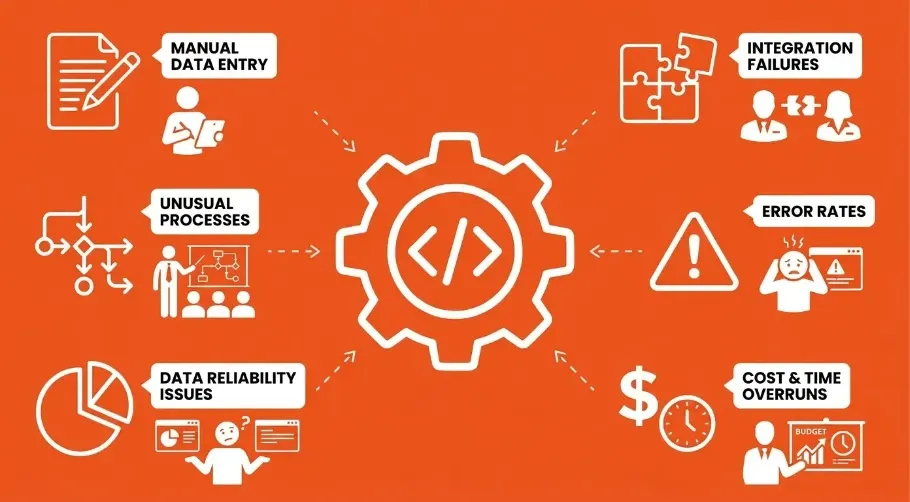
One signal on its own rarely justifies the cost of building. Any business can point to a frustrating tool or a report that annoys them. But when several of these signals show up together, and especially when they cluster around how you make money, the case for custom software development gets strong.
The pattern worth watching for is this: the break point comes when software sits close to your commercial advantage, or when your staff are manually holding your systems together with copy-and-paste. Run your own business against the situations below and count how many you recognise.
Your process is genuinely unusual
When a core workflow doesn't match any standard playbook, off-the-shelf tools force you into awkward compromises. You end up using a field for something it was never meant to hold, or running two tools side by side because neither does the whole job.
However, there's a caveat: a lot of processes might feel unique to you, but turn out to be standard once you examine them. Strip away the terminology your team uses and describe the process in plain steps. If a competent outsider recognises it as a common pattern, you don't need custom software for it. If they genuinely can't map it to anything standard, you need custom software.
Integrations keep breaking down
You run several systems that don't talk to each other, so people bridge the gap by hand. They reformat exports from one system before importing them into the next. When a vendor changes something, the fragile connection you rigged up stops working and someone spends a day fixing it.
The cost of this is bigger than it looks, and every mistake gets more expensive the later you catch it. Manual entry also drains money, with one survey putting the figure at $28,500 per employee each year. Add up the hours your team spends moving data between systems, then add the time spent finding and fixing the errors that movement creates. When that number is large and growing, a custom layer that unifies the flow starts to pay for itself.