How to evaluate a custom software development agency beyond the pitch

Content authorBy Lincoln WoolseyPublished onReading time9 min read
A client reviews two contrasting agency proposal binders at a wooden meeting table in a warm, naturally lit workspace.

Most custom software agencies talk a big game during the pitch. The ones worth hiring back it up with evidence. Here's what that proof looks like, and the warning signs that show up together when it's missing.

Why the pitch tells you so little

You have sat through the confident decks and the well-rehearsed case studies, and you still cannot say with any certainty which custom software development agency will actually deliver something that survives past launch.

Most failed builds collapse because scope was never pinned down and ownership lacked clear governance before work started. The Standish Group's CHAOS research, drawn from more than 50,000 projects, found that only 31% of software projects finish successfully, while 19% are cancelled outright. When McKinsey and the University of Oxford studied large IT builds, the average project ran 45% over budget and delivered 56% less value than promised.

Pitch means nothing without evidence. Here's how it looks.

What discovery-led delivery looks like

The single most telling signal comes early. Does the custom software development agency insist on real discovery before quoting a number, or does it hand you a firm price off a first conversation? A discovery-led delivery approach means the team invests in understanding your problem before it commits to a solution, and it produces something written you can hold them to.

Inaccurate requirements are the leading cause of failure. The Project Management Institute found that 37% of organisations name inaccurate requirements as the primary reason projects fail. A firm price given before anyone understands the requirements is a guess dressed up as a commitment, and you inherit the risk when the guess is wrong.

Discovery output gives you:

  • A written definition of the business problem and the outcomes that count as success

  • The scope broken into deliverables, with assumptions named openly

  • A view of how technical risks and integration points relate to the data the system depends on

Colette Wyatt, CEO of Evolved Ideas, puts the discipline plainly: "Distance is rarely the thing that causes delivery problems. Unclear ownership and inconsistent communication do far more damage." Discovery is where that ownership and communication get established. A software delivery partner that skips it is asking you to trust a number nobody has earned yet.

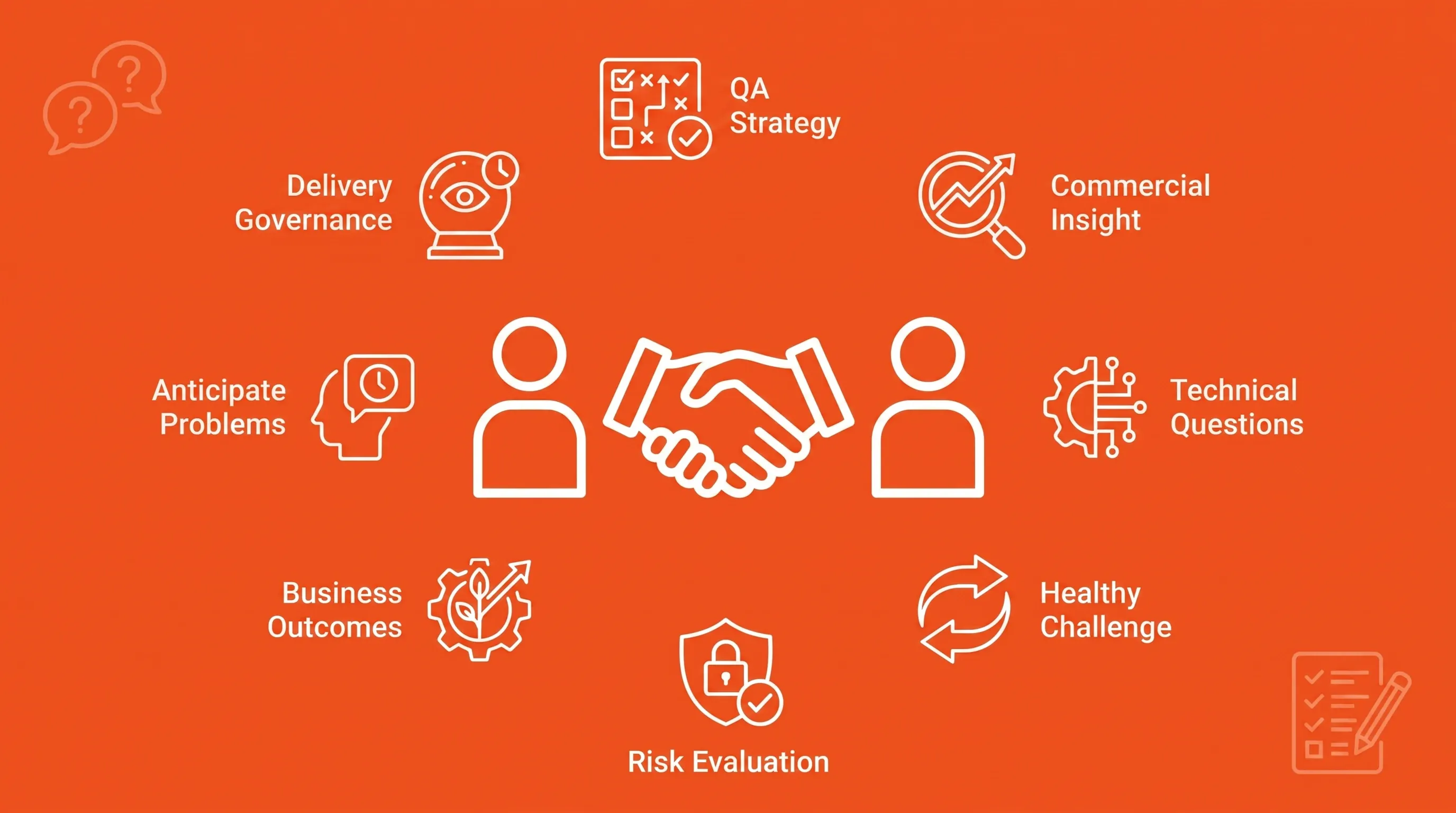
Evidence a serious agency should show

-e-x-t-e-r-n-a-l_-i-m-a-g-e_-t-o_-i-m-a-g-e-dd7f55f0-065c-4379-b3c3-32f322cc78e4.png

A vague answer to one question is survivable. Several are the most reliable predictor that a build is heading sideways.

What you're listening for is whether the team has done this before and remembers what went wrong. Confident specifics beat smooth generalities every time.

Ready to bring your ideas to life?

Book a free 30-minute discovery call with our team — we'll understand your objectives and advise how bespoke software, MVP development, or an extended team can help your business.

Commercial understanding

A strong software delivery partner talks about business outcomes and trade-offs before it talks about technology stacks. Listen for what the team asks you first. If they want to know how a project slip affects your revenue and which deadline matters to the business, they're thinking about what the build is meant to change commercially. If they only ask for a feature list, they're thinking about their invoice.

Ask directly: what happens to our numbers if this launches three months late? A team with commercial understanding will probe the answer with you and adjust the plan around it. An evasive team will nod and return to the feature list. The difference tells you whether they see the build as your investment or their contract.

Technical questioning

A serious custom software development agency pushes back. It asks hard questions about integrations and data quality. It also probes edge cases and disagrees with you when your assumptions don't hold. That challenge is a good sign, while a team that agrees with everything during sales is optimising for the close.

Healthy challenge is specific. "How does this behave when the payment provider times out?" or "That integration assumes clean data from your CRM, and it isn't clean, so how do we handle that?" If nobody on the other side of the table ever says "that will be harder than you think," you're not talking to people who have shipped much.

Delivery governance

Governance is how the custom software development agency handles change once the build is underway, and it's where scope creep and budget disputes begin.

Ask to see the artifacts that keep that under control:

  • A change request process where every change is priced and approved before it's built

  • Sprint or fortnightly progress reporting that shows what was built and what it cost. It also states what's next.

  • A named person you talk to when something slips, and a defined escalation path

Worst overruns tend to happen on projects with incoherent checkpoints, where months passed before anyone noticed trouble. Short feedback loops surface the problem in week two instead of month nine. Thin or informal governance is the opposite, and it's where budgets quietly break.

QA standards

A real quality approach shows up in the staffing plan. Look for test engineering as a named role and a stated position on automated testing versus purely manual checks. A proposal with no quality assurance (QA) strategy at all is a common and dangerous blind spot, because finding and fixing bugs is the single largest expense in the software lifecycle. The Consortium for Information and Software Quality put the cost of poor software quality in the US at $2.41 trillion.

You don't need to understand the tooling to ask a useful question. Try this: how will you prove to me that a new feature hasn't broken an old one?

Documentation and ownership

Confirm in writing who owns the code and the intellectual property when the project ends. The agreement also addresses architecture documentation. Without an explicit IP assignment clause, the vendor may retain ownership by default under copyright law in many jurisdictions, even though you paid for the work. Ownership also extends beyond code to project infrastructure and access.

The bigger risk is being held hostage by your own supplier. When a system can only be maintained by one person or a small group who keep the knowledge in their heads, switching partners becomes a separate project with its own cost and timeline. Usable documentation is a form of insurance. It's the thing that lets your internal team, or a future software delivery partner, pick up the work without starting over. Ask to see a sample of the documentation the custom software development agency delivers, not a promise that it exists.

Ready to bring your ideas to life?

Book a free 30-minute discovery call with our team — we'll understand your objectives and advise how bespoke software, MVP development, or an extended team can help your business.

Team continuity and support

Meet the people who will build the software alongside the people who sell it. Confirm that the developers in the room will stay on your project rather than being swapped out once the ink dries. Continuity protects the context that makes delivery fast, which is the point Colette Wyatt makes about the extended team model working best "when external developers are fully integrated into the delivery process."

Then press on what happens after go-live. Get a written service level agreement (SLA) that defines bug response and maintenance obligations before surprises arise later. A team that stays useful after launch is the whole reason you're being careful now. Support that only appears as an afterthought tells you the relationship was designed to end at launch.

How to spot a presentation-led supplier

Once you've asked these questions a few times, a shape starts to appear. The custom software development agency sells before it has done any discovery. It quotes a firm price fast, because a fast number wins the room even when it can't be trusted. It agrees with everything you say and glosses over how change and quality will be managed. And when you raise long-term ownership or support, it goes quiet or waves the question away.

Any one of those on its own can have an innocent explanation. What should stop you is the clustering. A proposal with a loose estimate and absent discovery-led delivery process reveals gaps in QA and ownership planning. This pattern identifies a team that sells better than it delivers, and it is not consistent enough to trust.

You'll feel it before you can prove it. The conversation stays smooth precisely because nobody is doing the hard work of pinning anything down.

Questions to ask before you sign

You don't need a technical background to run this conversation. Put these questions to any custom software development agency on your shortlist and grade the answers by how specific they are.

  1. What discovery will you do before you give me a price, and what document do I get at the end of it? A confident answer describes a defined process and a written artifact. An evasive one offers a number today.

  2. What happens to my business if this launches late, and how does your plan account for that? Confident teams probe the commercial stakes. Evasive teams return to features.

  3. Where do you disagree with what I've asked for? Confident teams name real trade-offs and risks. Evasive teams tell you everything is straightforward.

  4. How are changes priced and approved once we start, and how will you report progress? Confident teams show you the artifacts. Evasive teams keep it informal.

  5. How will you prove a new feature hasn't broken something that already worked? Confident teams describe automated testing. Evasive teams mention checking at the end.

  6. Who owns the code and the IP when we finish, and can I see a documentation sample? Confident teams put it in writing. Evasive teams stay vague.

If the answers stay specific under pressure, you've found a team that has done this before. If they soften into reassurance, you've learned something the pitch was designed to hide.

Choosing a partner that lasts

Step back and remember what you're actually deciding. You're choosing a relationship that has to hold up for years as the software changes after launch and staff turnover tests it. Evidence beats presentation because the team that takes time to challenge your assumptions and document their work is the one still useful to you long after the launch date.

Take the six questions above and run them against your current shortlist this week. Evolved Ideas works as a discovery-led delivery team that augments your in-house people and is built on nearly two decades as a software delivery partner. If you're weighing up a large build, it's worth talking to our team before you sign with any custom software development agency.

Ready to bring your ideas to life?

Book a free 30-minute discovery call with our team — we'll understand your objectives and advise how bespoke software, MVP development, or an extended team can help your business.

Ask for two client references from projects comparable in size and complexity. Speak with the people who owned the budget, then ask what changed after kickoff, how disputes were handled, and whether the same team completed the work. Public case studies don't answer those operational questions.

Check whether the estimate separates discovery from delivery costs and identifies third-party charges. A custom software development agency should state its assumptions, exclusions, and rate basis in writing. You can then compare proposals by scope instead of comparing headline prices that cover different work.

Ask who controls the cloud accounts and source-code repositories. Your organization should own the primary accounts, while agency staff receive role-based access. Require multi-factor authentication and a written offboarding process so access is removed when a team member leaves the project.

Ask before you sign the contract. An exit plan should state how code, documentation, credentials, and work in progress transfer if the relationship ends. It should also set a handover period and identify who pays for it, which avoids disputes during a supplier change.

Yes. Evolved Ideas can discuss a proposed delivery approach and the evidence you should request, including project documents and ownership terms. That conversation doesn't replace comparing written proposals, checking client references, and reviewing the contract with appropriate legal advice.

Schedule a Discovery Call

Book a free 30-minute call that works for you

You Might Also Like

Discover more insights and articles

A collaborative workspace with a wooden table covered in documents and sticky notes, featuring diverse team members engaged in discussion.

Product discovery: how to de-risk a software project before development

Before spending on development, the assumptions behind a software idea need testing. Learn how to frame the problem correctly and turn research findings into a scope developers can actually estimate against.

A warm, daylight-filled workspace features a wooden desk with a glass roadmap, sticky notes, and a diverse team collaborating.

Technical roadmap: turning software priorities into a practical delivery plan

A phased plan turns discovery findings into a scope, sequence, and funding path you can actually approve. See what belongs in each phase and how to invest in stages without pretending the plan is a fixed schedule.

A realistic workspace scene with a wooden conference table, professionals discussing a 'Software Audit Report' in warm daylight.

Software audit: when to review a codebase before rebuild, support, or scale

A software audit is worth the hassle when it answers a specific question: is this application safe to keep building on, or is it accumulating risk you can't see? Learn what an audit actually examines, the conditions that make one worth the spend, and how to translate technical findings into a decision the business can act on.

A modern tech startup office featuring a premium desk with a sleek monitor, three professionals engaged in various tasks, and natural light.

Application support for business-critical software: what should be covered

Learn what a complete application support service should cover once custom software goes live and becomes part of daily operations. Essential service areas, from monitoring and incident response to maintenance and reporting, show how agreed ownership turns ad hoc technical help into an accountable service.