Price tighter targets
Every hour you shave off an RTO buys you capacity you pay for whether or not you use it. A four-hour target for disaster recovery planning means documented restore procedures and support available during the window when the failure happens. A one-hour target means warm standby infrastructure and someone contractually obliged to respond at 3am. A target measured in minutes means running duplicate production capacity across zones or regions permanently.
The cloud pricing structure makes this explicit. Amazon's compute agreement offers a 99.99% Region-Level commitment only for instances deployed concurrently across two or more Availability Zones. Run a single instance, and you drop to a 99.5% Instance-Level commitment, which permits roughly 3.6 hours of unavailability per month before any credit is due. The stricter number is an architecture you fund.
Tightening RPO follows a different cost curve, driven by how often you capture data and where you put it:
-
Daily backups give you an RPO of up to 24 hours and cost little beyond storage.
-
Hourly or four-hourly snapshots narrow the gap considerably and add moderate storage and orchestration overhead.
-
Continuous replication to a secondary site pushes RPO towards seconds, and brings the operational cost of running and validating that replica indefinitely.
Near-zero on either measure of recovery time objective vs recovery point objective carries cost that rises far faster than the benefit. Replication also faithfully replicates corruption and ransomware encryption, which is why the National Cyber Security Centre's guidance insists on the 3-2-1 rule of three copies on two devices with one offsite, and on keeping at least one copy offline. An organisation with continuous replication and no immutable copy has bought a fast route to restoring bad data.
The British Library shows where the money actually goes when recovery has not been priced in advance. The October 2023 Rhysida ransomware attack forced a rebuild, and recovery has cost at least £7 million, around 40% of its unallocated reserves, with services still returning more than two years later.
Set defensible targets
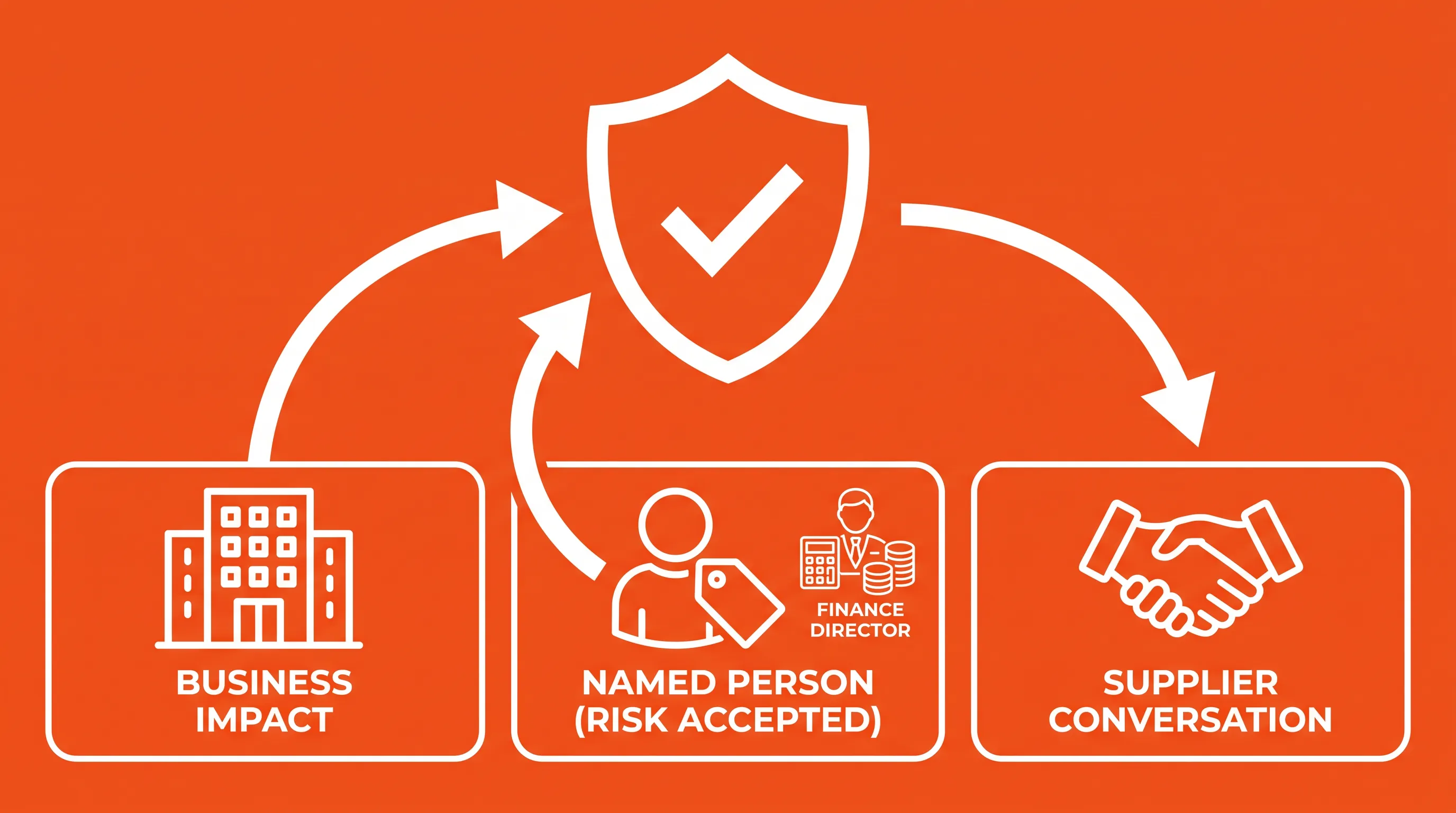
A defensible target survives contact with a finance director. That means it comes from business impact, and it carries a named person who accepted the risk. The sequence below produces targets you can take to a supplier conversation.
Business continuity impact
Start disaster recovery planning by mapping how the cost of an outage escalates. The first thirty minutes cost nothing because orders queue. Hour four triggers contractual penalties. Day two triggers press coverage. Work out the shape of that curve for each critical process from your own revenue per hour and the fully loaded cost of the staff who would be sitting idle.
Then identify the manual workarounds you genuinely have. NCSC chief executive Richard Horne put the requirement plainly when writing to UK business leaders: "Organisations need to have a plan for how they would continue to operate without their IT, and rebuild that IT at pace, were an attack to get through." Paper fallbacks buy you hours, and those hours belong in your RTO. Business continuity planning that ignores what staff can do offline sets targets tighter than they need to be.
The point at which disruption becomes unacceptable is a judgement about harm. For a clinical or safety-related system it arrives quickly. For an internal expenses tool it arrives in a week. Write down where that line sits and why, because that reasoning is what your board is approving.
Tolerable data loss
Convert data loss into a time value by working from transaction volume. If your platform processes 400 orders an hour at peak and each lost order requires a customer call to reconstruct, the labour cost of a two-hour gap is straightforward to calculate. Reproducibility matters as much as volume: data that exists in a supplier's system or in a customer's inbox is recoverable, while data that only ever existed in your database is not.
Reconciliation effort is the cost people consistently underestimate. Financial records that fall out of step with payment provider records take days of skilled finance time to align, and the work cannot be delegated. Add any legal obligation to retain complete records, and any scenario where a data gap causes direct harm to a customer, such as a missing safeguarding note or a lost medication record.
Take the largest acceptable figure across those tests and express it as a time for recovery time objective vs recovery point objective. Two hours. Fifteen minutes. Twenty-four hours. That number is your RPO, and it should be recorded next to the reasoning that produced it.
Map critical dependencies
An application-level target for recovery time objective vs recovery point objective means nothing if the components underneath it recover more slowly. Your map needs to cover databases and the integrations that carry data in and out. It also needs to cover people, because a four-hour RTO that depends on one engineer who happens to be on annual leave is not a four-hour RTO.
October 2025 made the argument better than any diagram. A race condition in DynamoDB's automated DNS management left an empty record for a regional endpoint, and the resulting failure ran for more than 15 hours for some customers. It took down Slack and Atlassian along the way. As Cisco ThousandEyes noted, the incident showed "how a failure in a single, centralized service can ripple outwards through dependency chains that aren't always obvious from architecture diagrams."
Your slowest dependency sets your real recovery time. If a third-party payment integration takes six hours to reauthenticate after a failover, your two-hour RTO is fiction regardless of how quickly your own servers come back.