Delivery and supportability
Delivery and supportability is the review area buyers overlook and regret overlooking. It covers environments and build and deployment pipelines. The review examines how release controls work with monitoring. It also considers the relationship between backups and incident handling. Rollback procedures complete the picture. It also asks the blunt question a support takeover depends on: does a new team have the access and written guidance required to operate this application safely without the original developer sitting beside them?
The honest answer is no. The problem is rarely an outdated README. It's knowledge that existed only in people's heads and architectural decisions made verbally and forgotten. Onboarding depended on one person's availability. That is the gap that turns a routine handover into a months-long recovery.
Manual processes and reliance on individual developers directly affect three things you pay for:
-
Service continuity, because a deployment only that one person knows how to run stops when they are unavailable
-
Takeover time, because a new team has to reverse-engineer what should have been written down
-
Ongoing support cost, because everything undocumented takes longer and carries more risk than it should
The delivery and supportability review tells you whether you are buying an application you can run, or a black box that comes with a person attached.
Evidence the audit should produce
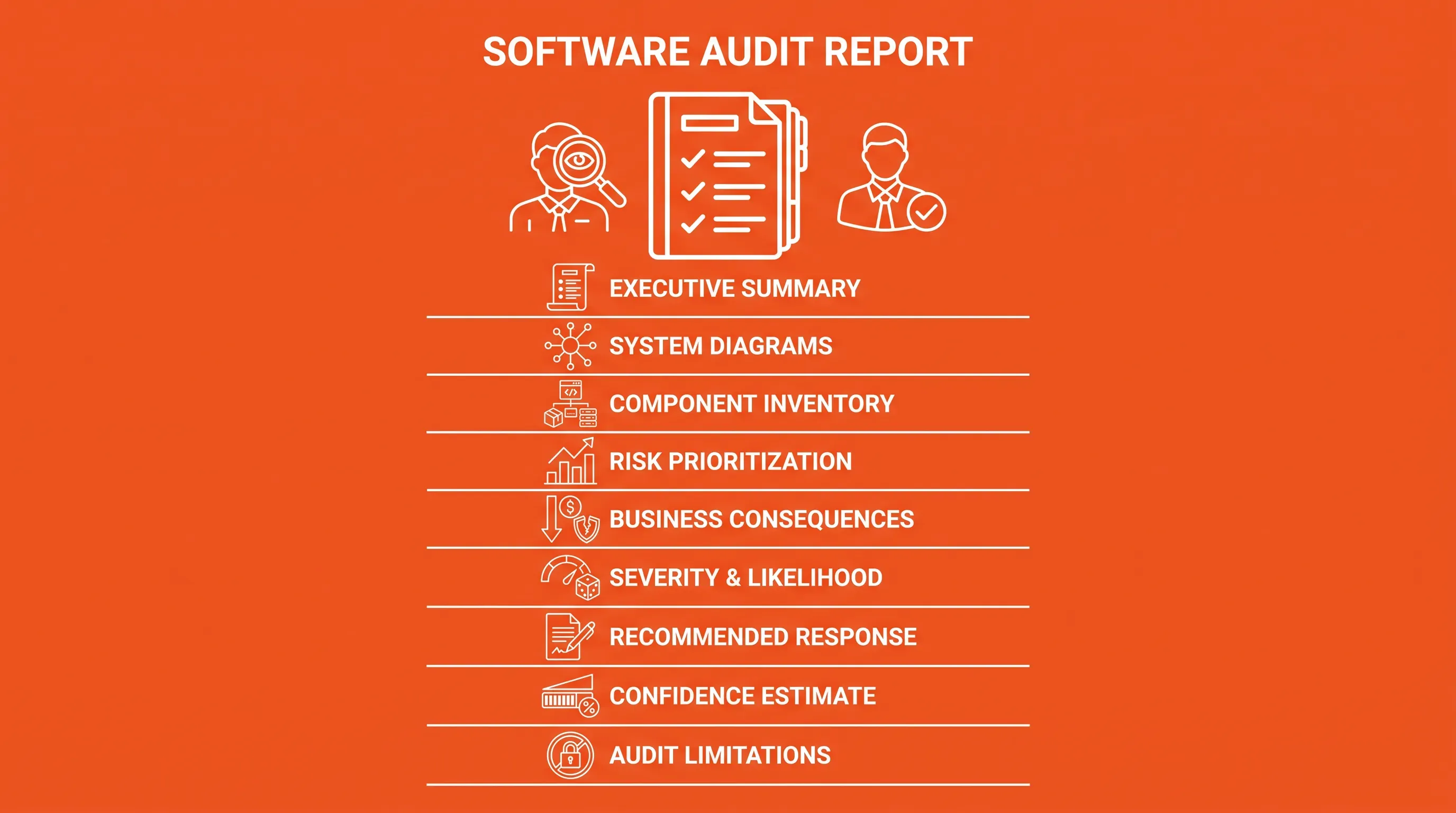
Pay only for a report you can act on. A credible software audit produces specific deliverables. An executive summary that a non-technical decision-maker can read and act on. System and data-flow diagrams. An inventory of components and dependencies. A prioritised list of risks with supporting observations, and an explicit statement of what the audit could not examine.
Every material finding must carry the same information so you can weigh it against every other finding:
-
Its business consequence, stated in plain terms of cost and continuity, with the effect on the roadmap made clear
-
Its severity and likelihood
-
The recommended response and a confidence-rated estimate of the effort range
The last requirement is the one that tells you the reviewer is being straight with you. A good report identifies missing access or evidence and distinguishes verified facts from assumptions. It provides enough traceability for another technical team to challenge the conclusions. If the auditor lacked access to the production telemetry, the report must say so and mark the affected findings as lower confidence. A software audit that presents every conclusion as certain, with no gaps and no assumptions, is either superficial or overselling.
Turn findings into choices
The findings exist to support a decision, and the decision is a comparison. You are weighing five technical paths against the application's business value and risk. The comparison also accounts for urgency and expected remaining lifespan in relation to the cost of change. The five paths begin with stabilise or maintain. From there, the options are modernise or migrate, with rebuild as the final path. Changing development partner sits alongside these as a delivery decision, not a sixth technical option, and it is worth being clear about why.
Changing partner can accompany any of the technical paths. It fixes a supplier problem. It does not fix a code or architecture problem on its own, and treating it as a remedy for both is how buyers end up disappointed with a new supplier inheriting the same mess. Decide the technical path from the evidence first, then decide who delivers it.
The rebuild option deserves particular caution, because the instinct to start fresh is strong and the odds are poor. The Standish Group found that 70% of manual software rewrites fail, and modernisation platform data shows that 67% of full rewrites exceed their initial budget by 50% or more. This is why the incremental strangler fig pattern, it ships value in waves and limits each cutover to a small piece that you can roll back. The software audit must tell you whether your application genuinely needs a rebuild or whether modernising in place carries less risk for less money.
The practical tool is a decision table. List each option and link it to the supporting evidence and required prerequisites. Then set out the indicative cost and time ranges, followed by the transition risk and consequences of doing nothing. That last column is the one buyers skip, even though inaction has a cost too. Sixty per cent of CIOs told McKinsey their technical debt had grown over the past three years, which is what happens when the do-nothing option wins by default.
Commission the software audit
Brief the auditor around the decision you are making. Tell them whether the decision concerns scaling or taking over support. If it concerns a partner change or rebuild, say so, and give them the relevant growth or service targets. A software audit scoped to a real decision produces a usable report. An audit commissioned as a generic review produces a document that sits in a drawer.
Before work starts, agree the terms in writing. Cover the following so there are no surprises when the report lands:
-
The scope and methods the audit will use, plus a statement of its exclusions so everyone understands its boundaries
-
Deliverables and confidentiality, and how findings will be validated
-
The access the reviewer needs to code and infrastructure, together with the required documentation and telemetry. Identify the knowledgeable staff who must be available.
Check that the reviewer combines architecture and security experience with a strong operational background. A codebase audit run by someone strong on code but weak on infrastructure will miss the delivery and supportability gaps that cost you most in a handover. Ask what they will do when they hit a locked door, because how a reviewer handles missing access tells you how honest the final report will be.
Run an independent, time-bounded assessment before you commit to any costly remedy, then use it to build a roadmap that assigns immediate risk controls first and the next investment decision second. Evolved Ideas works with CTOs and product owners as a delivery and consulting partner. It also works with operations leaders to reduce risk and augment in-house teams. If you are weighing a rebuild or migration, or if you plan to change supplier, it is worth talking to our team about an independent software audit before you spend on the fix.