Software development company in UK: how to choose a partner for complex projects

Content authorBy Lincoln WoolseyPublished onReading time12 min read
A UK project leader reviews a tablet at a modern tech startup office, surrounded by abstract panels representing decision criteria.

Learn how to predict whether a complex, business-critical build succeeds, from discovery and architecture through governance. Discover why a growing number of UK buyers pair UK accountability with a European delivery team, and how to run your own shortlist against a concrete set of questions.

Why the cheapest quote is the wrong test

You own a build that matters. It connects to systems you already depend on, it carries real money or real compliance risk, and if it slips or breaks, the business feels it. And yet the process pushing you along wants you to compare vendors on two numbers: the price at the bottom of the proposal and the headcount they can throw at it. When you are choosing a software development company UK buyers can trust with something this exposed, both numbers mislead you.

The lowest quote almost always hides the work nobody wanted to price. It means skipped discovery and thin testing. Your budget pays for a junior team to learn your domain. The largest software development company in the UK has the opposite problem, where your project becomes one account among hundreds, and the senior people who won the pitch quietly hand you to whoever is free. The odds here are sobering. The Standish Group's 2020 CHAOS report, drawn from around 50,000 projects, found only 31% succeed outright, while large projects succeed less than 10% of the time.

The best software partner option is the one who understands the business problem underneath the feature list, the delivery risk you are actually carrying, and how the thing gets supported once it is live. That fit is measurable. This article walks through the specific capabilities that separate a genuinely capable partner from a plausible-looking one, one at a time, so you finish able to interrogate any shortlist yourself.

What a complex project really demands

Complexity is not the same as size. A big project can be simple if it repeats a well-understood pattern. A smaller one turns complex when it has to integrate with a legacy system nobody fully documented and satisfy regulators. It also has to serve stakeholders who each define success differently. Those are the conditions that produce disasters. McKinsey and the University of Oxford studied 5,400 large IT projects and found they run 45% over budget on average while delivering 56% less value than predicted.

Most of that damage is caused by coordination and judgement failing under pressure. Requirements shift as the business learns. A change agreed in a hallway ripples through three subsystems. The IEEE-published research on scope creep is blunt about the root cause: it names poor scope definition as the leading trigger. The Standish data lists requirement volatility as a primary factor in failure.

Here is what makes a B2B build genuinely complex:

  • Integration with legacy or third-party systems that behave in undocumented ways

  • Regulatory and data-handling constraints, particularly under UK and EU GDPR

  • Multiple stakeholders with competing definitions of "done"

  • A long-running roadmap where today's architecture decisions bind you for years

This is precisely where cheap or oversized partners fail. A freelancer cannot hold that many moving parts in their head. A giant software development company UK has the capacity but not the incentive to give your problem senior attention. Complexity rewards a partner who treats judgement as the deliverable.

What to look for in a software development company

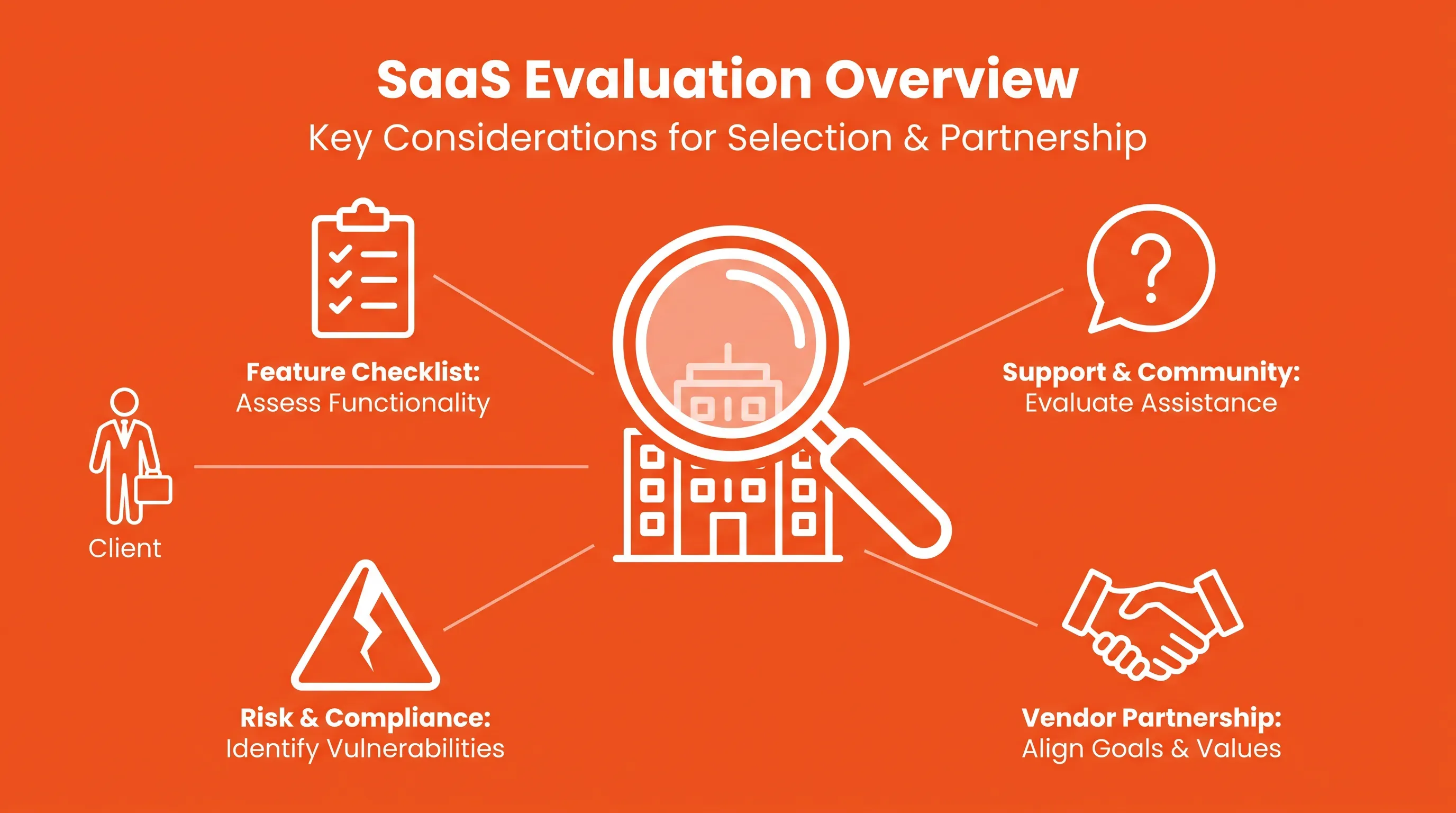
Bold flat-design SaaS evaluation infographic with a bright orange background, featuring a central magnifying glass icon and four surrounding icons.

Separate a capable software development company from one that only interviews well. Here's what you can ask in a first conversation, even without a technical background. The point is to expose weakness early, while it costs you nothing.

Discovery before build

A serious software development company in the UK refuses to quote a fixed price for a complex build before a paid structured discovery process. Good discovery produces a shared understanding of the business problem and a map of the hidden integrations. It also produces an estimate you can actually trust. The economics justify it. Firms that skip requirements analysis pay up to 60% more than their original proposal, and roughly half of all rework traces back to poorly gathered requirements.

The warning sign is a partner who hands you a confident fixed price for a complex project without asking hard questions first. That number is a guess dressed as a commitment, and you will pay for the gap later through change requests. Ask them directly: what does your discovery process produce, and what happens to the estimate afterwards?

Ready to bring your ideas to life?

Book a free 30-minute discovery call with our team — we'll understand your objectives and advise how bespoke software, MVP development, or an extended team can help your business.

Architecture and scalability

Early architecture decisions quietly set your long-term cost. A team optimising for the fastest possible demo will make choices that look fine at launch and become expensive to unwind once real usage and new integrations arrive as the roadmap grows. A software development company worth hiring designs for change from the start, so adding the next capability does not mean rebuilding the last one.

The accumulated cost of these shortcuts is real. Technical debt in the US alone reached roughly $1.52 trillion in 2022. Ask for a technical interview with the engineers who will actually design your system. The people who will make the decisions should be the ones answering your questions about them.

Project governance and reporting

Governance is what keeps a multi-month build from drifting. It means a named owner who is accountable for delivery and clear milestones. It also sets a defined escalation path when something goes wrong and documents how scope changes are handled openly. Without it, a complex project slides into scope creep and hidden cost while everyone stays polite.

Colette Wyatt, CEO at Evolved Ideas, put the underlying discipline this way: "We believe that technology is more than just writing code. For every project, whether it's a Minimum Viable Product (MVP), bespoke software, or a new product, we strive to understand your real needs." Ask who your named delivery lead will be and how often you will get progress reporting. Also ask about the process when scope changes. Vague answers here predict painful surprises later.

Communication and time zone fit

Communication quality is one of the strongest predictors of success on complex work, because complex work generates constant small decisions that cannot wait a full day for an answer. Real-time overlap matters far more here than it does for a simple, well-specified task. You want same-working-day collaboration and genuine language fluency. You also want one clear point of contact who owns the relationship.

Take reviews seriously on this point. When former clients flag communication problems, those complaints are almost always real, because communication friction is the first thing a struggling engagement produces and the last thing a vendor will admit to. A software partner that can meet you inside your working day removes a whole category of delay before it starts.

Sector and domain understanding

A software development company that already understands your sector makes better decisions with less hand-holding. They know the workflows, the compliance rules, and what your users expect, so they do not burn your budget learning the basics. Domain expertise varies across fintech and healthcare, and logistics has its own demands. Each has its own rules and failure modes, and a team fluent in one can be dangerous in another.

Demand case studies and references from your own industry. A logo proves someone paid an invoice. A reference from a business like yours, one you can actually call, tells you whether the partner understood the domain or had to be taught it at cost.

Quality assurance built in

Mature QA relies on automated testing and peer code review from the first sprint. Continuous integration supports both throughout delivery. The difference between a partner who treats QA as an afterthought and one who builds it into delivery shows up directly in your bill. According to IBM research, a bug found in production costs 100 times more to fix than one caught during design, and teams that shift testing left cut production defects by 60% to 90%.

On a complex system, skipping this creates instability that compounds with every release. Ask about their test coverage and their release process. A software development company that can describe how automated tests gate a release, and who owns quality when something breaks, is telling you they have done this before.

Ready to bring your ideas to life?

Book a free 30-minute discovery call with our team — we'll understand your objectives and advise how bespoke software, MVP development, or an extended team can help your business.

Nearshore delivery and application support

Two capabilities decide what happens after the build, and both are easy to overlook while you are focused on getting the thing shipped. The first is whether the software development company can scale a senior team quickly when your roadmap demands it. Nearshore delivery in Europe answers that. It gives you access to senior engineers on short notice while keeping the same working-day collaboration and EU-aligned data handling, which matters when your project touches personal data. European nearshore rates sit in a $4,500 to $7,000 per developer monthly band, above the cheapest offshore markets but with the collaboration overlap that removes the hidden costs offshore arrangements quietly generate.

The reason this matters in the UK specifically is supply. The Open University's 2024 Business Barometer found 62% of UK organisations reporting difficulty finding the right skills, and IT and data skills have been the hardest roles to fill for five straight years. A serious roadmap requires senior engineers faster than in-house hiring can provide them, which is where a European delivery team earns its place.

The second capability is long-term application support. A complex system is never finished at launch. A complex system needs maintenance and incident response for years. Its steady evolution depends on a software partner who holds knowledge nobody else can reconstruct cheaply. The question is who will still answer the phone eighteen months later when a payment integration breaks at 4 pm on a Friday. If the support model is vague in the proposal, it will be worse in reality.

UK accountability with a European delivery team

Here is the model worth recommending as the practical conclusion of everything above: keep strategy and accountability in the UK, with client-facing ownership there as well. Scale engineering through a European delivery team. You get UK contractual clarity and timezone alignment, with cultural alignment as well. A nearshore team provides GDPR-aware handling alongside the senior capacity and cost balance it provides.

This sits deliberately between the two extremes you are tempted by. A small UK-only shop gives you a person to hold responsible but cannot scale when the roadmap grows. A distant offshore team gives you scale and a low rate but puts an asynchronous wall between the people making decisions and the people writing the code, which is exactly the coordination failure that sinks complex projects. The hybrid keeps the accountability close and the capacity flexible. Map it against the earlier checklist, and it holds up because a single arrangement covers governance and communication. The same arrangement also provides QA and support.

How a UK software partner stays accountable

Accountability is a structure: one UK contract and a named UK owner. It includes a single escalation path, so you always know exactly who answers for delivery when something goes wrong. A UK software partner operating this way keeps recourse inside your own legal system, which a purely offshore arrangement cannot offer.

That structure protects you in concrete ways. Under the April 2021 IR35 reforms, medium and large UK businesses carry responsibility for contractor tax status, and a properly contracted UK partner keeps you clear of that exposure in a way loose contractor arrangements do not. On data protection, the EU renewed the UK's adequacy decision in December 2025, and an EU-aligned delivery team keeps personal data flowing under the same standard. If you have been burned by a vendor that went quiet the moment a problem surfaced, this is the layer that prevents a repeat.

When a European delivery team makes sense

Layering a European delivery team onto UK accountability is the right call if you need senior capacity fast or have a long roadmap ahead. It also helps when the UK skills shortage prevents you from hiring the scale you need in-house. The signals of a good setup are worth insisting on:

  1. You interview the named engineers who will work on your project.

  2. The team integrates into your own tooling and rituals.

  3. You get monthly reviews with real progress and honest problems.

Be honest about when this is overkill. If your need is a small, well-specified piece of work with a short life ahead of it, a full UK-plus-Europe structure adds coordination you do not need. The model earns its keep when business-critical work becomes complex over a long-running engagement, which is exactly the situation this article is about.

Running your own shortlist

Pull the criteria together into something you can act on this week. Insist on structured discovery before any fixed quote. Put the actual engineers in a room and ask them to defend their architecture. Get a named delivery lead and a reporting cadence. Establish the QA and support model separately. Then verify every claim through reference checks with clients in your own sector, because a sales deck tells you what a partner wants to be true, and a reference tells you what actually happened.

The honest next step is small. Scope a paid discovery engagement before committing to a full build, and treat it as a test of the partnership as much as the project. If a software development company runs discovery well and communicates clearly inside your working day, you have learned more than any pitch could tell you. Real accountability in writing confirms it. If you are weighing UK accountability against a European delivery team for a complex build, it is worth talking to our team at Evolved Ideas, a UK software development company buyers use to reduce delivery risk and scale senior capacity without giving up UK ownership.

Ready to bring your ideas to life?

Book a free 30-minute discovery call with our team — we'll understand your objectives and advise how bespoke software, MVP development, or an extended team can help your business.

Confirm ownership in the contract before work starts. It should state that your organisation receives the agreed source code, documentation, and rights to use them after payment. Also check whether third-party components carry licence terms that affect future changes or redistribution.

Request a data processing agreement if the partner will handle personal data for you. It should define processing instructions, security duties, subcontractors, and breach reporting. Ask where data is stored and whether access by the delivery team is limited to staff who need it.

Yes, ask a former client about delivery against the original scope and how the partner handled a problem. Ask whether the named engineers and delivery lead were involved throughout. A useful reference describes the working relationship, rather than only the finished product.

Require a handover plan before the project begins. It should identify the documentation you receive, access to code repositories, and the process for transferring credentials. This reduces dependence on one supplier if your team later changes its support arrangement.

Yes, you can speak with Evolved Ideas about discovery, UK accountability, and European delivery capacity before committing to a full build. Use that discussion to test whether the proposed team, commercial terms, and support approach fit your project’s risk and timeline.

Schedule a Discovery Call

Book a free 30-minute call that works for you

You Might Also Like

Discover more insights and articles

A collaborative workspace with a wooden table covered in documents and sticky notes, featuring diverse team members engaged in discussion.

Product discovery: how to de-risk a software project before development

Before spending on development, the assumptions behind a software idea need testing. Learn how to frame the problem correctly and turn research findings into a scope developers can actually estimate against.

A warm, daylight-filled workspace features a wooden desk with a glass roadmap, sticky notes, and a diverse team collaborating.

Technical roadmap: turning software priorities into a practical delivery plan

A phased plan turns discovery findings into a scope, sequence, and funding path you can actually approve. See what belongs in each phase and how to invest in stages without pretending the plan is a fixed schedule.

A realistic workspace scene with a wooden conference table, professionals discussing a 'Software Audit Report' in warm daylight.

Software audit: when to review a codebase before rebuild, support, or scale

A software audit is worth the hassle when it answers a specific question: is this application safe to keep building on, or is it accumulating risk you can't see? Learn what an audit actually examines, the conditions that make one worth the spend, and how to translate technical findings into a decision the business can act on.

A modern tech startup office featuring a premium desk with a sleek monitor, three professionals engaged in various tasks, and natural light.

Application support for business-critical software: what should be covered

Learn what a complete application support service should cover once custom software goes live and becomes part of daily operations. Essential service areas, from monitoring and incident response to maintenance and reporting, show how agreed ownership turns ad hoc technical help into an accountable service.