Software development costs: build a budget for your business system

Content authorBy Lincoln WoolseyPublished onReading time9 min read
A person sits at a large wooden desk in a bright coworking space, engaged in conversation with colleagues, surrounded by modern furnishings.

Supplier proposals for a bespoke business system are hard to compare when each one prices a different scope. Build your own software development cost budget before you ask anyone for a quote. A fillable cost model sets out what to include, and two fictional scope comparisons show how to get estimates you can compare line by line.

Why budgets fail before anyone writes code

Most of the damage to a software development cost budget happens in the weeks before a supplier sees the requirements. The number gets set from a half-remembered figure or a feature list someone wrote in an afternoon.

Then the evidence arrives. In Harvard Business Review, Bent Flyvbjerg and Alexander Budzier analysed 1,471 IT projects and found an average cost overrun of 27%. One project in six overran by 200% on average. The tail is your risk.

What follows is a way of building the number so it survives contact with reality, from scope through to the three years after go-live.

Define the right scope

Budgeting starts with the outcome you want. A finance team spending two days a month chasing approvals has a measurable problem. A list of twelve screens is a guess at the answer to that problem, and guesses priced as requirements are expensive.

The UK government's own guidance makes the same point. Its service manual tells teams that when presented with a predefined solution, they must "interrogate that solution and reframe it as a problem to be solved", with a typical discovery of 4 to 8 weeks before any build commitment. That reframing is where budgets get accurate, because it's where assumptions get killed cheaply.

Constraints matter as much as outcomes. Which system holds the master data and which interfaces you don't control. Write those down before the feature list, because they drive effort more than the screens do.

Discovery before commitment

When Bridgestone first approached Evolved Ideas, they asked for a workflow solution. We advised against it. Six months later, the conversation restarted, and a workshop was run to identify the real issues behind hundreds of trade agreements processed manually every two months. You can find more examples in our case studies.

What came out of that workshop was a cloud-based discount and rebate platform integrated with Bridgestone's existing enterprise resource planning (ERP) system, from budget creation through to digitally accepted trade agreements. An approval process that used to take days now takes hours.

The point here is that the scope the client asked for and the scope that solved the problem were different things, and the difference was found through structured questioning. A software development cost built on the first request would have been a precise number for the wrong system.

Software development cost model

softare-deveolpment-cost-model.png

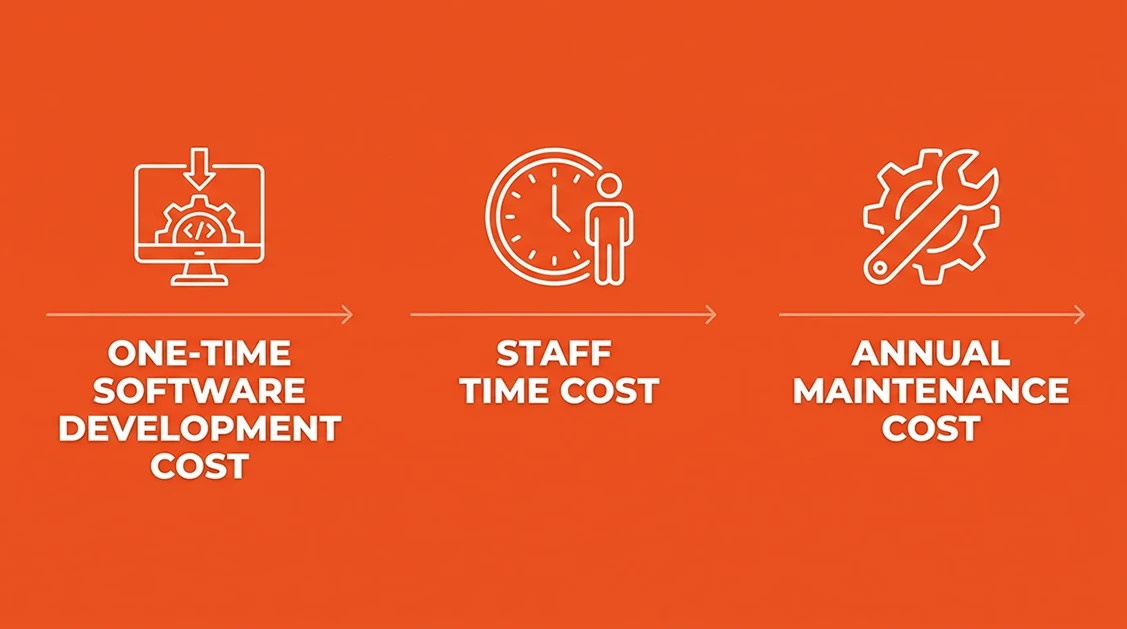
Use the model below with your own figures. Keep three groups separate, because mixing them is how organisations end up believing a build was cheap and an operating budget was a surprise.

The first group is the one-time software development cost. The second is your own people's time. The third is what you pay every year to keep the thing alive once it's working.

Ready to bring your ideas to life?

Book a free 30-minute discovery call with our team — we'll understand your objectives and advise how bespoke software, MVP development, or an extended team can help your business.

Role hours and rates

Price each role at agreed hours multiplied by that role's rate. A single blended rate is convenient and hides exactly the thing you need to see, which is where the effort sits.

  • Discovery and business analysis: hours agreed with the supplier, at the analyst rate

  • Design, covering user interface and user experience work

  • Development, split between front end and back end if the supplier estimates them separately

  • Testing and quality assurance, quoted as its own line

  • Project management, expressed as a percentage of delivery effort, which you convert back into hours

  • Technical architecture and any DevOps work needed to get code into an environment

For sanity-checking rates, ITJobsWatch puts the median UK software developer contract rate at £525 a day in the six months to October 2026. Agency and consultancy rates sit higher, because they include testing and delivery management that a single contractor doesn't provide. Compare like with like, or the comparison tells you nothing.

Technical cost lines

These lines have no relationship to how many screens you asked for, and they routinely decide whether a software development cost lands or doubles. Integrations are the clearest example.

When Hope Cement needed to stop two full-time employees manually emailing proof of delivery documents, the answer was a self-serve portal integrated with a third-party scanning partner, with reporting built in so customers could raise issues directly. Those 1,000 monthly calls dropped to zero. The portal was the visible part, but the integration and the reporting requirement shaped the work.

Budget separately for data migration, which is where estimates go quiet. Experian cites Gartner research finding that 83% of data migration projects either fail or exceed their budgets and timelines. Add environments and any third-party licences the system depends on.

Client effort and risk

Your organisation is a supplier on this project. Record the days your process owners will spend in workshops and the work of extracting and cleaning data from the system you're replacing. Count that time once, either as an internal cost or as a capacity constraint, never as both.

Contingency goes on once, against a stated base, with a written reason. HM Treasury's supplementary guidance publishes an upper-bound optimism bias uplift of 200% for equipment and development projects, which includes software. That uplift falls as project-specific risks get identified and managed. You won't apply 200%. You should be able to say why your figure is lower, and that answer is "because discovery closed these specific questions".

Scope change is the risk your contingency is actually covering. The Project Management Institute's 2018 Pulse of the Profession found that 52% of projects completed in the previous twelve months experienced scope creep, up from 43% five years earlier.

Ready to bring your ideas to life?

Book a free 30-minute discovery call with our team — we'll understand your objectives and advise how bespoke software, MVP development, or an extended team can help your business.

Three-year ownership

Keep this out of the build total. Each year gets its own lines for hosting and maintenance.

The research on lifetime cost is consistent even when the figures differ. Published estimates of maintenance as a share of total lifecycle cost run from 67% (Schach) to over 90% (Erlikh), with annual maintenance for actively developed systems commonly set at 15 to 25% of the original build. Treat that as a starting anchor and refine it against your own integration count and compliance obligations. For deeper planning on this, work through our dedicated maintenance budget guidance.

Compare two fictional scopes

The two figures below are invented illustrations built to show how effort moves. They are not Evolved Ideas prices, and they are not benchmarks for your system. Both exclude tax and ongoing operation.

One approval workflow

A single approval workflow, estimated at 160 hours and priced at £75 an hour, gives £12,000 of labour. Add £2,000 of non-labour costs for environments and a licence, and the base is £14,000.

Apply 20% contingency once, against that stated base, and you get £16,800. That's the software development cost. Value added tax at the standard rate of 20% sits outside the figure, as does everything you'll pay from the day it goes live.

Expanded workflow

Now add one integration with your finance system and a reporting requirement for the people who approve. Effort rises to 240 hours, so labour is £18,000, and non-labour costs rise to £3,000 because the integration needs its own environment and test data. The base becomes £21,000, and £25,200 with the same 20% contingency.

Eighty extra hours for what sounds like two small additions. The integration brings mapping and error handling. The reporting brings decisions about what gets stored and who can see it, which is design work before it's development work.

Test every assumption

Every number above rests on an assumption that needs to be argued with before money moves. Evolved Ideas starts with in-depth consultation sessions to understand your processes and goals, then a structured workshop. The software development cost estimate comes after that work.

Three questions do most of the damage when left unasked. Who owns each interface, and what happens when the other side changes it? What is deliberately excluded from this scope? And who inside your organisation is accountable for the decisions that unblock delivery?

After launch, the questions change but don't stop. Tier 3 development support covers security patching and new features, which is the maintenance line in your three-year view made concrete. An early estimate is a position to be tested, not a quotation to be banked.

Compare proposals consistently

Suppliers will structure proposals differently, and the differences are where comparison breaks. Send the same checklist to everyone and ask them to answer in your format.

  1. Scope statement in business outcomes, with exclusions written out explicitly

  2. Hours by role, with the rate for each role shown separately rather than blended

  3. Integrations listed individually, naming the system on the other side of each one

  4. Data migration effort, including profiling and reconciliation

  5. Environments and hosting as their own lines

  6. Third-party licences, with who holds the contract

  7. Client effort expected from your team, expressed in days by role

  8. Contingency as a percentage, with the base it applies to and the rationale

  9. Tax treatment stated, so net and gross are never confused

  10. Three-year recurring costs by year, separated from the build

If your system includes a mobile element, estimate that against our mobile development guidance. The same applies to scoring the responses themselves, where a weighted model beats a side-by-side glance at totals. Both sit in their own guides.

Discuss your system

Bring us the workflow as it runs today and the interfaces you depend on. Evolved Ideas has built bespoke business systems since 2007 from our Leicester head office, and we test your scope assumptions with you. Book a 30-minute call through our contact page and let's examine the software development cost together before a proposal is written.

Ready to bring your ideas to life?

Book a free 30-minute discovery call with our team — we'll understand your objectives and advise how bespoke software, MVP development, or an extended team can help your business.

No. An estimate states expected effort and cost based on current assumptions, while a fixed price depends on defined scope, exclusions, and change rules. Ask suppliers which assumptions could alter the price, what evidence supports the estimate, and how approved changes will be charged.

Convert each proposal into the same cost model before comparing totals. Separate role hours, rates, integrations, migration, licences, contingency, tax, and three-year operating costs. Record each supplier’s exclusions beside the figures, because a lower total often reflects missing work rather than lower delivery effort.

Yes, but remove low-value work after confirming the business outcome. Protect data migration, security, integration error handling, and testing when those items support that outcome. A smaller first release can lower the initial cost, provided deferred work has an owner, a budget, and a later decision date.

Involve process owners during discovery, before supplier estimates are final. Ask them to explain current steps, confirm constraints, review migrated data, and make decisions during delivery. Record their time as an internal cost or capacity requirement, but don't count the same effort twice.

A client should document the business problem, affected systems, known constraints, desired outcome, exclusions, and internal decision owners. Evolved Ideas can examine those assumptions before preparing a proposal. Contact the team through https://evolved-ideas.com/contact-us to discuss the software development cost.

Schedule a Discovery Call

Book a free 30-minute call that works for you

You Might Also Like

Discover more insights and articles

A close-up of hands writing on documents at a wooden desk, surrounded by colorful post-it notes and a softly glowing laptop.

Membership website development: connecting members, events and CRM

An association’s public site and member portal often fail in the same way: they work on their own, but they no longer talk to the membership, payment, and event systems around them. Replacing either one is easier to commission when you start from seven requirements. Use them to set the scope first, then organise procurement around them, so every supplier responds to the same brief and the integration problems that prompted the replacement stay at the centre of the decision.

A focused programmer types on a laptop at a sleek black desk in a modern office, surrounded by multiple monitors displaying code.

Software intellectual property: 7 ownership questions before you sign

Paying for bespoke software does not automatically mean you own it, and the gaps usually surface when the relationship ends. Before you sign, settle seven questions about software intellectual property with your development partner and with qualified legal counsel. They establish what transfers to you, and what you need in practice to keep the system running if the partnership ends, such as source code, documentation, and access to the environments it runs in.

A person examines software development documents at a metallic desk, surrounded by a softly blurred office in warm natural light.

Fixed price vs time and materials for a software development project

Fixed price feels safe and time and materials feels flexible, but neither tells you what you’re committed to when the brief changes. Compare three ways to buy bespoke software: fixed price, time and materials, and a sequence of capped phases. For each, see what it commits you to and how an unplanned requirement plays out in practice. Then settle a short list of questions before you sign anything, while you can still change the terms.

A business professional focused on coding at a sleek black desk in a modern office with natural lighting and an exposed brick wall.

5 .NET development companies for established applications

Choosing a firm to look after an established, business-critical .NET application is a risk decision, and the case studies on a supplier’s website rarely settle it. Five companies that work on this kind of system are reviewed here against their published case evidence, so you can see what each one has demonstrably done. A set of due-diligence questions and a controlled trial brief then let you test any of them, including firms not on the list, before you hand over the application.