Web application development services for complex B2B workflows

Content authorBy Lincoln WoolseyPublished onReading time10 min read
A sunlit office workspace features a wooden table with a process map, business actors collaborating, and workflow objects in a warm atmosphere.

Some workflow problems are just friction; others are structural limits on how far your business can scale. We cover how to tell which one you're dealing with, what to expect from web application development services, and how to scope a first release that earns back its cost.

When the spreadsheet becomes the system

Most operations teams don't set out to build critical infrastructure in Excel, and yet the shared tracker that started as a stopgap ends up governing pricing approvals and month-end reconciliation. The moment you start considering web application development services, it's because that file has become load-bearing and everyone knows it.

The risk isn't hypothetical. Ray Panko, a professor of information technology management at the University of Hawaii, found that 88% of spreadsheets contain errors in 1% or more of formula cells. Add the fact that the average company now runs hundreds of SaaS applications, and the picture gets clearer. Your process is smeared across a dozen.

Map the workflow problem

Before you price anything, document what actually happens. Follow the real sequence of who touches the record and what people do when the system doesn't cover the case in front of them. Sit with the person doing the work and watch them switch tabs.

A 2022 study of 20 teams published in Harvard Business Review found the average worker switched between apps and websites nearly 1,200 times each day, which costs just under four hours a week in reorientation alone. In one Fortune 500 consumer goods business the authors studied, a single supply-chain transaction required about 350 switches across 22 applications.

When you map, capture these specifics for each step:

  • Who performs it and who gets blamed when it goes wrong

  • Where the same data is typed a second time, and into what

  • How long the step waits before anyone picks it up

  • What the exception looks like, and how frequently it happens

Telling inconvenience apart from constraint

An inconvenience is annoying and stable. A constraint gets worse as you grow, because the workaround consumes headcount in direct proportion to volume. If doubling your customers means doubling the admin team, that's a constraint on your operating model, and it belongs on the executive agenda rather than the IT wishlist.

The other marker is service quality. When errors reach the customer or when your team can't answer "where is my order" without three phone calls, the cost has moved off your P&L and onto your reputation. Those two signals, cost that scales with volume and defects that customers see, are what justify serious investment in web platform development.

Define platform requirements

Requirements written as a feature list age badly. Requirements written as operational outcomes survive contact with reality, because they tell an engineering team what the system has to achieve rather than what buttons someone imagined. "Approve a supplier rate change in under four hours with a full record of who agreed to it" is a requirement. "Approval screen with dropdown" is a guess.

Colette Wyatt, CEO of Evolved Ideas, emphasizes the same point: "Platforms must scale, integrate, and evolve; our CoE ensures they can." That framing matters when you're translating a messy process into a specification, because the constraints you write down now determine how expensive change will be in year three.

Roles and governance

Start with who is allowed to do what, because permissions shape everything downstream. Employees and customers rarely need the same view of the same record, and the differences are where the compliance risk sits. Write down which role can create and which can approve.

Audit trails are the part teams skip and later regret. If a dispute arrives six months after a transaction, you want the system to answer it without anyone opening an inbox. IBM's 2025 report put the global average cost of a data breach at USD 4.44 million, and shadow AI tools were involved in 20% of breaches, almost all at organisations without proper access controls. Data ownership deserves the same clarity. Know which records are yours and how you'd get them out.

Ready to bring your ideas to life?

Book a free 30-minute discovery call with our team — we'll understand your objectives and advise how bespoke software, MVP development, or an extended team can help your business.

Workflow automation

Not every step should be automated. The useful test is whether the rule is repeatable and the outcome is checkable. Status notifications and routing based on value thresholds are good candidates for workflow automation because the logic doesn't change with judgment.

Approvals sit in the middle. You can automate the routing and the escalation while keeping a human decision at the point where money or risk changes hands. Exception paths are where poorly designed workflow automation fails, since a system that can only handle the happy path pushes every unusual case straight back into email. Design the exception first, and the standard case becomes easy.

Data and reporting

Conflicting spreadsheets are a symptom of the same record existing in several places with no agreed source. A shared operational record fixes reporting almost as a side effect, because once the data has one home, the dashboard stops being a reconciliation exercise. That's the quiet return on web platform development that rarely makes the business case.

Decide what you need to measure before you build the screens. Cycle time per stage and exception rate will tell you more about the health of the operation than a monthly summary ever did. And when the numbers are live, arguments about whose figures are right stop.

Integrations and customer access

After web platform development, your new platform needs to talk to your accounting system. An Application Programming Interface (API) is the mechanism that lets two systems exchange data without a person copying it, and most modern SaaS tools publish one.

The connectivity gap is wide. Salesforce's 2025 MuleSoft Connectivity Benchmark, based on responses from IT leaders, found the average enterprise runs 897 applications with only 29% integrated, and 90% of organisations reported business obstacles caused by data silos. Customer portals are worth considering here too, since giving clients self-service access to their own status removes the enquiries your team currently answers by hand.

Choose build or extension

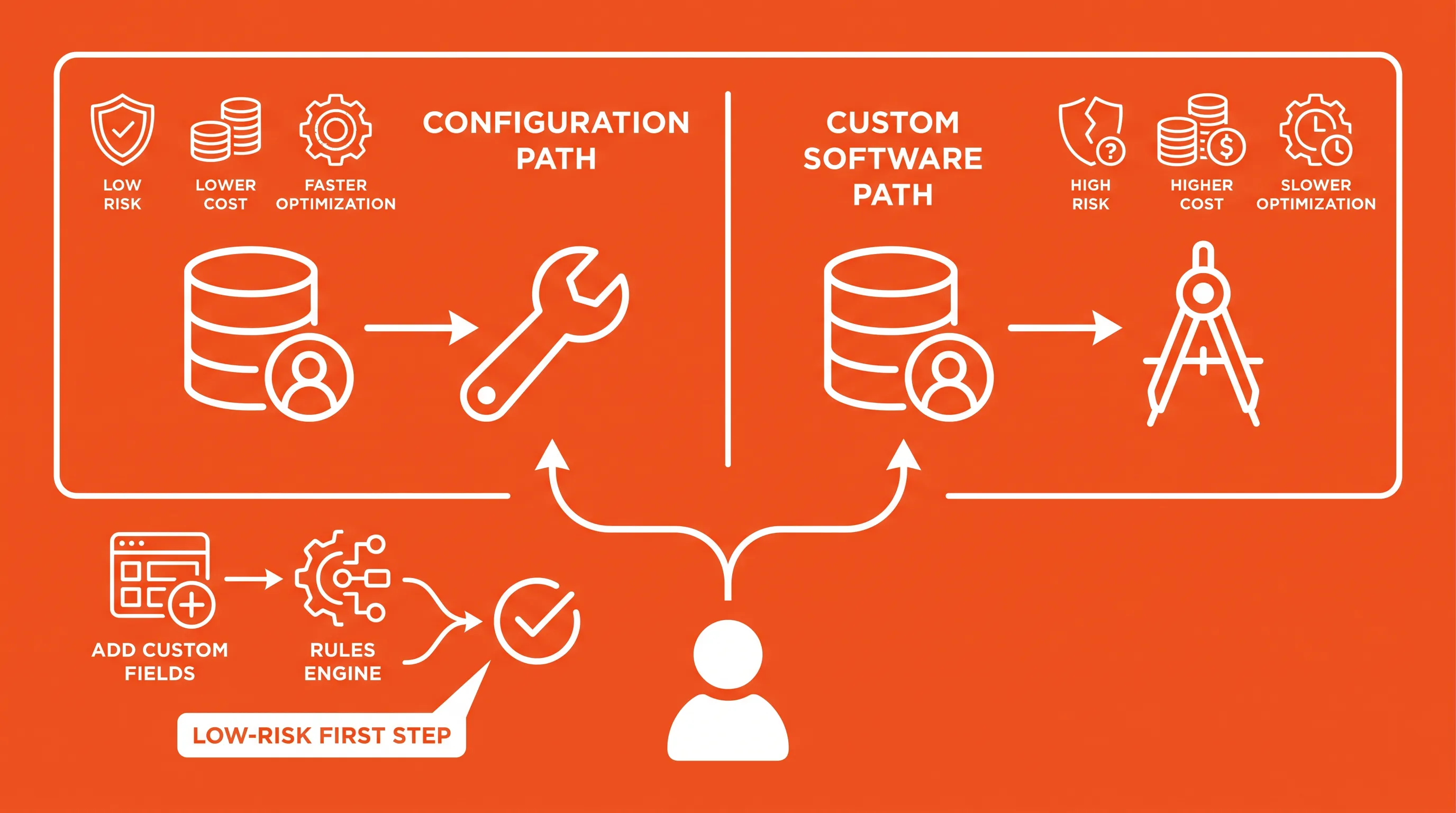
Bold flat-design infographic on bright orange background, featuring CRM icons for configuration and custom software paths with user decision arrow.

Four options are on the table, and the honest answer is that custom software is the right one less often than software companies suggest. Configuring what you already own costs the least and carries the least risk, so exhaust it first. If your Customer Relationship Management (CRM) system can hold the process with a few custom fields and a rules engine, that's the answer.

Adding integrations comes next. Connecting two systems you already pay for solves the duplicate-entry problem without introducing a new application to maintain. Low-code platforms occupy the middle ground, and Gartner forecasts that low-code will account for 75% of new application development by 2026. The trade-off is vendor lock-in and per-seat pricing that becomes uncomfortable at scale.

Bespoke web application development services earn their place when the process is genuinely yours and commercially valuable. Judge it against these questions:

  1. Is the process a differentiator, or is it standard practice you happen to do differently?

  2. Would a competitor gain if they copied it?

  3. How long can the business tolerate the current constraint?

  4. What does the SaaS licence cost over five years at your projected headcount?

  5. Who owns the data and the code if the relationship with the vendor ends?

If the process is standard and the urgency is high, configure or integrate. If it's distinctive and you expect it to keep changing, custom web application development services give you control that a vendor roadmap never will.

Ready to bring your ideas to life?

Book a free 30-minute discovery call with our team — we'll understand your objectives and advise how bespoke software, MVP development, or an extended team can help your business.

Assess web application development services

Coding is the commodity part. What separates a partner from a supplier is what happens before anyone opens an editor, because the McKinsey and University of Oxford study of more than 5,400 IT projects found that large ones run 45% over budget while delivering 56% less value than predicted. Missing focus and unclear objectives accounted for the largest single slice of that overrun.

So ask what the discovery phase produces. A firm offering credible web application development services should come back with a documented process map and a view on which parts shouldn't be built at all. Evolved Ideas runs a 1-2 day workshop to validate assumptions and assess build versus buy before producing a roadmap, which is the sequence you want.

Beyond discovery, look for evidence rather than claims. Integration experience with the specific systems in your stack and named B2B platforms they've delivered and still support. Ask to speak to a client whose system has been live for three years, because that conversation tells you more about a provider of web application development services than any case study.

Scope the first release

Pick one workflow and take it end to end. Focus on the one where the constraint costs most and the boundaries are clear enough to finish. A quote-to-order path that works completely beats six half-built modules that each require a spreadsheet to function.

The temptation to rebuild everything at once is expensive. Prioritise the ones people actually use the most.

Define success in numbers before web application development services start. Cycle time cut from five days to one, or error rate below a set threshold. Then split your list into what the workflow can't function without and what would be nice once people are using it daily. The second list changes once real usage data arrives, which is exactly why it should wait.

Plan long-term ownership

Custom software built through web application development services is a product you now own, and ownership has a running cost. Across industries, maintenance accounts for 50 to 80 percent of total cost of ownership over a system's life, and the Standish Group has found that post-deployment enhancements cost three to four times the original build. Budget for it at the start rather than discovering it in year two.

What ongoing ownership actually involves:

  • Hosting and monitoring, so you find out about an outage before your customers do

  • Security patching for the platform and every dependency underneath it

  • User support and documentation that survives the departure of the person who knew everything

  • A funded backlog for improvements, because a system nobody improves is a system people work around

That last point decides whether the investment holds its value. Systems that get refined based on how people actually use them keep paying back. Ones that get frozen at launch drift out of step with the business, and within three years someone opens a new spreadsheet to cover the gap. Continued workflow automation of the cases you deliberately deferred is the cheapest source of return you'll find.

MIT's Project NANDA studied 300 public deployments and found that only 5% of custom enterprise AI tools reach production. Lead author Aditya Challapally attributed the gap not to model quality but to tools that "don't learn from or adapt to workflows." The same logic applies to any operational platform. Software that stops adapting stops earning.

Work with Evolved Ideas

If your growth is capped by manual administration rather than demand, the question is which fix is proportionate. Sometimes that's better configuration or a single integration. Sometimes it's custom web platform development, and knowing the difference before you commit budget is the point of a proper discovery conversation.

Evolved Ideas is a UK-headquartered consultancy that runs discovery and engineering for complex B2B platforms alongside in-house teams rather than replacing them. Speak to our team about your workflow constraints and web application development services options, and we'll tell you honestly whether building is the right next step.

Ready to bring your ideas to life?

Book a free 30-minute discovery call with our team — we'll understand your objectives and advise how bespoke software, MVP development, or an extended team can help your business.

Choose people who complete the workflow every day and include a person who handles exceptions. Pilot users should represent each permission level involved in the release. Set a fixed test period, record failed tasks, and decide which issues block launch before you expand access.

Keep records that support live work, reporting, or a legal retention duty. Clean duplicates and agree a source of truth before migration, because importing conflicting data recreates the problem in a new system. Archive the remaining files in read-only storage with clear access rules.

Yes. Set an accessibility standard, such as WCAG 2.2 AA, in the requirements and test keyboard operation and screen-reader labels before release. Check colour contrast separately. Include people who use assistive technology in acceptance testing, because automated scans don't identify every barrier.

Schedule security testing before launch and after material changes to authentication or data handling. Web application development services should define who tests the platform, how findings are prioritised, and when fixes must be verified. A review of user permissions should also happen before real customer data enters the system.

Ask for written response times and responsibility boundaries. Also ask how fixes and planned releases reach production, since an unclear release process delays routine improvements. When speaking with Evolved Ideas, confirm who maintains hosting, security updates, and the backlog after the first release.

Schedule a Discovery Call

Book a free 30-minute call that works for you

You Might Also Like

Discover more insights and articles

Over-the-shoulder view of hands typing on a laptop in a modern tech studio, with multiple screens displaying code and a coffee cup nearby.

Flutter vs React Native for B2B Mobile Apps: A Buyer’s Decision Guide

Picking a mobile framework by gut feel is how commercial trade-offs get made by accident. This guide translates the technical differences between the two leading options into terms that matter before you brief suppliers: cost, timeline risk, and talent availability. It includes a weighted scoring method you can run against your own requirements to reach a defensible decision rather than a default one.

A UK buyer evaluates app development teams in a modern workspace, featuring natural light, a premium desk, and minimalist decor.

App Developers Near Me: How UK Buyers Should Evaluate Local Fit

Picking a software partner because they're a short drive away feels safe, but proximity solves fewer problems than you might think. This guide separates what proximity genuinely improves from what it doesn't guarantee, and matches collaboration models (co-located, nearshore, extended team) to what your project actually needs.

A modern office space with an IT consultant discussing disaster recovery plans, featuring a laptop and collaborative professionals in the background.

RTO vs RPO: Setting Recovery Targets for Business-Critical Software

Every resilience conversation eventually needs to answer two questions: how long can this system be down, and how much data can you afford to lose? Here's how to turn those questions into numbers the board will actually sign off on.

A modern tech startup workspace with exposed brick, featuring diverse professionals collaborating around sleek devices and a central digital tablet.

AI Governance Framework for SMEs: Controls That Scale With Adoption

Most AI governance frameworks are built for enterprises with dedicated compliance teams. But what about lean teams that prioritise a fast pace? Here's an alternative: risk tiers to triage exposure, and a phased rollout sized for smaller organisations.