Agile vs Scrum: Choosing the Right Delivery Model for Complex Software

Content authorBy Lincoln WoolseyPublished onReading time11 min read
A modern tech startup office with diverse professionals discussing around a premium desk, featuring Agile, Scrum, Kanban, and Hybrid delivery models.

Choosing between Agile and Scrum starts with matching the delivery model to your team’s needs. Compare Scrum, Kanban, and deliberate hybrids across cadence and governance, then use the readiness test and decision tree to determine which approach fits your project before commissioning the build.

Why the delivery model decision lands on your desk

A finance director signs off a £400k build and sees a slick delivery deck full of sprints and burndowns. Eleven months later, that director is asking why the release date has moved three times. That conversation is where the Agile vs Scrum question stops being an academic one. The model your supplier proposes decides how change gets absorbed and what evidence you get before the money runs out.

McKinsey and the University of Oxford studied 5,400 IT projects and found large ones run 45% over budget while delivering 56% less value than predicted. Choosing an Agile vs Scrum delivery model won't fix that on its own. Choosing one your organisation can't actually staff or govern will make it worse.

Agile vs Scrum basics

Agile is a set of values and principles. The four values published in the 2001 Manifesto put working software ahead of comprehensive documentation and responding to change ahead of following a plan. That's a philosophy of Agile software development. It tells you nothing about how long an iteration should be or who decides what gets built next.

Scrum answers those questions. It's one framework for applying Agile principles. Ken Schwaber and Jeff Sutherland defined it in a 13-page guide that specifies accountabilities, events and artefacts and the rules binding them together. So Scrum sits inside Agile as one implementation of it.

Two other implementations deserve equal standing in your evaluation. Kanban manages work as continuous flow with explicit limits on how much is in progress at once. Hybrid delivery combines elements of both, or runs different tracks under different rules. Neither is a watered-down version of the real thing, and the numbers back that up: the Project Management Institute found hybrid use rose from 20% in 2020 to 31% in 2023, with average project performance varying only marginally across Agile and hybrid approaches.

Compare the delivery models

The table below is the practical version of the Agile vs Scrum decision, extended to include the third option most suppliers won't put in a proposal. Read it against your own organisation rather than against the ideal one described in framework training.

DimensionScrumKanbanHybrid
CadenceFixed sprints, usually one to four weeksContinuous flow, no fixed iterationPlanning cadence plus flow limits on some tracks
RolesProduct Owner, Scrum Master, DevelopersNo prescribed roles, service delivery manager commonNamed owner per track, agreed in writing
PlanningCommitted sprint scope against a sprint goalPull the next highest priority item when capacity frees upSprint-level forecast with a reserved flow lane
Backlog readinessItems must be doable within one sprintItems refined just before they're pulledVaries by track, needs an explicit standard
Change handlingBetween sprints, protected during themAny time an item hasn't startedRules must be written down or the model collapses
GovernanceSprint review as the natural checkpointFlow metrics, service level expectationsCombined, with defined escalation
PredictabilityVelocity-based forecasting after three or four sprintsCycle time distribution and throughputDepends which measures you actually keep
Stakeholder inputConcentrated at review, dependableContinuous, needs discipline to avoid interruptionScheduled reviews plus an intake route
Best conditionsStable cross-functional team, complex product, empowered ownerMixed demand, support alongside build, shifting prioritiesRegulated or multi-supplier delivery

Ready to bring your ideas to life?

Book a free 30-minute discovery call with our team — we'll understand your objectives and advise how bespoke software, MVP development, or an extended team can help your business.

Scrum framework

Scrum works by making a short-term commitment and then protecting it. The team agrees a sprint goal at planning, which Scrum.org describes as a commitment for the Sprint Backlog that provides focus and a target against which progress can be measured. During the sprint, developers can adjust scope. They can't change the goal.

That protection is where the business value sits. A sprint review gives you a working increment to inspect rather than a percentage-complete figure, and the retrospective gives the team a standing mechanism to fix its own process. The Scrum framework remains the most common team-level choice for good reason, with most team-level Agile users running it.

It also carries real prerequisites. The Scrum framework depends on a Product Owner whose decisions the organisation respects, because the 2020 Scrum Guide is blunt that for Product Owners to succeed, the entire organisation must respect their decisions. If your nominated owner has to escalate every prioritisation call to a steering group that meets monthly, sprints become queues and Scrum becomes theatre.

Kanban delivery

Kanban starts from what you already do and limits how much of it happens at once. Work-in-progress limits are the mechanism that makes cycle time predictable, because Little's Law ties cycle time directly to the ratio of work in progress to throughput, a relationship proven in 1961 and still governing delivery flow today.

This suits teams whose demand won't sit still. If your development team also handles production incidents and regulatory fixes, sprint commitments break weekly, and everyone learns to distrust the plan. Kanban absorbs that reality instead of fighting it, and reprioritisation costs nothing as long as the item hasn't started. Kanban University's survey found 87% of adopters rated the method more effective than what they used before.

The trade is that Kanban gives you no natural forcing function for stakeholder engagement. Nobody has to show up on a Thursday afternoon. You have to build that discipline deliberately, or feedback arrives too late to change anything.

Hybrid Agile software development

Most real delivery ends up here. PMI's research showed the most common hybrid patterns are 38% chiefly predictive with small Agile components and 37% combining Agile and predictive components throughout the life cycle. Hybrid Agile software development means keeping sprint planning and reviews for the build track while running support and compliance work through a flow lane with its own limits.

That works when the rules are explicit. It fails when a team keeps the meetings from Scrum and adds a board with no limits. What you get then is the ceremony cost of one model with the predictability of neither.

Before you approve a hybrid, write down three things and keep them visible:

  • Which decisions belong to which track, and who owns each one by name

  • What "ready" means for items entering each track

  • Which measures you report, and how a mid-sprint escalation is handled

Test your delivery readiness

The honest way to settle Agile vs Scrum for your organisation is to test whether you can meet Scrum's conditions before you commit to them. It's five questions with answers you either have or don't.

  1. Can you name one person who decides priority and whose call sticks without a committee?

  2. Do you have enough refined backlog to fill the first two sprints, at the level of detail where items can be completed within one sprint?

  3. Will the same people stay on the team for the next six months, or are they shared across three programmes?

  4. Can decisions reach the team inside 48 hours? The Standish Group found teams with low decision latency reach a 63% success rate against 18% for high-latency teams.

  5. Will your stakeholders attend a review every two weeks and give feedback specific enough to act on?

Answer yes to all five and the Scrum framework will pay for its overhead. Answer no to the first or the third, and Scrum will fail in a way that looks like the supplier's fault. Colette Wyatt, CEO of Evolved Ideas, has watched this play out repeatedly across delivery engagements: "Distance is rarely the thing that causes delivery problems. Unclear ownership and inconsistent communication do far more damage."

Ready to bring your ideas to life?

Book a free 30-minute discovery call with our team — we'll understand your objectives and advise how bespoke software, MVP development, or an extended team can help your business.

Factor in project constraints

Deadline certainty and fixed scope are different commitments, and conflating them is how iterative delivery gets blamed for problems it never caused. A regulatory deadline and a contracted go-live: those are fixed dates. What ships on that date is a separate question, and every model handles it differently.

Scrum absorbs change by moving it to the next sprint boundary, which protects focus but means urgent requests wait. Kanban absorbs change by reordering the queue, which serves volatile demand but weakens medium-term forecasting. If your contract is firm fixed price, the model has to be paired with a change mechanism, which is why arrangements like Jeff Sutherland's "Money for Nothing, Change for Free" require an item of comparable effort to leave the backlog whenever a new one enters.

Supplier structure matters as much as the contract. A team split across your staff and an external partner needs one backlog and one owner. Where you're using extended or managed teams, the practical difference for Agile vs Scrum is who provides the product owner, and that single answer changes which model is viable.

Govern iterative delivery

Governance that tracks tasks will slow an iterative team without telling you anything useful. The UK Government Digital Service sets out six governance principles for Agile delivery that begin with "do not slow down delivery" and end with "trust and verify". The point of those principles is that oversight should focus on outcomes and decision rights rather than on inspecting work in flight.

Build your governance around a short evidence set rather than a status pack. Progress towards the business outcome and the working product delivered so far. Sprint reviews and flow metrics both produce that evidence naturally, which is why the reporting burden falls when governance is designed around the model instead of bolted onto it.

Regulated delivery doesn't change the answer. AAMI's TIR45, recognised by the FDA in its 2023 revision, exists precisely because manufacturers and regulators needed a documented answer to whether Agile software development suits medical device software. Regulations require defined activities and evidence. They don't prescribe a development sequence. Your audit trail comes from the definition of done and the traceability of backlog items.

Agile vs Scrum decision tree
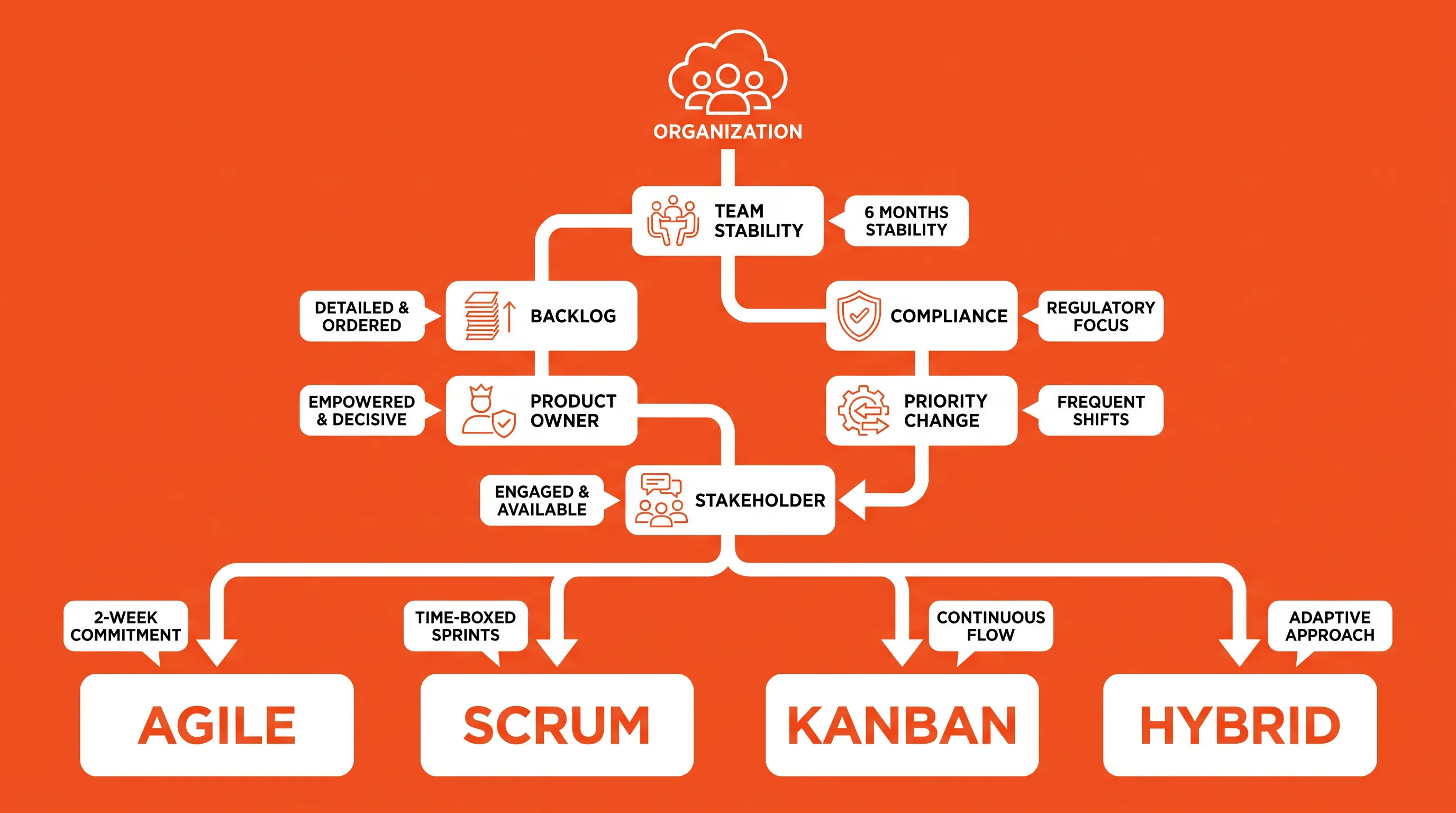
Bold infographic on bright orange background, featuring a decision-flow pathway with white icons and labels leading to Agile, Scrum, Kanban, and Hybrid.

Run this in order and stop at the first branch that describes you honestly. The Agile vs Scrum choice resolves faster when you answer about the organisation you have rather than the one in the transformation plan.

  • Is demand predictable enough that a two-week commitment survives most weeks? If no, start with Kanban and revisit in a quarter.

  • Do you have a named, empowered product owner and two sprints of ready backlog? If no, Scrum's overhead buys you nothing yet.

  • Is the team stable and cross-functional for the next six months? If no, flow-based delivery will give you more reliable forecasts.

  • Are stakeholders available fortnightly with decision authority? If no, Scrum's review loop breaks and Kanban's service level expectations serve you better.

  • Do compliance or multi-supplier dependencies force separate tracks? If yes, design a deliberate hybrid with written rules for each track.

  • Does the priority order change more than once a fortnight? If yes, Kanban. If it's stable across a sprint, the Scrum framework fits.

Answer yes down the list, and Scrum is the right call. A single no on decision authority or team stability points to Kanban. Two or more no answers alongside a fixed contractual date point to a hybrid you design deliberately.

Agree during discovery

Settle the Agile vs Scrum model before delivery starts. A discovery workshop is where that happens, and the attendee list is the part organisations get wrong. The business sponsor and product decision-maker, along with the technical lead and the supplier's delivery lead. Missing any of those means the rules you agree won't survive contact with the people who weren't there.

Independent discovery works because the people running it have no stake in the answer being "build it now". Product discovery tests assumptions in Agile software development before budget commits. The delivery model conversation belongs in the same session, because your answers about ownership and cadence are the inputs to it.

Leave the workshop with these agreed and written down:

  • Named owners for priority, technical decisions and sign-off

  • Cadence, backlog readiness standard and definition of done

  • Governance forum, evidence set and the metrics you'll report

  • Change rules and the first three review dates in diaries

Everything in that list is a business decision. Which is why it can't be delegated to the development team and discovered later.

Where this leaves you

The right delivery model for Agile vs Scrum is the one your organisation can actually staff and govern. Get that judgement right and iterative delivery gives you working software to inspect every fortnight. Get it wrong, and you buy the ceremonies without the control.

Evolved Ideas has spent more than 19 years running bespoke builds and extended teams for SMEs and enterprises, and the delivery model is agreed in discovery before any code is written. If you're weighing Agile vs Scrum for a complex build, or deciding how your team and supplier should work together, it's worth speaking to our team.


Ready to bring your ideas to life?

Book a free 30-minute discovery call with our team — we'll understand your objectives and advise how bespoke software, MVP development, or an extended team can help your business.

Yes, if the team first builds the conditions Scrum requires. Use Kanban to expose demand patterns and establish clear priority ownership. Move to fixed sprints after priorities remain stable, the team has enough capacity, and stakeholders can inspect completed work on a regular schedule.

Give the product owner authority to rank work and accept completed items. Set a 48-hour expectation for routine decisions, and document which decisions still require formal approval. If leadership won't accept those boundaries, flow-based delivery is a better fit while governance changes.

Review the working product against the agreed business outcome, plus the delivery measure that fits the model. For Scrum, inspect forecast accuracy and blocked decisions. For Kanban, inspect cycle-time trends and work that exceeds its service expectation. Assign each exception to an owner with a stated resolution date.

Use separate boards when work follows different rules, such as planned feature delivery and incident response. Each board needs its own entry standard and capacity limit. Keep one prioritisation owner across both boards, so urgent requests don't quietly displace agreed product work.

For an agile vs scrum assessment, Evolved Ideas can use a discovery workshop to document decision rights, team availability, and contract constraints before a client selects a model. The output should be a written operating model that defines ownership, cadence, evidence, and change rules.

Schedule a Discovery Call

Book a free 30-minute call that works for you

You Might Also Like

Discover more insights and articles

Over-the-shoulder view of hands typing on a laptop in a modern tech studio, with multiple screens displaying code and a coffee cup nearby.

Flutter vs React Native for B2B Mobile Apps: A Buyer’s Decision Guide

Picking a mobile framework by gut feel is how commercial trade-offs get made by accident. This guide translates the technical differences between the two leading options into terms that matter before you brief suppliers: cost, timeline risk, and talent availability. It includes a weighted scoring method you can run against your own requirements to reach a defensible decision rather than a default one.

A UK buyer evaluates app development teams in a modern workspace, featuring natural light, a premium desk, and minimalist decor.

App Developers Near Me: How UK Buyers Should Evaluate Local Fit

Picking a software partner because they're a short drive away feels safe, but proximity solves fewer problems than you might think. This guide separates what proximity genuinely improves from what it doesn't guarantee, and matches collaboration models (co-located, nearshore, extended team) to what your project actually needs.

A modern office space with an IT consultant discussing disaster recovery plans, featuring a laptop and collaborative professionals in the background.

RTO vs RPO: Setting Recovery Targets for Business-Critical Software

Every resilience conversation eventually needs to answer two questions: how long can this system be down, and how much data can you afford to lose? Here's how to turn those questions into numbers the board will actually sign off on.

A modern tech startup workspace with exposed brick, featuring diverse professionals collaborating around sleek devices and a central digital tablet.

AI Governance Framework for SMEs: Controls That Scale With Adoption

Most AI governance frameworks are built for enterprises with dedicated compliance teams. But what about lean teams that prioritise a fast pace? Here's an alternative: risk tiers to triage exposure, and a phased rollout sized for smaller organisations.