Test critical assumptions
List what has to be true for this to work, then rank by how much damage a wrong answer would do. Cagan's warning about prototype testing is worth holding onto here: novice teams put a high-fidelity prototype in front of 15 people who say they love it, then think they've validated the product. People say all kinds of things and then go do something different.
So test in ways that cost people something. A pricing page that measures click-through or a signed letter of intent from a prospective customer. Cagan assumes that at least half of the ideas won't work, and the best teams assume three-quarters won't. Design your tests to find that out in days.
Feasibility gets tested differently. Give an engineer the riskiest technical assumption and a short timebox to prove or break it. If the integration you're depending on turns out to be rate-limited or read-only, you want that finding while the design is still a sketch.
Set commercial guardrails
A business case requires more than a validated user need. Some genuine problems cost more to solve than they return, and this is the section where founders and operations leads skip ahead.
Work through the money. Then set it against build cost and the annual maintenance that rarely appears in the original quote. If the case is efficiency rather than revenue, put a number on the hours saved and the error rate reduced, then convert it.
The useful discipline is to invert the question. Instead of forecasting a return, state what would have to be true for the investment to make sense: the adoption rate you'd need and the volume threshold below which it doesn't pay back. Now you have testable conditions rather than a spreadsheet built on optimism.
Regulatory dependencies belong in this calculation too. If the product handles health data, payments, or children's data, compliance work is a cost line and a timeline factor. The Information Commissioner's Office can issue fines of up to £8.7 million or 2% of global annual turnover for failing to carry out a required DPIA. That's not a detail to leave for the technical lead to discover.
Apply feature prioritisation
By now you have more candidate capabilities than budget. Feature prioritisation is how you decide which ones survive, and it works best when the criteria are agreed before anyone argues about a specific feature.
Rank each capability for feature prioritisation by the user value the evidence supports and what it costs to build. The strength of that evidence and the risk it carries belong in the same ranking. A capability with strong evidence and low effort ships first. A capability everyone loves with no supporting evidence goes into a holding list where it can be tested.
The MoSCoW method, created by Dai Clegg in 1994 at Oracle and later formalised within DSDM, is still the most practical way to communicate this to a mixed group. Must, Should, Could, Won't. The value is in the last category. Explicitly naming what you won't build in this release stops it reappearing as an assumption during development.
Your minimum viable product boundary sits at the smallest set of capabilities that tests the core proposition end to end. Everything a user needs to complete the central task once, and nothing that merely makes the experience nicer. Feature prioritisation done properly gives you a defensible line you can point at when someone asks why their request isn't in scope. It's defensible because it's evidence-based, not because you fought harder for it.
Good feature prioritisation also protects the build team. When a change request arrives mid-sprint, the question becomes which prioritised item it displaces, rather than whether there's room to squeeze it in.
Define success metrics
Pick metrics that tie back to the problem you framed at the start. If the problem was two days of re-keying per account manager per month, the metric is hours spent on that task.
Google's HEART framework, developed by Kerry Rodden, splits experience measurement across five dimensions including happiness and task success. Rodden's own caveat is the important part: "Metrics are not useful unless they are aligned closely with the team's high-level goals." Pick two or three that map to your problem and ignore the rest.
Two things must happen before development starts. Record the baseline, because a metric without a starting number can't demonstrate improvement. And set the decision thresholds now: what result means continue and what result means stop. Agreeing those in advance removes the temptation to reinterpret a disappointing number as encouraging.
Decide what happens next
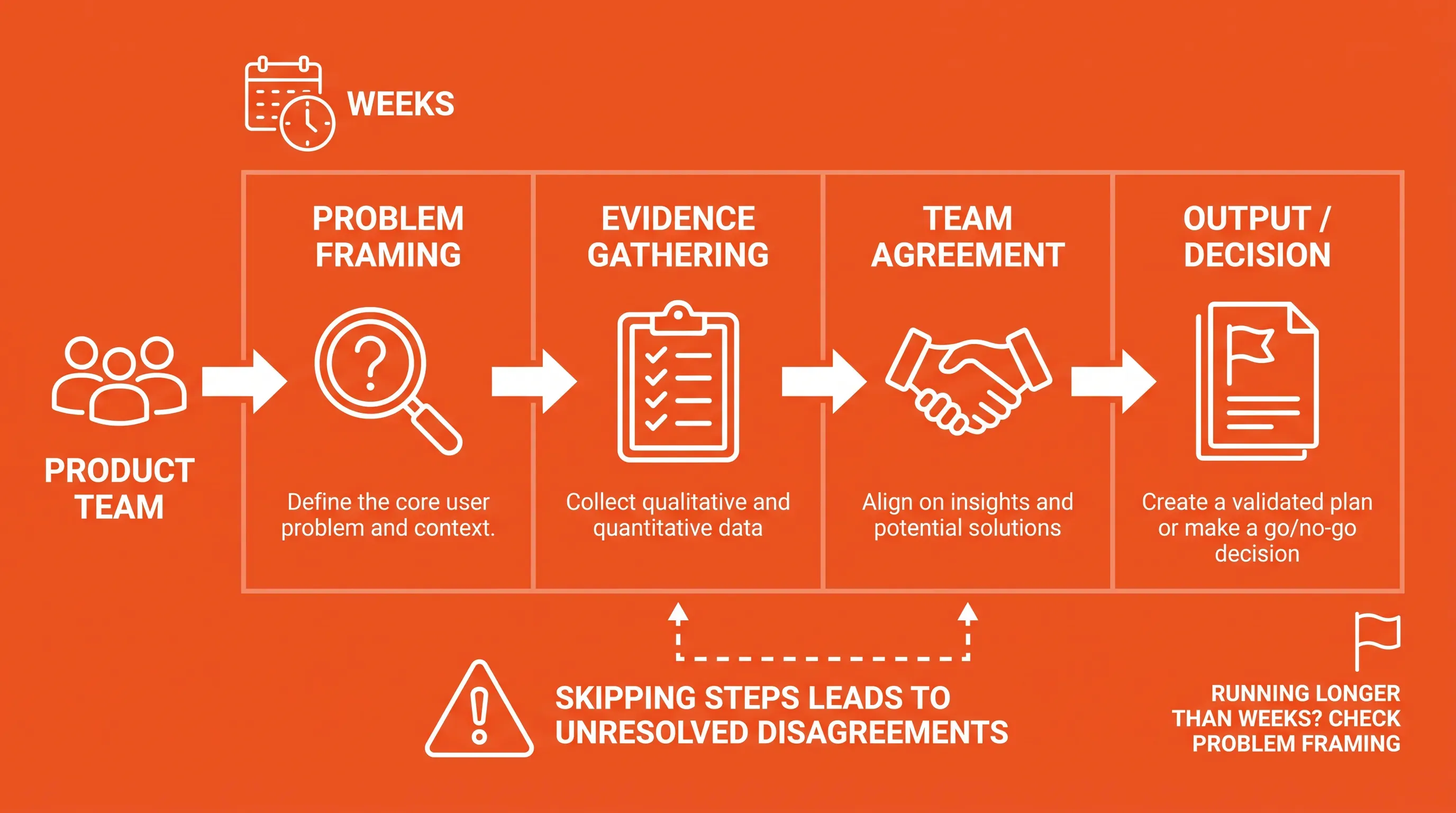
Product discovery ends in a decision. There are four honest outcomes, and stopping is one of them.
-
Go. The problem is confirmed, and the priority scope is clear enough to estimate.
-
Revise. The problem is real, but the proposed solution isn't the right response to it.
-
Test further. One critical assumption remains unresolved, and a further experiment costs less than building around the uncertainty.
-
Stop. The evidence didn't support the case, and you've saved the build budget.
Whichever you choose, the handover pack is the same. Development teams need the validated problem statement and the prioritised scope with the explicit out-of-scope list. They also need the risks still open and the evidence behind each priority call. Give an estimator that and you get a defensible number. Give them a feature list, and you get a guess with a risk premium built in.
Get discovery support
Independent product discovery works because the people running it have no stake in the answer being "yes, build it." Evolved Ideas has spent more than 19 years advising startups and enterprises on exactly this question, and the consultancy process starts with a workshop to collect facts and validate assumptions before any build vs buy recommendation is made.
If you're weighing a custom build or an MVP and want the assumptions tested before you commit budget, it's worth speaking to our team about product discovery first.