How scoping sharpens estimates
Product scoping is the mechanism that turns a vague brief for bespoke software development services into an estimate you can actually plan around. A brief says "we need a portal for our suppliers." A scope says what the portal does and what it must never do for compliance reasons. Only the second version can be estimated with any honesty.
Here's the practical chain. Documented functional requirements let a provider size the work feature by feature. Non-functional requirements, the things like performance and uptime, let them plan the harder engineering that thin briefs ignore until it's too late. Together they let a provider set realistic milestones and build in sensible contingency. A thin scope does the opposite. It almost guarantees change requests, because every unspoken assumption surfaces mid-build as a surprise you're asked to pay for.
The stakes show up in the wider data. McKinsey and the University of Oxford studied more than 5,400 IT projects and found that large ones run 45% over budget on average while delivering 56% less value than predicted. Roughly a third to a half of projects overrun, and unclear scope sits underneath a large share of that. When you pay for proper product scoping, you're buying certainty, and certainty is the thing a six-figure decision most needs.
Why a software engineering partner matters
The choice that most affects whether your build becomes a durable asset or an expensive dead end is the one people think about least. The key choice for bespoke software development services is whether you engage a one-off supplier or a lasting software engineering partner. That single decision shapes the next five years more than any architecture diagram.
Consider where the money actually goes. Maintenance and evolution account for the majority of a system's lifetime cost. IEEE software engineering research puts maintenance at 50% to 80% of total lifetime cost of ownership. So the build you're negotiating over is, in cost terms, the smaller half of the story. The larger half is everything that happens after launch, and that's precisely the part a one-off supplier has no incentive to get right.
A software engineering partner who stays reduces code debt and keeps the architecture healthy as the business changes. This is the antidote to the fear that brought you to this decision in the first place: a build that gets delivered, then rots because nobody left understands it or is willing to maintain it. The difference between the two paths comes down to what happens after handover:
-
Whether the provider documents as they build or treats documentation as an afterthought
-
Whether they offer a structured support and maintenance arrangement or vanish at handover
-
Whether they keep enough continuity of people to remember why decisions were made
A one-off supplier optimises for shipping and moving on. A software engineering partner optimises for the system still serving you in year five. You're choosing who you'll call when it needs to change, and it will need to change.
Choosing the right provider
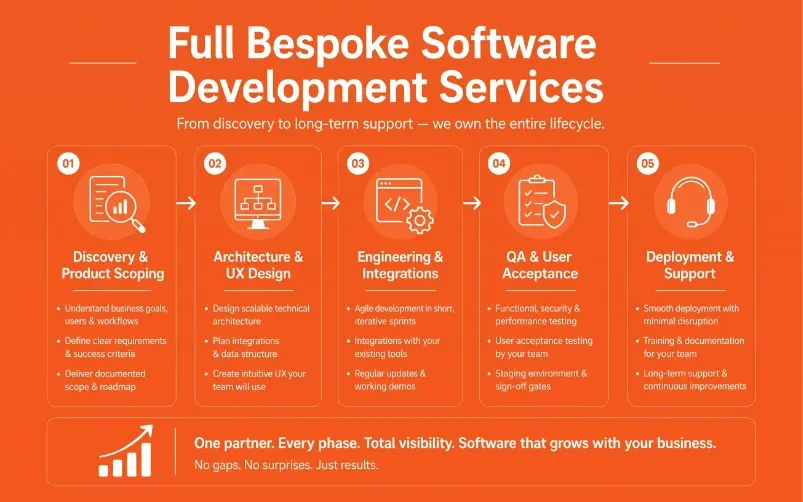
You can walk into vendor conversations prepared by treating the lifecycle above as your checklist. The questions below separate a lifecycle partner from a firm that ships code and disappears, and you don't need to be technical to ask them or judge the answers.
-
Ask for discovery before a quote. A provider confident enough to scope first, price second, is telling you they estimate honestly. One that quotes a complex build instantly is telling you the opposite.
-
Test whether they can explain architecture trade-offs in plain terms. If you can't follow why they chose one approach over another, that's a communication problem that will compound over years.
-
Check how they handle documentation and handover. Ask what you'll own at the end and what happens if their team changes. A vague answer is a black box in the making.
-
Confirm they offer ongoing support. A firm that treats maintenance as an afterthought has told you where their interest ends.
The UK market spans a wide quality range. Custom projects for mid-market firms commonly run between £25,000 and £250,000, and the market itself is projected to reach USD 5.8 billion by 2030 at a 20.2% annual growth rate, according to Grand View Research. That growth has drawn in providers of every standard. The right choice depends on your budget and how complex your problem genuinely is. A firm that's excellent for a lightly regulated internal tool is the wrong fit for a compliance-heavy financial platform, and honest product scoping is what surfaces that mismatch before you commit.
One more signal worth weighing. A partner who talks about augmenting your in-house team thinks in years. That framing travels with the documentation habits and continuity a long relationship needs.
Making the decision with confidence
A complete lifecycle of bespoke software development services, anchored by real product scoping and a lasting software engineering partner, is what separates a build that pays back over five years from one that becomes a liability by year two. The phases matter, but the throughline matters more: a clear scope and visible delivery with someone close enough to maintain the system. Asking a provider for that full picture upfront is exactly what a serious firm expects and is ready to answer.
Evolved Ideas works as a long-term delivery and engineering partner to UK and European businesses and owns the whole lifecycle from discovery through to ongoing support. If you're weighing a build, it's worth starting with a scoping or discovery conversation before you commit to anything larger. Speak to our team about bespoke software development services and where a proper scope would leave you.