Software development services in UK: what scaling businesses actually need

Content authorBy Lincoln WoolseyPublished onReading time9 min read
A warm, naturally lit workspace with a wooden table where a UK business team discusses labeled folders and notebooks on software models.

Looking to scale your UK business? Learn which software development services can help you with that and different engagement models on the market. See practical factors that will help you weigh your own situation and describe what you want in plain terms.

Why the service you ask for matters

You have outgrown the off-the-shelf tools that got you this far, and looking for software development services feels like the obvious next move. The backlog is growing. Two systems that used to be fine can't communicate anymore. Onboarding takes too long, and a couple of leads slipped through last month because a manual handoff broke. You know you need outside help, but you don't know what kind yet.

Most people walk into supplier conversations about software development services as if it were one thing, when it covers at least four different commercial arrangements with different price tags and different allocations of risk and control. Vague questions lead to whatever the supplier happens to sell. Your business overpays or ends up with an engagement that never fits. Name the right service before the first call and the whole conversation changes. You stop being pitched and start being scoped.

Software development services explained

The terms you have heard tossed around are distinct engagement models. Each one places delivery risk in a different place, which also determines day-to-day control and long-term ownership. Here's a map of the main software development services options so the comparison later makes sense.

Managed software projects

Managed software projects are the model where the supplier owns delivery from start to finish against an agreed scope. You act as the client. You set the outcome, agree the budget and milestones, and the partner carries the responsibility for hitting them. The delivery risk sits with them, which is the whole point.

This fits when you have a clear result in mind but limited engineering leadership inside the business to run a build yourself. You trade hands-on control for predictable delivery and far less management overhead. That trade matters when the numbers on self-run builds are this stark. According to the Standish Group CHAOS data, 66% of technology projects across 50,000 studied end in partial or total failure, and large projects succeed less than 10% of the time. Handing delivery to a partner who does this for a living is one way to move those odds. For a growing business, managed software projects also mean you are not pulling your best people off revenue work to babysit a build.

If you have problems defining the outcome, managed software projects is your choice.

Bespoke and application development

Bespoke builds are custom software shaped around how your business actually works and are a core part of software development services. Scaling businesses reach for this at a predictable point. The subscriptions stop talking to each other, or a core process gets too specific for any generic tool to handle without ugly workarounds.

Web and mobile app development are delivery surfaces inside this category. A bespoke build can serve as a web application for your team or a customer-facing mobile app; it can also do both, based on where the work happens. The label on the front end doesn't change the nature of the engagement underneath.

As a trade-off, you pay more upfront than a monthly licence, and in return you get software that fits your business precisely and bends as you grow. That fit compounds over time, because you are not paying in lost hours every day for a tool that almost does the job.

Ready to bring your ideas to life?

Book a free 30-minute discovery call with our team — we'll understand your objectives and advise how bespoke software, MVP development, or an extended team can help your business.

Team extension and application lifecycle support

Team extension means adding external developers into a team you already have and still manage. You keep control and direction. The outside people give you extra capacity or a specific skill you can't hire fast enough. Application lifecycle support is the ongoing care of software already in use. It covers maintenance and fixes as the product evolves after launch.

Both suit a business that already has some internal capability and needs capacity or continuity. And the timing is not hypothetical. The Open University's Business Barometer 2024 found 62% of UK organisations reporting difficulty finding the skills they need, with software engineers among the most cited shortages. When you can't hire the niche skill in a reasonable window, team extension gets you moving without a permanent headcount commitment.

The distinction to hold onto is ownership. With team extension and application lifecycle support, the business keeps control, and the software stays yours. The partner adds hands and expertise while the business keeps the wheel. Application lifecycle support stops a shiny new build from slowly rotting once the launch buzz fades, and good application lifecycle support is the difference between software that ages well and software you rebuild in three years.

Technical discovery and project rescue

Technical discovery is a short, structured phase within software development services that clarifies scope and risk before you commit real money to a build. It establishes the right technical approach. It is cheap insurance against expensive mistakes. Project rescue is what happens when an existing build is already over budget or behind schedule. It also applies when the build is simply not delivering, and someone needs to come in and steady it.

These two go together because a rescue starts with a discovery to work out what is actually broken. And the need is common. Around 70% of software projects exceed their initial budget, with scope creep and changing requirements among the usual causes. The Project Management Institute found 52% of projects experience scope creep. If you recognise your own build in those numbers, you are in ordinary company.

These fit two kinds of clients. One is unsure what they need and wants clarity before spending. The other has a build that needs a steady hand.

Ready to bring your ideas to life?

Book a free 30-minute discovery call with our team — we'll understand your objectives and advise how bespoke software, MVP development, or an extended team can help your business.

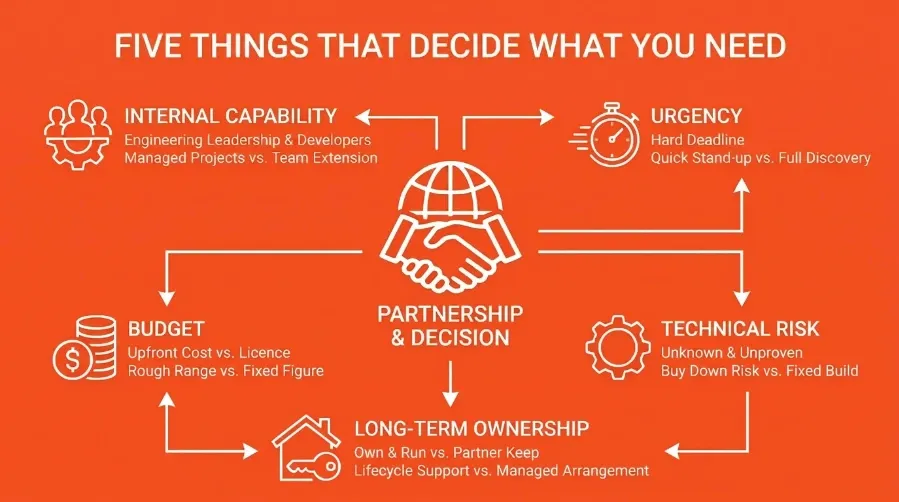
Five things that decide what you need

Edited image

The right services depend on your own context. Five factors decide it, and they interact, so it helps to think through them together before you approach anyone.

  • Internal capability. Do you have engineering leadership and developers already, or none at all? No internal engineering leadership points toward managed software projects, because someone has to own delivery and it can't be you. A small stretched team points toward team extension instead.

  • Urgency. A hard deadline changes what is realistic. When you need capacity fast and already have a team, extension is quicker to stand up than a full managed build. When the timeline is comfortable, you have room to run a proper discovery first.

  • Budget. Bespoke builds carry higher upfront cost than a licence, and managed software projects price in the partner carrying delivery risk. Knowing your rough range, even as a band rather than a figure, stops you being scoped for something you can't fund.

  • Technical risk. How much is unknown or unproven in what you want built? High uncertainty is the clearest signal to start with technical discovery before committing to a fixed build. Given that only 31% of software projects succeed within their planned time frame and budget, with the agreed scope, buying down risk early is rarely wasted money.

  • Long-term ownership. Do you want to own and run this software yourselves in a year, or would you rather a partner kept it healthy? If you plan to own it, application lifecycle support and team extension keep the knowledge close. If you'd rather not, a managed arrangement makes more sense.

The combination of factors points somewhere.

Matching your situation to a service

You have a good small internal team, and they're buried. A deadline is bearing down, and you need more hands who know the stack. That is team extension. You keep control and ownership, and you get capacity fast. The skills shortage makes this route common, because hiring permanently for a six-month crunch rarely adds up when software engineers sit near the top of the UK's hardest-to-fill roles.

You have a clear outcome you can describe in business terms, but nobody internal who can lead a build. Managed software projects suit leaders who run the company and cannot take on part-time project management. That is a managed project. You agree the scope and milestones, while the partner carries delivery and you remain the client. It is the model that exists precisely for the leader who knows what they want but can't personally steer the how.

You already have a build underway, and it's slipping. Costs are climbing, and dates keep moving. You are no longer sure the thing will work. Start with a short technical discovery to find out what's actually broken, which then flows into project rescue. As Colette Wyatt, CEO of Evolved Ideas, put it after the firm was named among the UK's top software companies, the aim is to "work hand in hand with our partners to make sure we understand their challenges and their goals so that, together, we build solutions not just software." A rescue that skips the diagnosis adds another layer to the mess.

Application lifecycle support is the right service when a live product needs steady care. It keeps what you already run healthy as it evolves.

What to bring to your first supplier call

An honest picture of your situation is enough for a good first conversation. Bring a rough read on the five factors. Explain what capability you have inside and how urgent this is. State the budget band you can work within. Also explain how much of the build is unknown and whether you want to own the result yourselves long term.

That's enough for a good partner to scope properly instead of guessing. It also tells you quickly whether you're talking to someone who listens or someone reciting a menu. If you're weighing software development services and want a partner who helps you name the right engagement before pricing it, it's worth talking to the team at Evolved Ideas.

Ready to bring your ideas to life?

Book a free 30-minute discovery call with our team — we'll understand your objectives and advise how bespoke software, MVP development, or an extended team can help your business.

Prepare a short description of the user problem and current process. Include system constraints and identify who can approve trade-offs. Share examples of the work that fails today, since they give a supplier a basis for defining acceptance criteria rather than estimating from a broad idea.

Compare proposals against the same written brief. For software development services uk, check the stated assumptions and acceptance criteria, then compare the total cost through launch. Read how each proposal handles scope changes, because a lower headline figure can exclude testing, handover, or post-launch fixes.

Yes, but the contract should set out a change-control process before work begins. Each requested change needs a written assessment of its impact on the agreed plan. Approve that assessment before work proceeds, so the original budget and the revised commitment remain clear to both sides.

You should normally own the source code and documentation for software that runs a core business process. Put repository access and handover obligations in the contract before development starts. This gives your business the option to change support partners or bring maintenance in-house later.

Ask the supplier to restate the operational problem and explain how success will be measured. Evolved Ideas, or any prospective partner, should identify assumptions that need validation before committing to a scope. A proposal that only lists features leaves business rules and delivery boundaries unclear.

Schedule a Discovery Call

Book a free 30-minute call that works for you

You Might Also Like

Discover more insights and articles

A collaborative workspace with a wooden table covered in documents and sticky notes, featuring diverse team members engaged in discussion.

Product discovery: how to de-risk a software project before development

Before spending on development, the assumptions behind a software idea need testing. Learn how to frame the problem correctly and turn research findings into a scope developers can actually estimate against.

A warm, daylight-filled workspace features a wooden desk with a glass roadmap, sticky notes, and a diverse team collaborating.

Technical roadmap: turning software priorities into a practical delivery plan

A phased plan turns discovery findings into a scope, sequence, and funding path you can actually approve. See what belongs in each phase and how to invest in stages without pretending the plan is a fixed schedule.

A realistic workspace scene with a wooden conference table, professionals discussing a 'Software Audit Report' in warm daylight.

Software audit: when to review a codebase before rebuild, support, or scale

A software audit is worth the hassle when it answers a specific question: is this application safe to keep building on, or is it accumulating risk you can't see? Learn what an audit actually examines, the conditions that make one worth the spend, and how to translate technical findings into a decision the business can act on.

A modern tech startup office featuring a premium desk with a sleek monitor, three professionals engaged in various tasks, and natural light.

Application support for business-critical software: what should be covered

Learn what a complete application support service should cover once custom software goes live and becomes part of daily operations. Essential service areas, from monitoring and incident response to maintenance and reporting, show how agreed ownership turns ad hoc technical help into an accountable service.