Technical roadmap: turning software priorities into a practical delivery plan

Content authorBy Lincoln WoolseyPublished onReading time9 min read
A warm, daylight-filled workspace features a wooden desk with a glass roadmap, sticky notes, and a diverse team collaborating.

A phased plan turns discovery findings into a scope, sequence, and funding path you can actually approve. See what belongs in each phase and how to invest in stages without pretending the plan is a fixed schedule.

Why priorities need sequencing

A finance director at a growing logistics firm opens the prioritised feature list and asks the only question that matters: what does phase one cost and when does it go live? Nobody can answer, because a list of features is a wish register with an order applied to it.

The gap is expensive. McKinsey and the University of Oxford studied more than 5,400 IT projects and found the large ones ran 45 percent over budget while delivering 56 percent less value than predicted. Their breakdown attributes a large share of that overrun to unclear objectives and reactive planning, both of which are sequencing failures.

A feature list hides what has to exist before a feature can work, and the real difficulty of each item stays hidden along with the operational load your team will carry once it ships. Sequencing surfaces all three without claiming false certainty about dates.

Technical roadmap structure

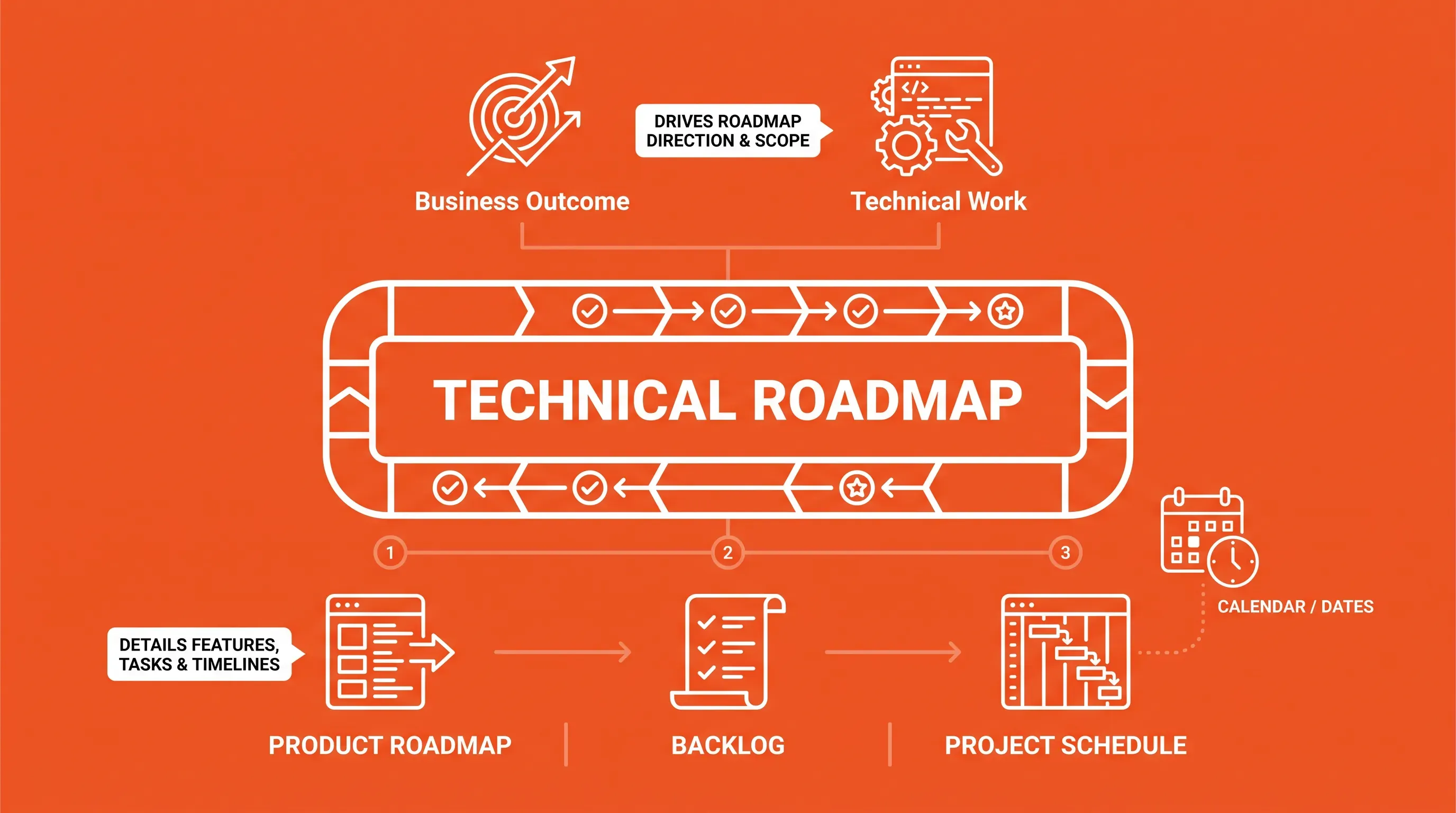
Bold infographic on a bright orange background featuring a white line art technical roadmap with milestone icons and labels.

A technical roadmap is a phased view that connects business outcomes to the technical work required, with milestones and decision points where you can stop, change direction, or commit more money. It answers what gets built when and what has to be true first.

That makes it a different document from the three things it gets confused with. A product roadmap describes capability themes for the market. A backlog holds granular tickets with no funding logic attached. A fixed project schedule asserts dates it can't defend, and dates are exactly what a good technical roadmap holds loosely while holding sequence firmly.

Steve McConnell, author of Software Estimation: Demystifying the Black Art, put the purpose plainly: "The primary purpose of software estimation is not to predict a project's outcome; it is to determine whether a project's targets are realistic enough to allow the project to be controlled to meet them." A technology roadmap does the same job at a larger scale.

Outcomes and scope

Every phase names the user or business outcome it delivers: "customers can check order status without calling the service desk." Written that way, scope boundaries and acceptance criteria follow naturally, because you can test whether the outcome happened.

This discipline also protects you from building things nobody uses. Outcome-anchored phases push more of your build into actually useful features.

Technology roadmap layers

Under the visible product sits work that stakeholders never see in a demo. Architecture decisions sit there with hosting and environments, along with the data model and any migration. Integrations with systems you don't control sit next to the security controls that make the whole thing lawful to run. A technology roadmap makes these layers visible next to the features they enable, so nobody mistakes the enabling work for optional extras.

Security belongs in the layer view. Under Article 25 of the UK GDPR, you must implement data protection by design from the design stage. The same duty applies by default throughout the lifecycle. That's a design constraint on phase one, not a task for phase four.

Ready to bring your ideas to life?

Book a free 30-minute discovery call with our team — we'll understand your objectives and advise how bespoke software, MVP development, or an extended team can help your business.

Delivery planning inputs

The sequence in a technical roadmap is a claim, and claims need evidence. Delivery planning inputs are what let you test whether the proposed order can survive contact with your actual team and calendar.

  • Dependencies between workstreams, plus anything that waits on a third party or an internal approval

  • Indicative effort per phase, expressed as a range

  • Team capacity in real available days, net of support duties, holidays, and existing commitments

  • Specialist skills the work needs and whether you have them, which matters when 75 percent of UK IT firms with hiring plans reported struggling to find qualified candidates in Q1 2025

  • Risks and the assumptions each estimate rests on

Without those inputs, delivery planning becomes arithmetic on invented numbers. With them, you can see which phase is fragile before you fund it.

Turn discovery into delivery

Discovery gives you findings, user needs, and constraints. Turning that into delivery planning means grouping the findings into workstreams, each with an owner and an outcome, then ordering the workstreams by what enables what. The user journey that generates revenue pulls a data model and an integration behind it, and those move ahead of it in the sequence.

Unresolved assumptions deserve different treatment. Instead of quietly absorbing them into an estimate, list them and convert each into a validation task with a defined output. "The warehouse system exposes stock levels via API" becomes a two-day spike that either confirms it or tells you to plan for a nightly export.

Mary Poppendieck, co-author of Lean Software Development, argues that "the biggest cause of failure in software-intensive systems is not technical failure. It's building the wrong thing." Validation tasks are how a technical roadmap keeps checking that it's still building the right thing while the build is happening.

Expose the hidden work

The estimate that gets approved is the estimate that only counted features. Everything else on this list is real work with real cost, and it appears in the invoice whether or not it appeared in the plan.

  • Architecture decisions and the proof-of-concept work that justifies them

  • Data migration and cleansing, where Gartner has estimated that 83 percent of data migration projects fail or exceed their budgets and schedules

  • Third-party integrations, which are not a stable dependencies

  • Environments, deployment pipelines, and release process

  • Quality assurance, where the IBM Systems Sciences Institute cost curve shows a defect found after release costing up to 100 times what the same defect costs when caught during design

  • Documentation, training, and the support arrangement that keeps the thing running after launch

That last item carries the longest tail. IEEE software engineering research puts maintenance at 60 to 80 percent of total lifecycle cost. A technical roadmap that ignores support is a roadmap that understates the real number by a multiple.

There's a compounding version of the same problem. In a McKinsey survey of 50 CIOs at billion-dollar-plus companies, respondents reported that 10 to 20 percent of the technology budget meant for new products gets diverted into resolving tech debt. Skipped enabling work becomes next year's diverted budget.

Ready to bring your ideas to life?

Book a free 30-minute discovery call with our team — we'll understand your objectives and advise how bespoke software, MVP development, or an extended team can help your business.

Sequence risk early

Put the uncertain things first. An integration you haven't tested, and an architectural choice you can't reverse cheaply both belong here. A compliance constraint nobody has confirmed with counsel, and a performance target you've never measured against real volumes belong here too. Each of these can invalidate the features that depend on it, so testing them early is what keeps the rest of the plan worth reading.

Risk reduction is a narrow, time-boxed piece of work that answers one question and stops. Premature engineering builds capacity and abstraction for a future you haven't confirmed yet, and it lands you in the same debt trap by a different route. Stripe's Developer Coefficient survey of more than 1,000 developers found they spend around 13.5 hours a week on technical debt, roughly a third of engineering capacity.

The order in a technical roadmap matters. Test the thing that changes the plan, then plan around what you learned.

Define phase one

Phase one is the smallest release you can operate in production and defend to a customer. Four criteria decide what makes it in.

  1. The essential user journeys, end-to-end, with the unglamorous parts like login and error handling

  2. The outcome with the clearest business value, so the phase pays for something measurable

  3. Critical enablers that the journey physically cannot run without

  4. The operational minimum: monitoring, backups, and a support route when something breaks at 4 pm on a Friday

Everything else moves back. Speculative features waiting on user evidence belong later, and so does scale engineering for volumes you don't have. Automation of processes that run fine manually at current throughput waits as well. Keeping phase one small is also the single strongest predictor in the data: Standish Group's CHAOS research reports small projects succeeding at roughly 90 percent against under 10 percent for large ones, and its 2020 figures put overall software project success at 31 percent with 50 percent challenged.

Colette Wyatt, CEO of Evolved Ideas, describes where delivery actually breaks down: "Distance is rarely the thing that causes delivery problems. Unclear ownership and inconsistent communication do far more damage." A tightly defined phase one makes ownership obvious, because there are fewer things to own.

Phase investment realistically

Translate each phase into what it needs: team shape and size, and the support commitment the release creates once it's live. Then put a funding gate at each phase boundary, with the criteria for passing it written down in advance. You're buying an option on the next phase.

Ranges are honest and single numbers are not. Because McKinsey's data shows every additional year on a project increasing cost overruns by 15 percent, shorter funded phases with real review points reduce your exposure directly. Each gate is also where the estimate improves, since you now have delivered work to calibrate against instead of assumptions.

Governance research on stage gates makes the same argument from the investment side: breaking commitment into stages separated by go or kill decision points means poor projects get killed early. Gates govern funding and direction. They don't micromanage scope inside a phase.

Set the delivery measures you'll review at each gate too. DORA's 2024 State of DevOps research clusters teams by change failure rate and recovery time, with elite performers around a 5 percent change failure rate and recovery inside an hour. Those numbers tell you whether phase two adds features or fixes the pipeline first.

Keep the roadmap useful

A technical roadmap earns its keep by changing. Revisit scope when validation tasks return unexpected answers. Revisit dependencies when a third party shifts, and revisit sequencing whenever a delivered phase teaches you that the next one was ordered wrong. Review the technical roadmap at every funding gate and after any incident that reveals something the plan assumed away.

Evolved Ideas has spent 19 years turning discovery findings into a costed route through build, launch, and later releases as a delivery partner alongside in-house teams. If you have discovery output and need a defensible sequence and budget before you commit, it's worth talking to our team about a technical roadmap.

Ready to bring your ideas to life?

Book a free 30-minute discovery call with our team — we'll understand your objectives and advise how bespoke software, MVP development, or an extended team can help your business.

Update it at each funding gate and whenever a validation task, incident, or supplier change affects an assumption. Keep a dated decision log that records the evidence, owner, and effect on scope or cost. That record prevents old estimates from being treated as current commitments.

No. Set a target window and state the assumptions behind it, rather than presenting an untested date as a commitment. Narrow the window after integration checks, architecture decisions, and capacity confirmation. If a deadline is fixed externally, reduce scope until the team can defend the release.

Bring discovery findings, the prioritised feature list, named business outcomes, and details of current team availability. Include known supplier contracts, approval steps, and data or security constraints. A technical roadmap is more credible when its sequence reflects actual dependencies instead of an idealised staffing plan.

Treat a failed integration check as a planning change, not a delivery exception. Re-estimate the dependent work, then assess an alternative interface or a scheduled file exchange. Adjust the phase scope if neither option supports the intended outcome, and record who owns the next decision.

Approval should sit with the person accountable for the budget and business outcome, informed by delivery and operational owners. Evolved Ideas can help the client assess evidence against the gate criteria, but the client retains the investment decision. Write the approval authority down before work begins.

Schedule a Discovery Call

Book a free 30-minute call that works for you

You Might Also Like

Discover more insights and articles

A collaborative workspace with a wooden table covered in documents and sticky notes, featuring diverse team members engaged in discussion.

Product discovery: how to de-risk a software project before development

Before spending on development, the assumptions behind a software idea need testing. Learn how to frame the problem correctly and turn research findings into a scope developers can actually estimate against.

A realistic workspace scene with a wooden conference table, professionals discussing a 'Software Audit Report' in warm daylight.

Software audit: when to review a codebase before rebuild, support, or scale

A software audit is worth the hassle when it answers a specific question: is this application safe to keep building on, or is it accumulating risk you can't see? Learn what an audit actually examines, the conditions that make one worth the spend, and how to translate technical findings into a decision the business can act on.

A modern tech startup office featuring a premium desk with a sleek monitor, three professionals engaged in various tasks, and natural light.

Application support for business-critical software: what should be covered

Learn what a complete application support service should cover once custom software goes live and becomes part of daily operations. Essential service areas, from monitoring and incident response to maintenance and reporting, show how agreed ownership turns ad hoc technical help into an accountable service.

A UK project leader reviews a tablet at a modern tech startup office, surrounded by abstract panels representing decision criteria.

Software development company in UK: how to choose a partner for complex projects

Learn how to predict whether a complex, business-critical build succeeds, from discovery and architecture through governance. Discover why a growing number of UK buyers pair UK accountability with a European delivery team, and how to run your own shortlist against a concrete set of questions.